Medical Grade Reverse Osmosis System
Medical reverse osmosis (RO) systems are used in hospitals and healthcare facilities to produce purified water for applications such as medical instrument cleaning, central sterile services departments (CSSD), endoscope reprocessing, dental equipment, and hemodialysis water treatment.
Different medical applications have different water quality requirements. System configurations may include pretreatment, reverse osmosis filtration, additional purification stages, disinfection, and treated water storage or distribution, depending on the intended use and applicable standards.
At Clear Environment, we source and supply medical RO water treatment systems from qualified Chinese manufacturers. We support equipment selection, customized configurations, OEM requirements, and supplier coordination for healthcare equipment distributors, engineering contractors, and hospital water treatment projects.
Water Quality Requirements for Medical RO Systems
Medical water quality requirements vary according to the intended application, medical equipment specifications, and applicable local or international standards. Reverse osmosis is commonly used as a core purification stage, but additional treatment, microbial control, and distribution system design may be required.
The following table summarizes typical medical water applications and key considerations for selecting a suitable RO water treatment system. Final water quality specifications should be confirmed for each project.
| Water Type | Relevant Department | Water Quality Requirements | Produced Water Conductivity | Microbiological Requirements |
|---|---|---|---|---|
| Analytical & Experimental Water | Laboratory Department | Product water quality complies with: "China National Standard for Water for Analytical Laboratory Use" GB6682-2008 Grade 1, Grade 2, Grade 3 | ≥ 10 MΩ·cm | |
| ≥ 1 MΩ·cm | ||||
| ≥ 0.2 MΩ·cm | Clinical laboratory reagent water < 10 cfu/ml | |||
| Pathology Department | ||||
| Laboratory | ||||
| Instrument Cleaning & Disinfection Water | Central Sterile Supply Department (CSSD) | Product water quality complies with: "Central Sterile Supply Department (CSSD) - Part 1: Processing Requirements for Cleaning, Disinfection and Sterilization" (WS310.1-2016) | ≤ 15 μs/cm | / |
| Endoscopy Room | < 10 cfu/100ml | |||
| Stomatology Department | / | |||
| Operating Room | / | |||
| Rinsing Water | Operating Room Scrubbing Area | Product water quality: Sterile Rinsing Water Standard | / | < 100 cfu/ml |
| High-Temperature Sterilization Water | Central Sterile Supply Department (CSSD) | Product water quality: "Central Sterile Supply Department (CSSD) - Part 1: Processing Requirements for Cleaning, Disinfection and Sterilization" (WS310.1-2016) Appendix B | ≤ 5 μs/cm | / |
| Dental Treatment Water | Stomatology Department | Product water quality complies with: GB5749 "Standards for Drinking Water Quality" | ≤ 15 μs/cm | < 100 cfu/ml |
| Hemodialysis Room | ||||
| ICU | ||||
| Acidified Water | Acidified Water Source | Product water quality: GB5749 "Standards for Drinking Water Quality" | / | / |
Clinical Laboratory RO Water Purification System
Single-Stage RO + DI Water Treatment Process
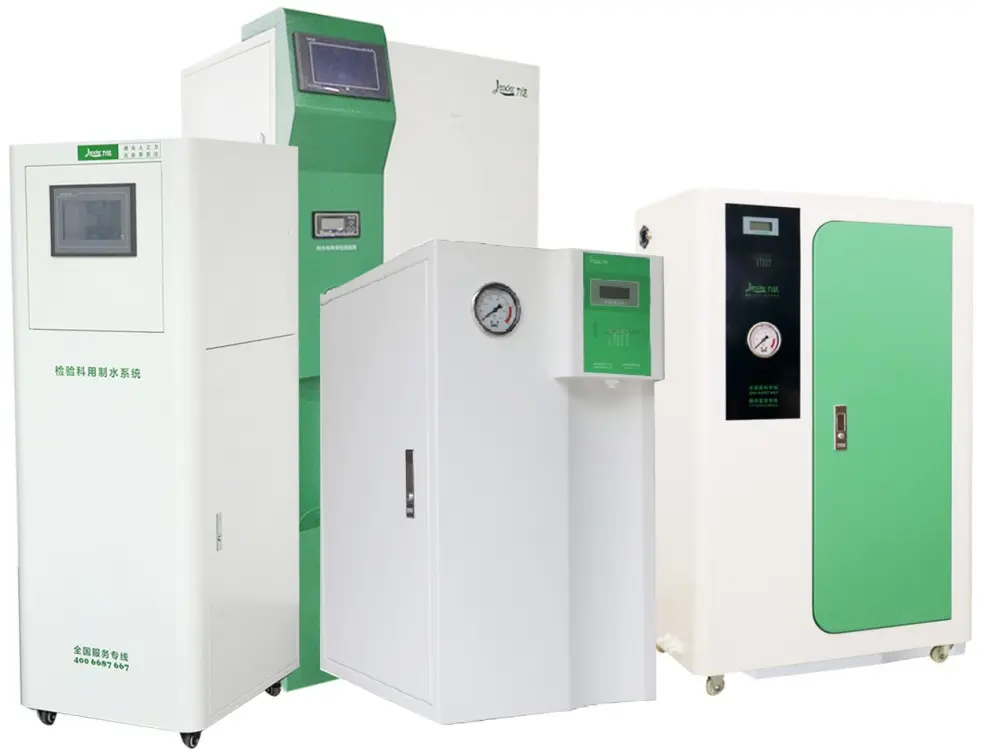
Available System Features
Automatic operation and water quality monitoring
Low-pressure and high-pressure protection
Automatic standby when the storage tank is full
Pretreatment configurations based on feed water quality
RO purification followed by DI polishing
Modular design for installation and maintenance
Optional automatic flushing and fault alarms
Applications
Suitable for clinical laboratory water purification, including selected biochemistry analyzers, immunoassay analyzers, reagent preparation, and laboratory glassware washing. Final water quality requirements depend on the analyzer manufacturer’s specifications and intended laboratory use.
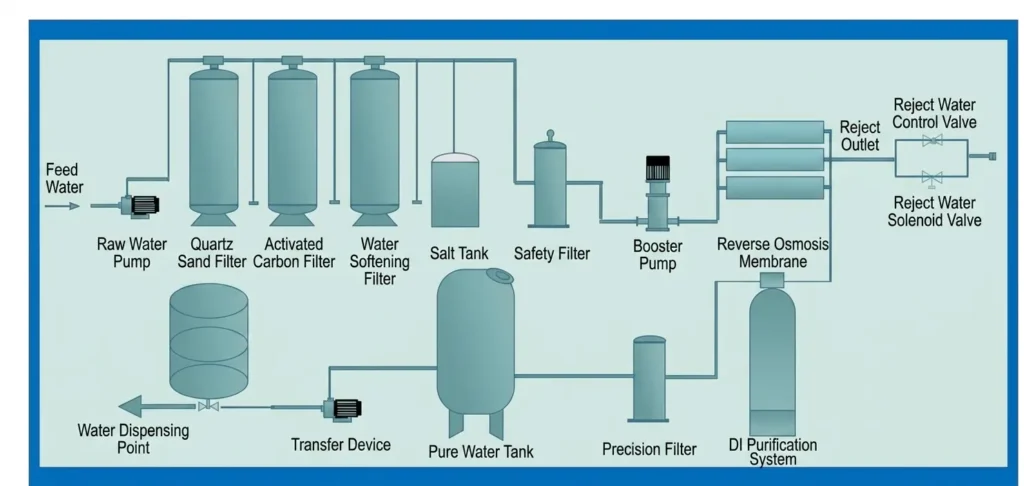
The diagram illustrates a typical single-stage RO + DI water purification process for clinical laboratory applications. Pretreatment may include multimedia filtration, activated carbon filtration, softening, and cartridge filtration, depending on feed water quality. The RO system reduces dissolved salts and other contaminants, while the downstream DI unit provides additional ionic purification.
System capacity, final water quality, storage, and distribution configurations are selected according to laboratory equipment requirements and the intended application.
Two-Stage RO + EDI Water Purification System
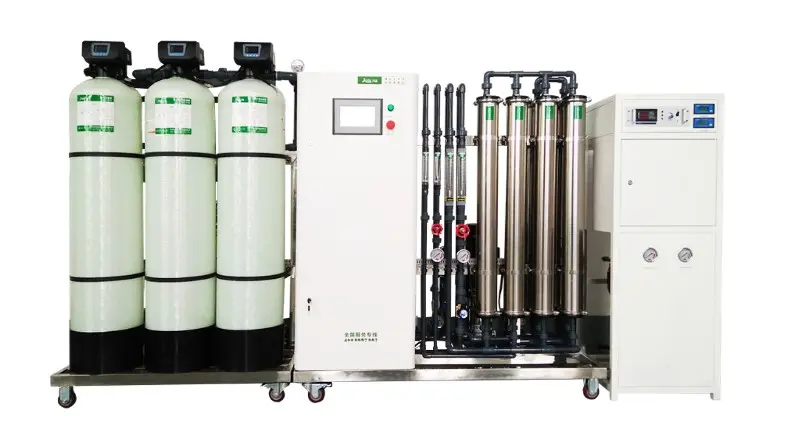
Available System Features
Two-stage reverse osmosis for additional dissolved salt reduction
EDI polishing for continuous high-purity water production
Automatic operation and water quality monitoring
Pressure and flow monitoring with system protection functions
Optional automatic flushing and fault alarms
Configurable pretreatment according to feed water quality
Modular equipment layout for maintenance and servicing
Applications
Suitable for clinical laboratories requiring higher-purity water, including centralized water supply for multiple biochemistry analyzers, automated laboratory equipment, and selected reagent preparation applications.
Final water quality specifications, treatment capacity, and distribution requirements should be confirmed according to the laboratory equipment and intended use.
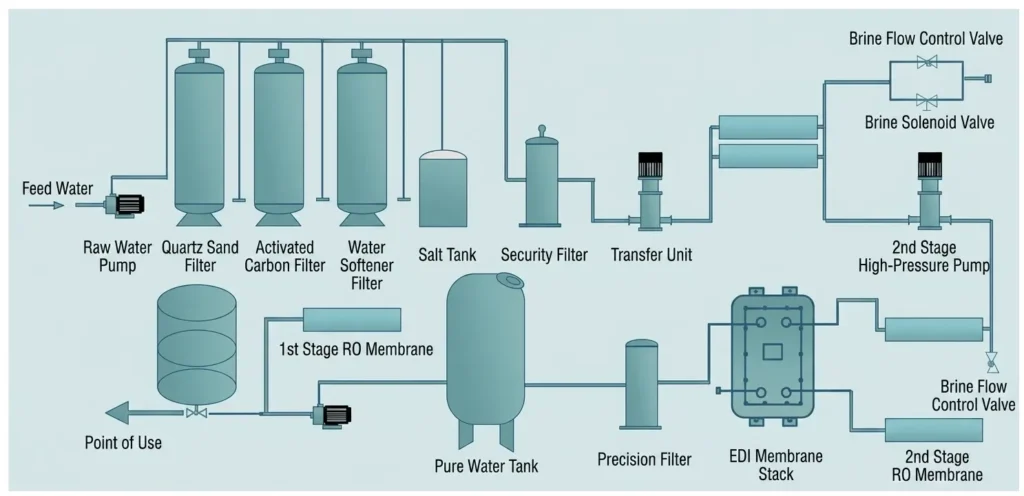
The diagram illustrates a two-stage reverse osmosis system followed by electrodeionization (EDI) for clinical laboratory water purification. Pretreatment protects the RO membranes, while the two RO stages reduce dissolved salts before the water enters the EDI module for further ionic purification.
This configuration can be considered for laboratories requiring higher-purity water. System design, water quality monitoring, microbial control, and distribution arrangements depend on the intended laboratory applications and equipment specifications.
RO Water Treatment System for Hospital Sterile Processing Departments (CSSD)
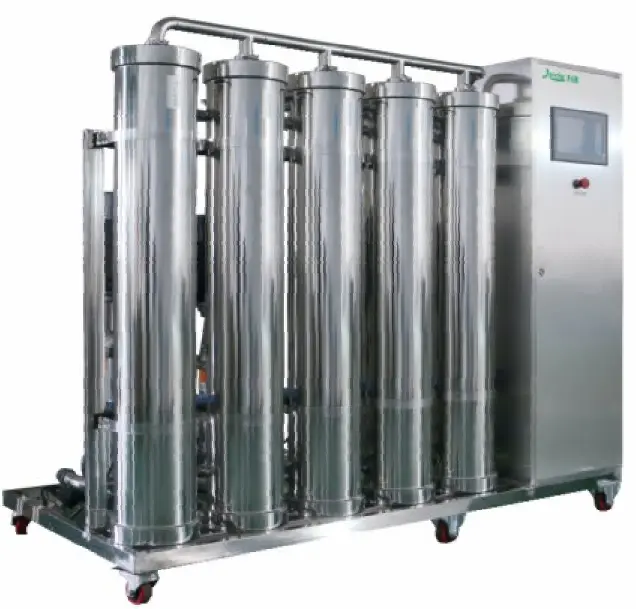
Key Features
Single-stage or two-stage RO configurations based on water quality requirements
Pretreatment options for suspended solids, hardness and chlorine reduction
PLC control with touchscreen operation (optional)
Automatic operation with pressure and flow monitoring
Conductivity monitoring for RO product water
Automatic flushing and system protection functions
Configurable storage tanks and water distribution systems
Stainless steel equipment configurations available
Optional fault alarms and leak detection
Applications
Designed for water treatment applications in hospital Central Sterile Supply Departments (CSSD), including medical instrument cleaning, washer-disinfectors and equipment requiring treated rinse water.
System configuration and final water quality requirements should be determined according to the intended cleaning or sterilization process, applicable standards and equipment manufacturer’s specifications.
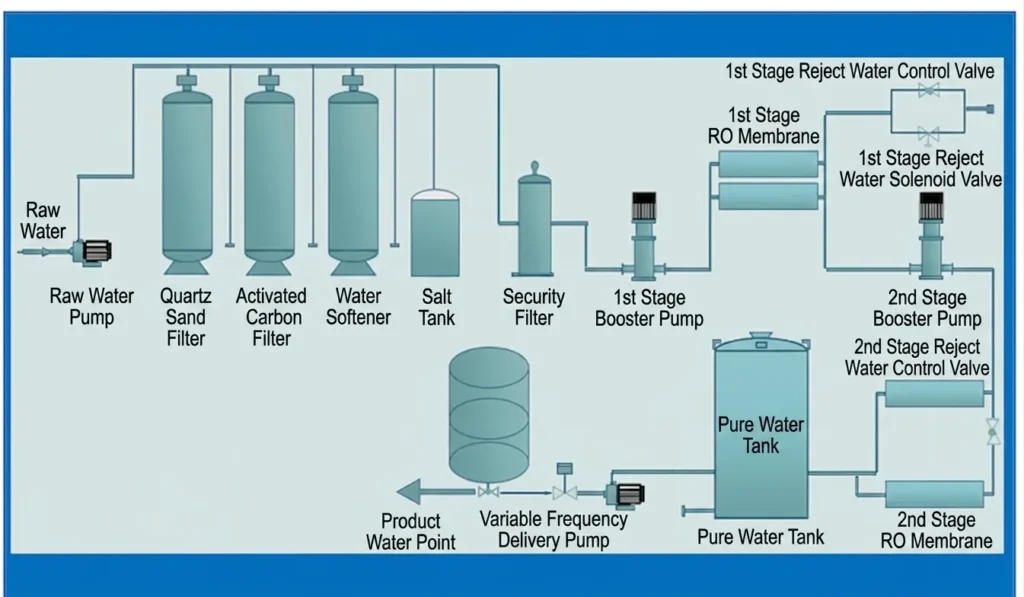
The diagram shows a typical two-stage RO water treatment process for hospital sterile processing applications. Pretreatment reduces contaminants that may affect RO membrane performance, while the two RO stages provide additional dissolved salt removal.
Depending on the intended use, the system can be configured with appropriate water storage, distribution, disinfection and monitoring arrangements. Final water quality requirements should be confirmed for each cleaning, rinsing or sterilization application.
RO Water Treatment System for Endoscopy Centers
Water quality requirements for endoscope cleaning, disinfection, and final rinsing depend on the type of endoscope, reprocessing procedure, and applicable healthcare standards.
In China, WS 507-2016 provides requirements for flexible endoscope cleaning and disinfection, including water quality and microbiological control. For international projects, the relevant local regulations, endoscope manufacturers’ instructions, and reprocessing equipment specifications should be confirmed before system design.
Reverse osmosis can be used to reduce dissolved salts and other contaminants in the feed water. Depending on the required water quality, additional filtration, disinfection, hygienic storage, and recirculating distribution may be necessary.
Purified water and sterile water are not interchangeable. Where sterile water is required for a particular procedure, an appropriately validated sterile water supply must be provided.
Key Features
RO water purification with configurable pretreatment
Automatic or manual operation with system protection
Online conductivity and operating pressure monitoring
Automatic RO membrane flushing
Optional water storage and recirculating distribution
Optional chemical or other suitable system disinfection methods
Hygienic storage tank and piping configurations available
Optional final filtration and microbiological control measures
Configurable water supply for multiple endoscope reprocessing stations
Applications
Suitable for centralized water treatment and distribution in hospital endoscopy departments, including water supply for endoscope cleaning and reprocessing equipment.
Final water quality and system hygiene requirements should be determined according to the intended reprocessing procedures and applicable standards.
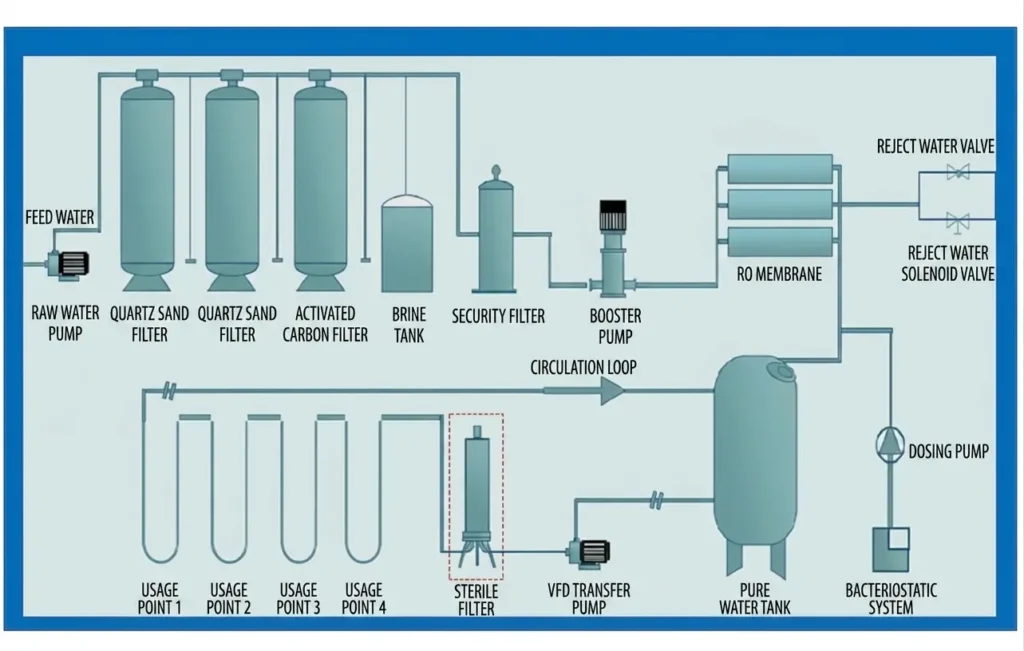
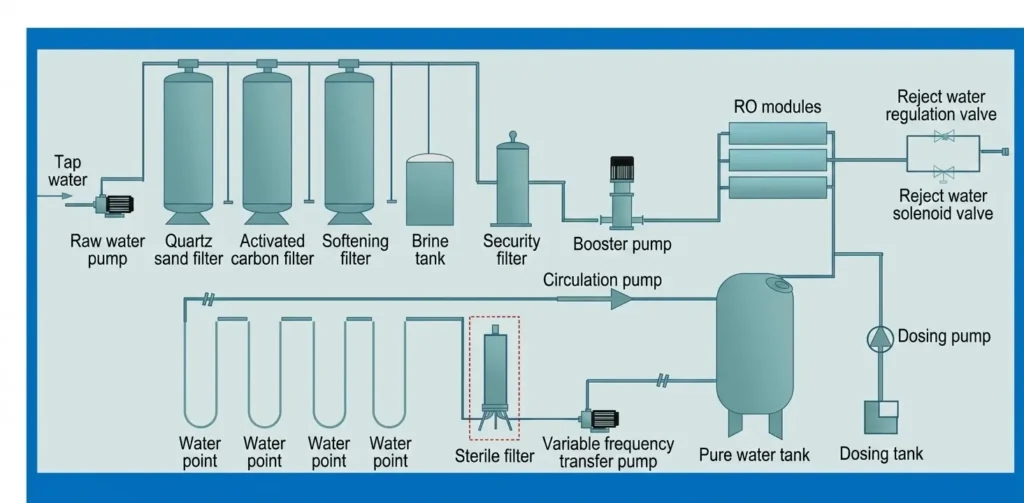
This process diagram illustrates a centralized RO water treatment system with storage and recirculating distribution for an endoscopy department. Pretreatment and RO purification are followed by water storage, optional microbial control measures, and distribution to multiple points of use. The final configuration should be selected according to the required water quality, reprocessing equipment, and applicable hygiene standards.
Dental RO Water Treatment System for Hospitals and Clinics
Water Quality Requirements for Dental Treatment Units
Water treatment systems are used in hospital dental departments and dental clinics to supply treated water for dental chairs, handpieces, three-way syringes, ultrasonic scalers, and other dental equipment.
Water quality requirements vary according to the intended use, local regulations, and dental equipment manufacturers’ instructions. Microbiological control is particularly important because biofilm can develop inside dental unit waterlines.
Reverse osmosis can reduce dissolved salts and other contaminants in the incoming water. However, RO treatment alone does not ensure microbiological safety at the point of use. Appropriate waterline maintenance, disinfection, and water quality monitoring are also required.
Dental Water Treatment and Distribution
Dental clinics may use municipal water directly or incorporate centralized water treatment systems, depending on source water quality and equipment requirements.
For facilities with multiple dental chairs, a centralized RO system can be combined with treated water storage, pressure-controlled distribution, and suitable disinfection measures. System design should consider daily water consumption, peak demand, waterline hygiene, and maintenance requirements.
Key Features
Single-pass or double-pass RO configurations available
Pretreatment selected according to feed water quality
Automatic operation with pressure and conductivity monitoring
Optional touchscreen control and system alarms
Treated water storage and centralized distribution
Optional closed-loop circulation for multiple dental chairs
Optional waterline disinfection and microbial control measures
Constant-pressure water supply with variable-frequency pump options
Configurable stainless steel storage tanks and piping
Applications
Suitable for hospital dental departments, dental clinics, and multi-chair dental treatment facilities requiring centralized treated water supply.
Water quality, disinfection methods, and distribution system design should be selected according to dental equipment requirements and applicable infection control guidelines.
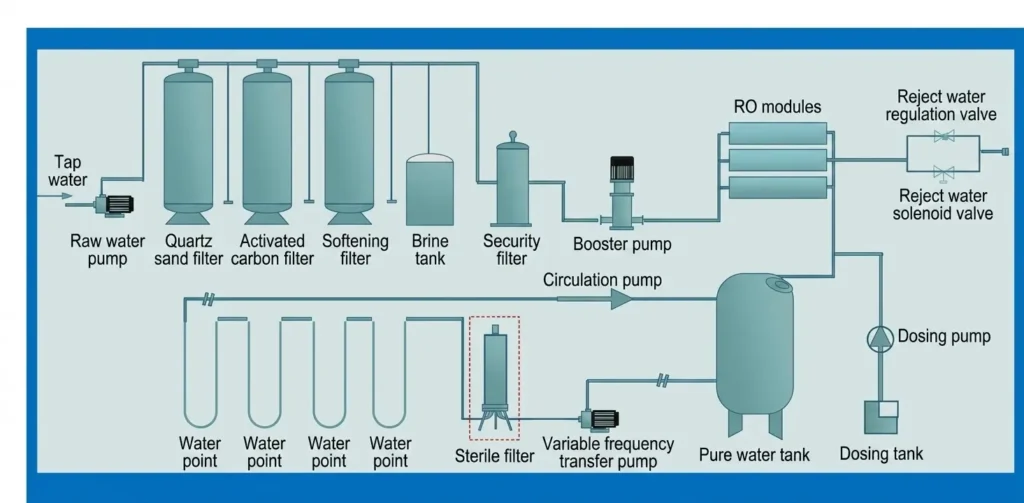
The diagram illustrates a centralized RO water treatment system for dental clinics, including pretreatment, RO purification, treated water storage, and distribution to multiple dental treatment units.
Optional circulation, disinfection, and final filtration can be incorporated according to the required water quality and dental equipment specifications. The system configuration should be confirmed based on feed water conditions, the number of dental chairs, and daily water demand.
Hemodialysis RO Water Treatment System
Standards & Applications
Hemodialysis water treatment systems are designed to produce treated water for dialysis fluid preparation and other approved dialysis-related applications.
Under commonly referenced ISO 23500 requirements for standard dialysis water, the maximum microbial count is 100 CFU/mL and the endotoxin limit is 0.25 EU/mL. More stringent requirements may apply to particular applications or local regulations. Chemical contaminants must also be controlled according to the applicable standards.
A complete dialysis water treatment system typically includes pretreatment, reverse osmosis, water quality monitoring, and a hygienically designed distribution system. Additional disinfection and microbial control measures are selected according to the facility’s requirements.
For detailed system configurations and technical information, see our Reverse Osmosis System for Dialysis.
Key Features
Single-pass or double-pass RO configurations available
Pretreatment for chlorine, hardness, and particulate reduction
Online conductivity, pressure, and flow monitoring
Automatic RO flushing and system protection functions
Optional PLC control and remote monitoring
Configurable disinfection and microbial control measures
Optional redundant RO units and automatic changeover
Hygienic water storage and recirculating distribution options
System configuration based on dialysis station capacity and applicable water quality standards
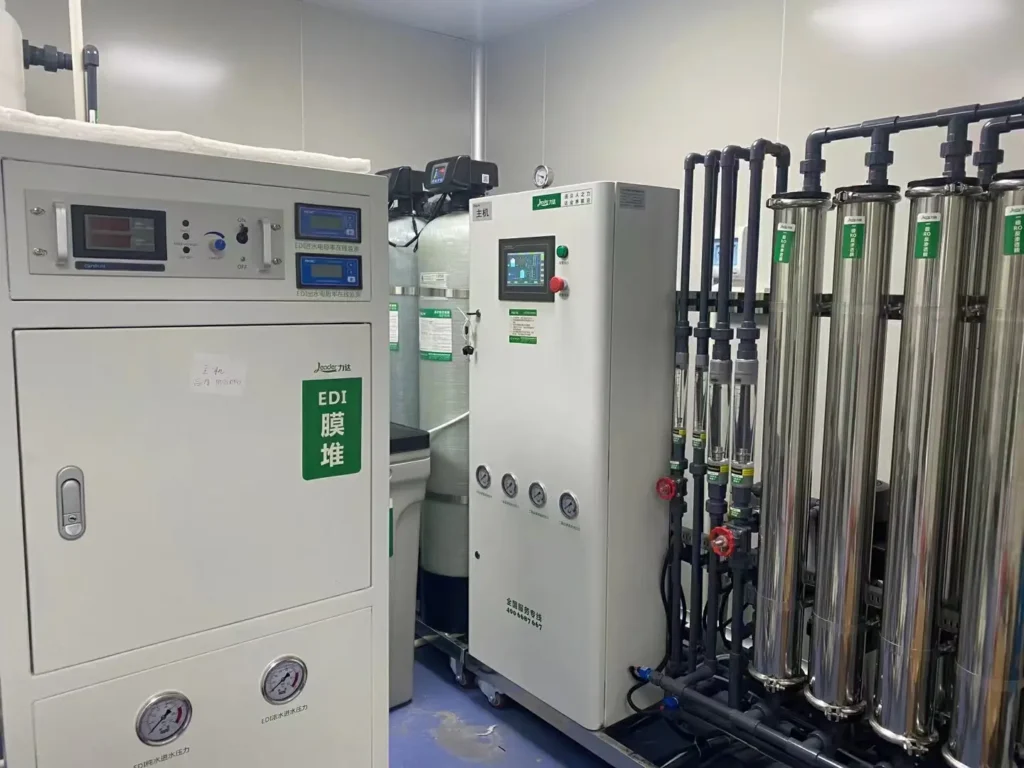
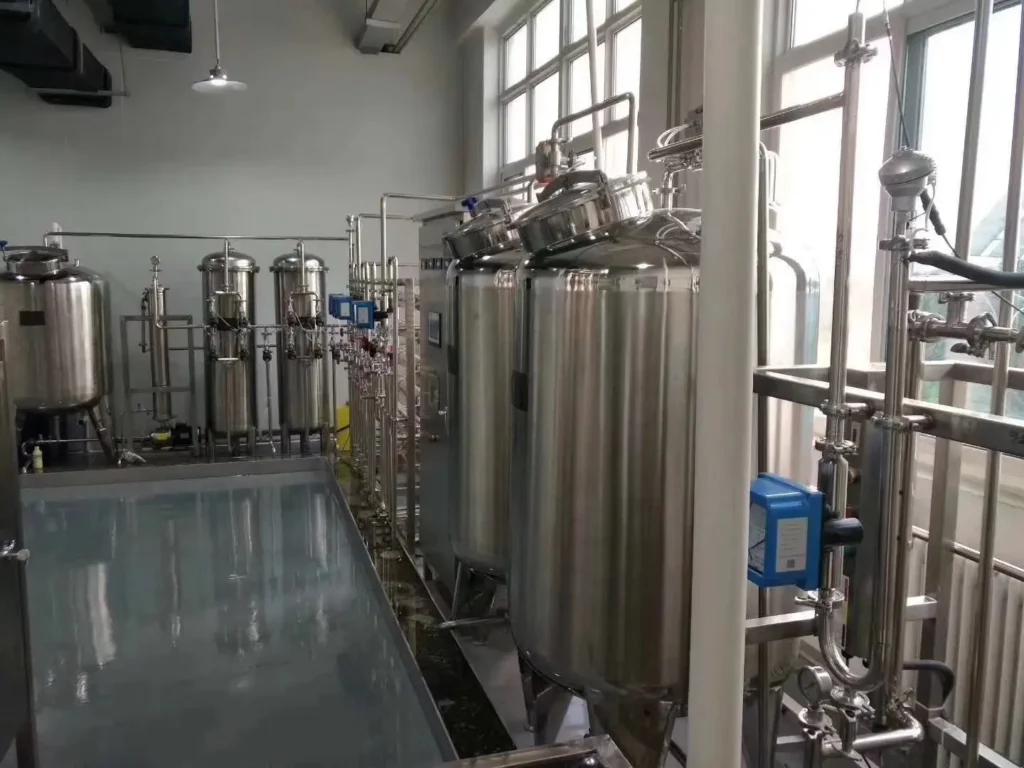
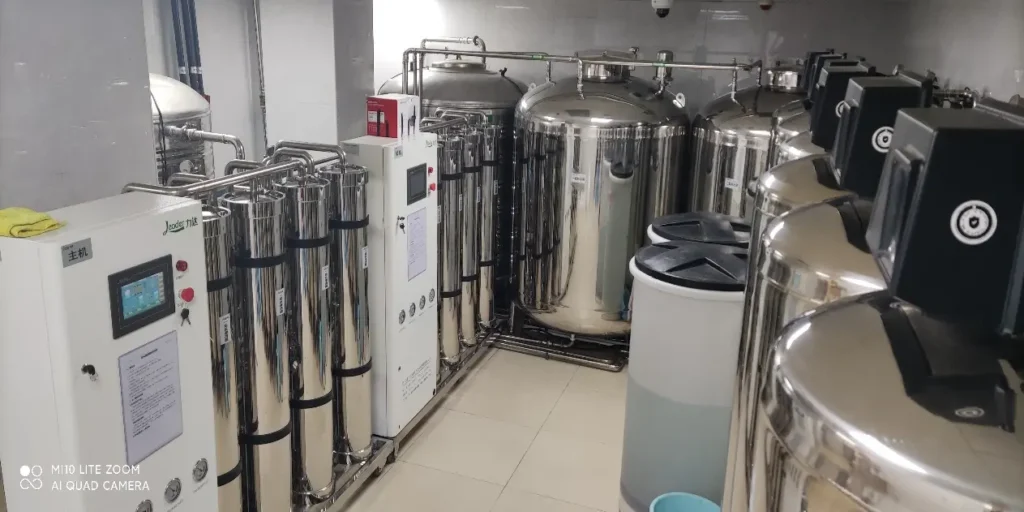
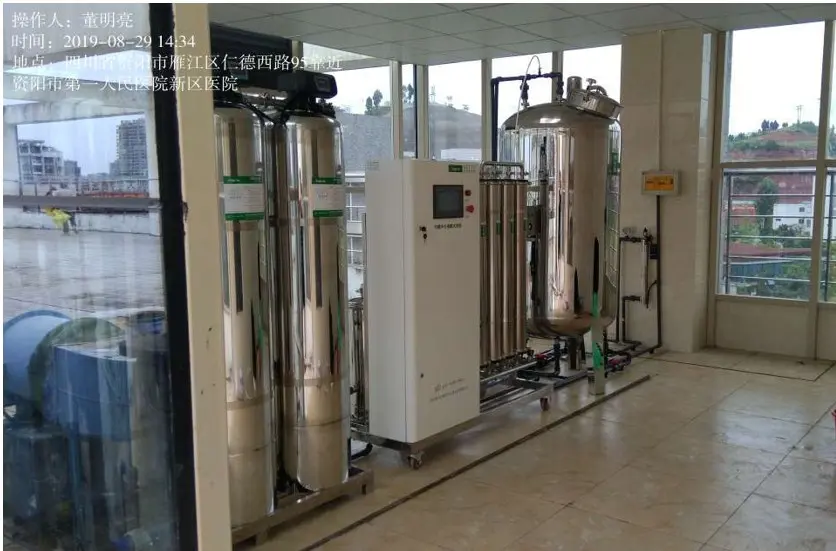
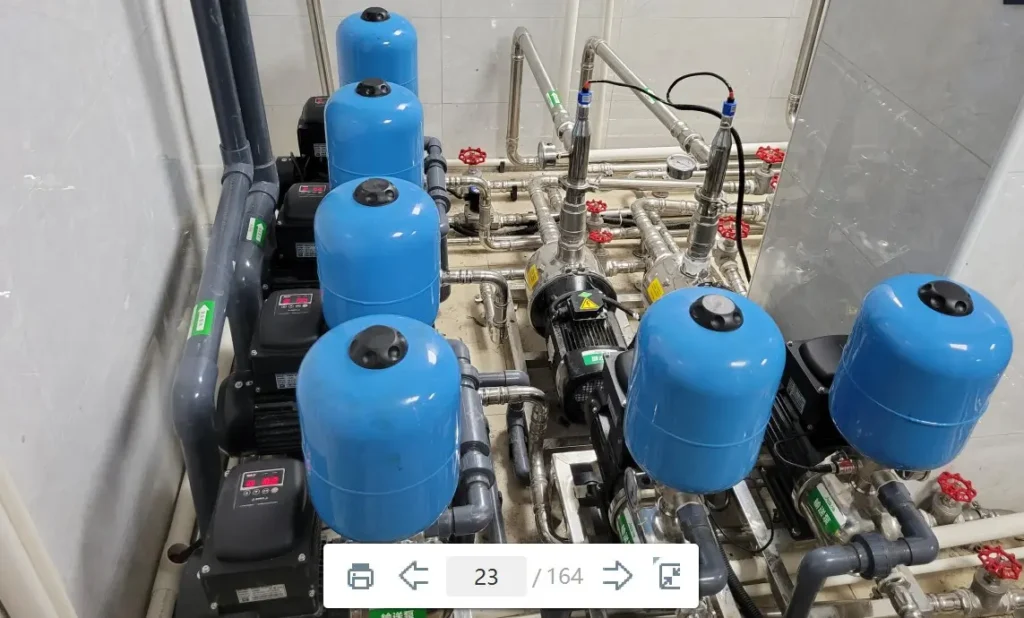
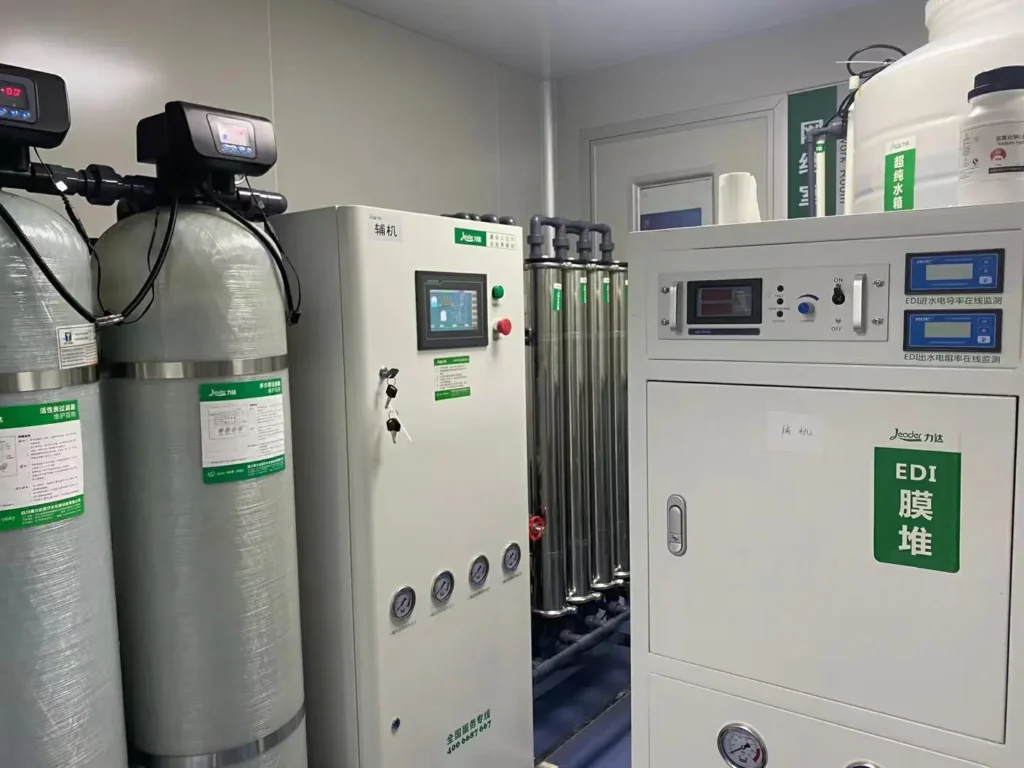
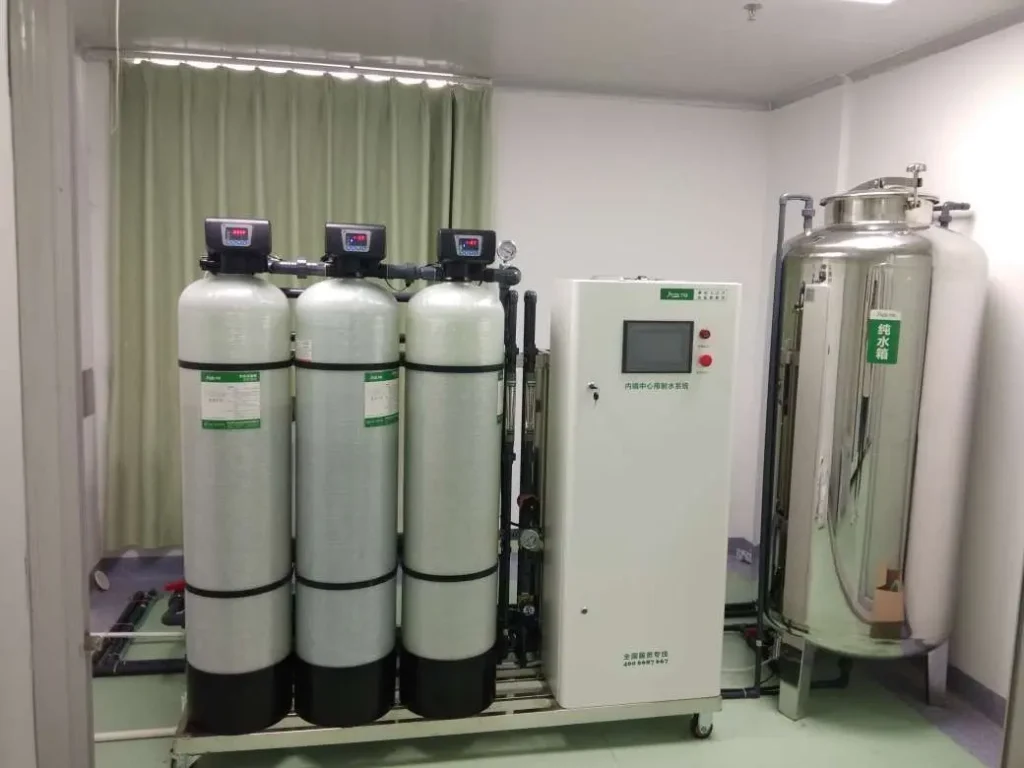
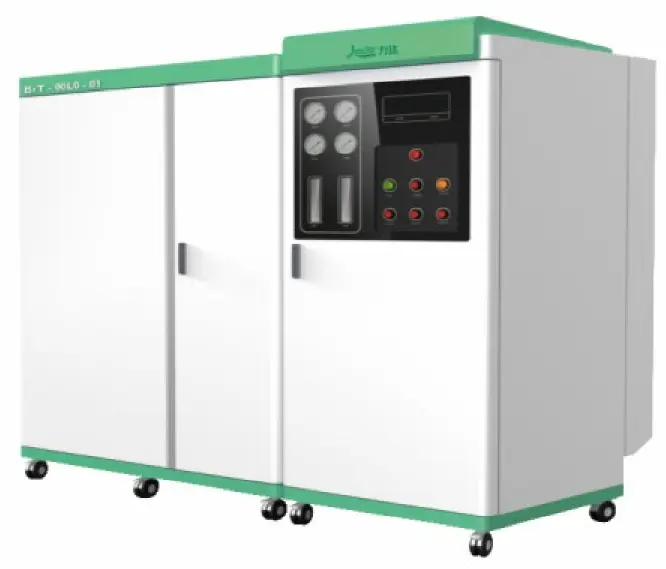
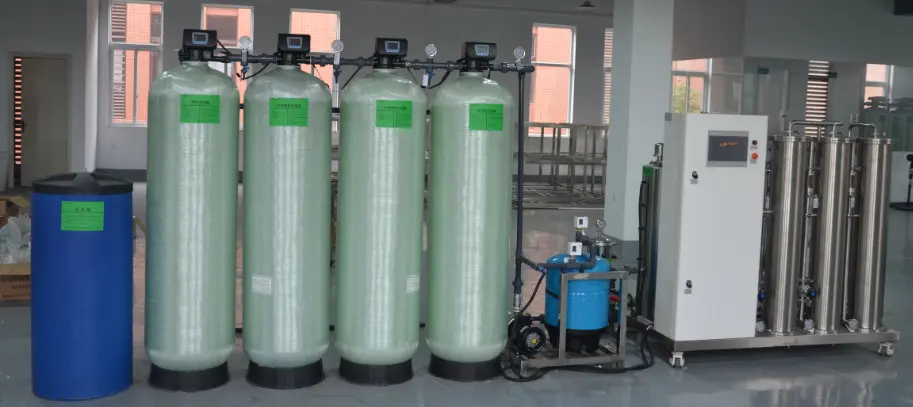
Medical RO Water Treatment System – Equipment & Installation Photos
Examples of RO water treatment equipment, RO + EDI configurations, storage tanks, and water distribution systems for healthcare and laboratory applications. Actual system configurations depend on the required water quality, treatment capacity, and application.