Pressure Gauges for Water
Water Pressure Gauge Manufacturers
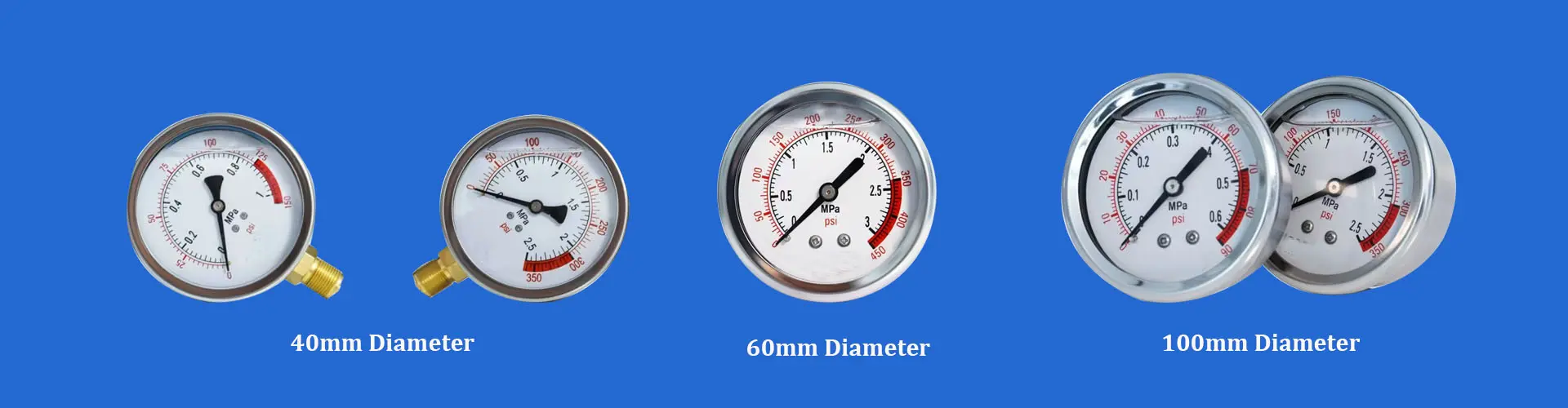
This pressure gauges for Water boasts remarkable advantages and features. Its high precision and reliability make it an ideal choice for industrial process monitoring, providing accurate readings and helping to maintain the optimal operating condition of equipment. The pressure gauge for water is designed simply and offers high cost-effectiveness. It can operate without power supply and works reliably in various environments. Its durability enables it to withstand harsh conditions, such as extreme temperatures and vibrations, ensuring long-term stable operation. They can be used for house, irrigation systems, reverse osmosis (RO) system, water pump, pool filter. If you want to buy water pressure gauge, like pressure of 0-10 bar, 0-30 psi, 0-60 psi, 0-100 psi, 0-200 psi, 0-300 psi, or connnection port of 3/4″ (3 4), 3/8″(3 8), 1/8″ (1 8), 1/4″ (1 4), 1/2″ (1 2), just send us inquiry.
400mm Dia Pressure Gauge for Water
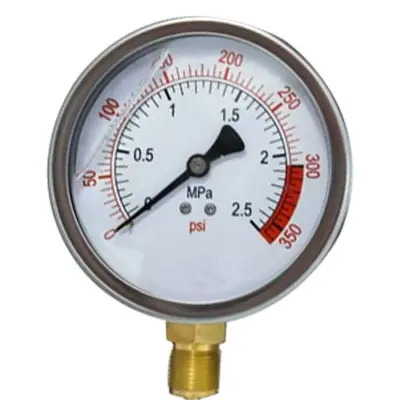
| Spec. | Model | Connection | Range of measurement | Connection Thread | Shell Material | Precison |
|---|---|---|---|---|---|---|
| 1 1/2" | Y-40 | Radial direction | 0-0.6MPa 0-90psi 0-1 MPa 0-150psi 0-1.6 MPa 0-240psi 0-2.5 MPa 0-350psi 0-3 Mpa 0-450psi 0-10 bar 0-16 bar 0-20 bar 0-25 bar 0-30 bar | 3/8" 1/2" NPT BSPT BSP M10X1 | Iron Stianless Steel | ±2.5% |
| Y-40Z | Axial direction without edge | |||||
| Y-40ZF | Axial direction with edge |
60mm Dial Pressure Gauge for Water Line
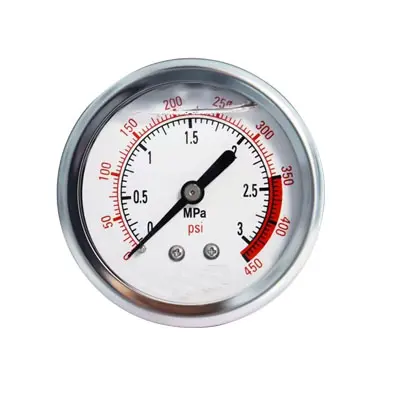
| Spec. | Model | Connection | Range of measurement | Connection Thread | Shell Material | Precison |
|---|---|---|---|---|---|---|
| 2 1/2" | Y-60 | Radial direction | 0-0.6MPa 0-90psi 0-1 MPa 0-150psi 0-1.6 MPa 0-240psi 0-2.5 MPa 0-350psi 0-3 Mpa 0-450psi 0-10 bar 0-16 bar 0-20 bar 0-25 bar 0-30 bar | 1/8" 1/4" NPT BSPT BSP M10X1 | Iron Stianless Steel | ±2.5% |
| Y-60Z | Axial direction without edge | |||||
| Y-60ZF | Axial direction with edge |
100mm Dial psi Water Pressure Gauge
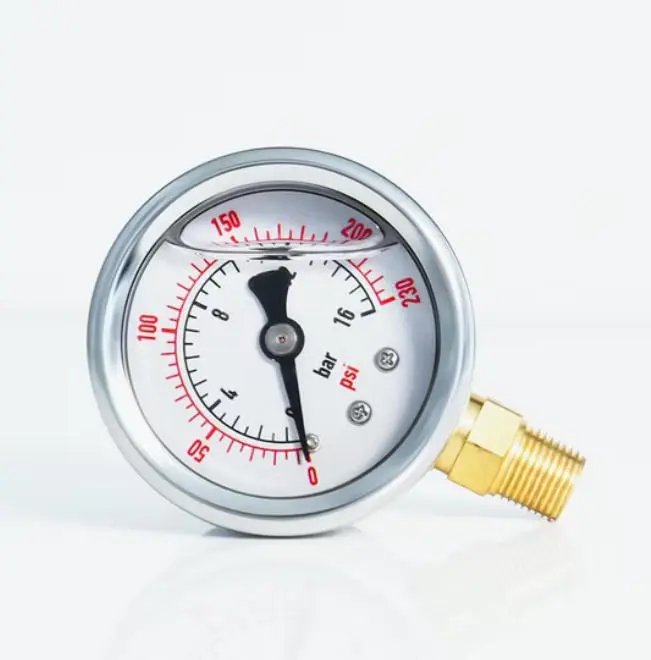
| Spec. | Model | Connection | Range of measurement | Connection Thread | Shell Material | Precison |
|---|---|---|---|---|---|---|
| 4" | Y-100 | Radial direction | 0-0.6MPa 0-90psi 0-1 MPa 0-150psi 0-1.6 MPa 0-240psi 0-2.5 MPa 0-350psi 0-3 Mpa 0-450psi 0-10 bar 0-16 bar 0-20 bar 0-25 bar 0-30 bar | 3/8" 1/2" NPT BSPT BSP M20X1.5 | Iron Stianless Steel | ±2.5% |
| Y-60ZF | Axial direction with edge |
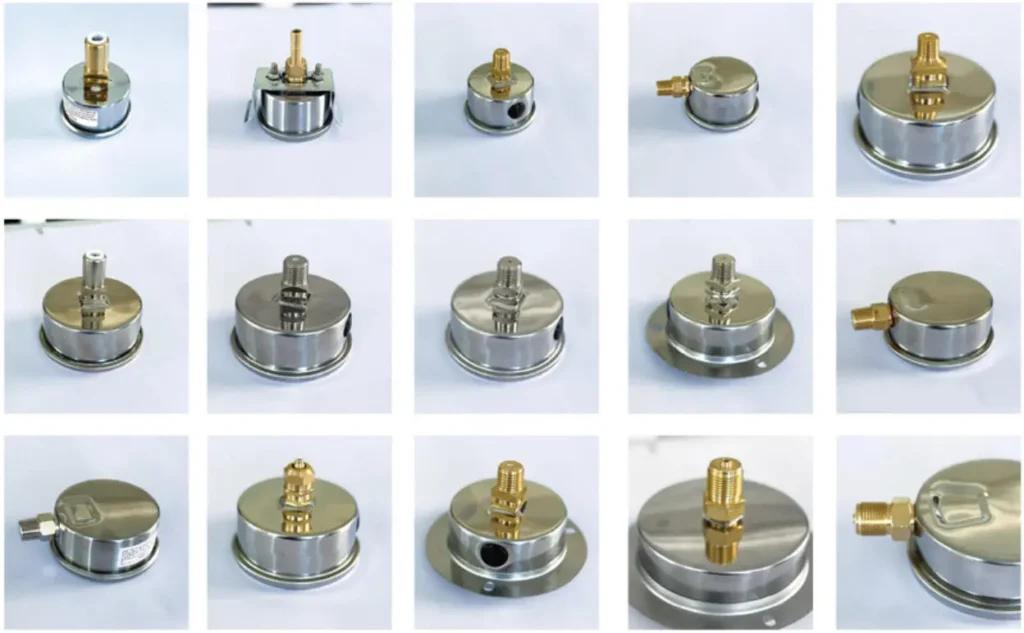
Details of RO Water Pressure Gauge
FAQ of Pressure Gauge for Water
How to read a water pressure gauge?
Check the unit on the dial (Pa, kPa, MPa, bar), find the pointer position, and read the corresponding scale value. If the pointer is between two marks, estimate the middle value. Make sure the unit is correct.
How do you use a water gauge pressure?
Install the gauge properly, open pressure slowly, read the value at eye level, and check the unit. Never exceed the pressure range, release pressure before removal, keep it clean, and calibrate regularly for accuracy.
What is the difference between air and water pressure gauge?
Gas pressure gauges measure gas pressure, while water pressure gauges measure liquid pressure. They differ in pressure range, accuracy, and sealing design, and are not interchangeable.
Can an air pressure gauge be used for water?
It is not recommended. Although some general-purpose gauges can measure different media, for accuracy and safety it is better to use gauges specifically designed for gas or liquid. When selecting a pressure gauge, the type of medium (gas or liquid) should be the first consideration, followed by pressure range, accuracy, and environmental conditions.
How much does a water pressure gauge cost?
The cost of a water pressure gauge varies depending on the size, pressure range, accuracy, materials, and application. Basic models are more affordable, while industrial-grade or high-precision gauges cost more. For an exact price, please contact us with your specifications and application requirements.
How to install a water pressure gauge?
First, shut off the system and fully release the pressure. Choose a gauge with a range 1.3–2 times the working pressure and check that it is in good condition. Wrap sealing tape around the threaded connection, screw in the gauge by hand, and tighten gently with a wrench (do not overtighten). Slowly reopen the valve, check the pressure rise, and use soapy water to ensure there is no leakage.