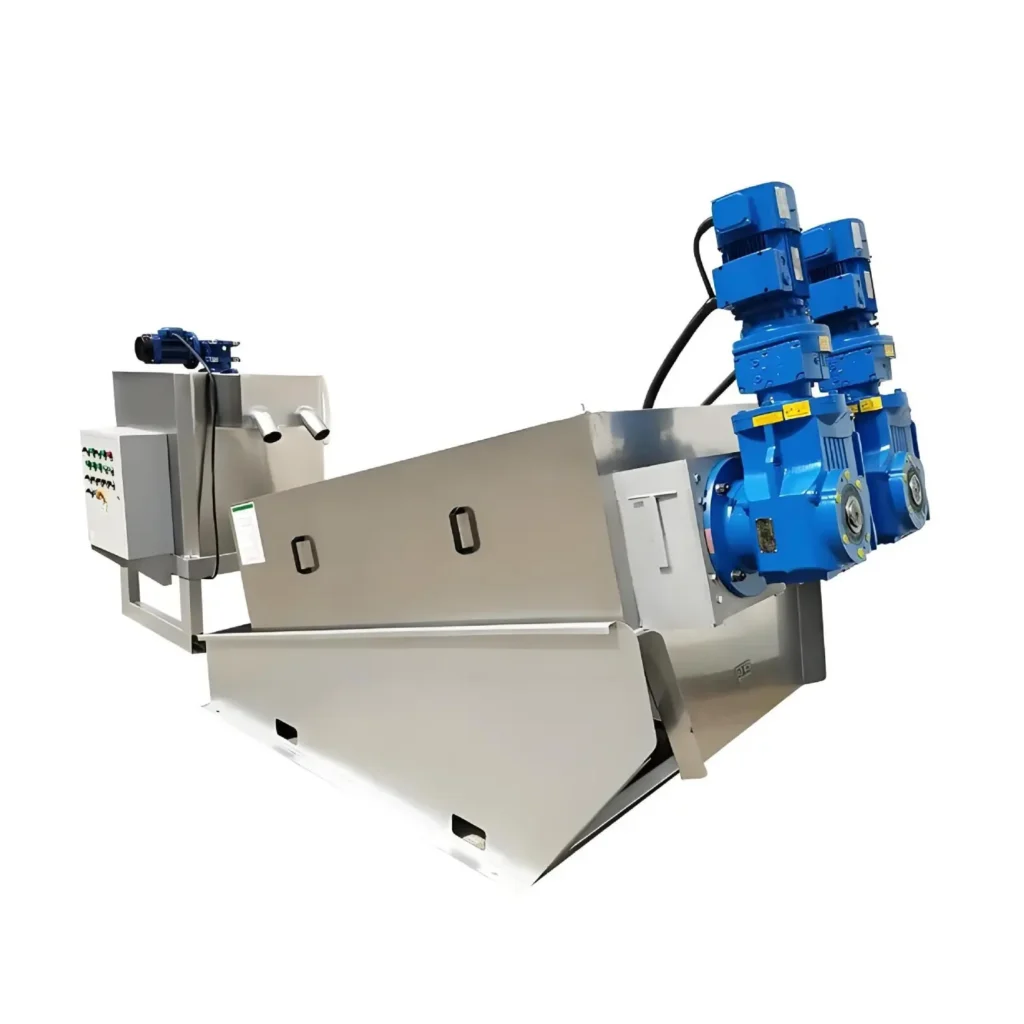
Screw Press Dewatering Machine for Wastewater Sludge
Clear Environment supplies multi-disc screw press dewatering machines for municipal and industrial wastewater sludge treatment. Designed for continuous solid-liquid separation, these systems combine sludge thickening, dewatering and automatic control in a compact configuration.
Suitable for wastewater treatment plants, food processing, chemical industries and other sludge treatment applications.

What Is a Multi-Disc Screw Press Dewatering Machine?
A multi-disc screw press is a mechanical sludge dewatering machine designed to separate water from sludge generated by wastewater treatment processes.
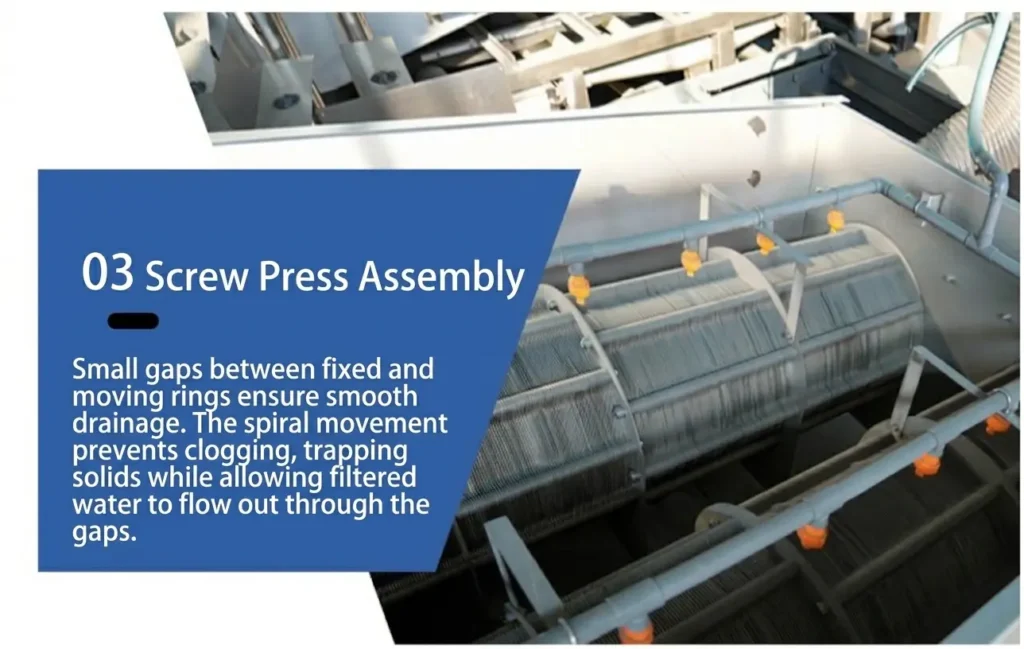
The equipment uses a slowly rotating screw shaft surrounded by alternating fixed and moving rings. As conditioned sludge travels through the machine, free water drains through the gaps between the rings, while the sludge is progressively compressed into a dewatered cake.
Unlike conventional filter presses that require batch operation, a multi-disc screw press can operate continuously with automated sludge feeding, polymer dosing and discharge.
Its compact design makes it suitable for both new wastewater treatment facilities and existing plants looking to upgrade their sludge handling systems.
How Does Screw Press Dewatering Work?
- Sludge Conditioning
Sludge is introduced into a flocculation tank, where a suitable polymer is added and mixed to form larger, more stable flocs for subsequent separation.
- Gravity Thickening
The conditioned sludge enters the thickening section. Free water drains through the gaps between the fixed and moving rings, increasing the solids concentration.
- Progressive Compression
The rotating screw conveys sludge towards the discharge end. The available volume decreases and the sludge is progressively compressed to release additional water.
- Cake Discharge and Filtrate Collection
Dewatered sludge cake exits the discharge section, while separated filtrate is collected and routed to the designated wastewater treatment process.
Key Advantages of Multi-Disc Screw Press Dewatering
Low Energy Consumption
Slow screw rotation and compact mechanical design help reduce energy demand.
Continuous Automatic Operation
PLC-based control supports coordinated sludge feeding, dewatering and discharge.
Self-Cleaning Ring Structure
The movement between fixed and moving rings helps reduce clogging during operation.
Compact Footprint
Integrated thickening and dewatering functions reduce the need for separate equipment.
Reduced Wash Water Demand
The ring filtration structure can reduce continuous washing requirements compared with certain conventional systems.
Enclosed Sludge Handling
An enclosed configuration helps contain splashing and reduce direct exposure to sludge.
Screw Press Dewatering Machine Models and Capacity
| Model | Low Concentration DS (kg/h) | High Concentration DS (kg/h) | Dimensions L×W×H (mm) |
|---|---|---|---|
| DL131 | 5 | 10 | 1870×730×1170 |
| DL132 | 10 | 20 | 2000×960×1230 |
| DL201 | 9 | 20 | 2400×900×1580 |
| DL202 | 18 | 40 | 2400×1200×1580 |
| DL251 | 15 | 30 | 2690×890×1600 |
| DL252 | 30 | 60 | 2810×1120×1600 |
| DL301 | 30 | 60 | 3310×1000×1700 |
| DL302 | 60 | 120 | 3500×1300×1700 |
| DL303 | 90 | 180 | 3700×1650×1700 |
| DL304 | 120 | 240 | 4000×2100×1750 |
Important Selection Notes
The listed capacities are reference dry-solids loading rates under different sludge concentration conditions. Actual hydraulic throughput and dewatering performance depend on sludge characteristics, feed solids concentration, polymer conditioning and operating conditions.
Final equipment selection should be based on project-specific sludge data and, where necessary, dewatering tests.
Operating Requirements and Utility Consumption
| Model | Total Motor Power (kW) | Wash Water (L/h) | Dimensions L×W×H (mm) |
|---|---|---|---|
| DL131 | 0.36 | 43 | 1870×730×1170 |
| DL132 | 0.54 | 86 | 2000×960×1230 |
| DL201 | 0.55 | 58 | 2400×900×1580 |
| DL202 | 0.55 | 58 | 2400×1200×1580 |
| DL251 | 0.92 | 58 | 2690×890×1600 |
| DL252 | 1.47 | 116 | 2810×1120×1600 |
| DL301 | 1.30 | 93 | 3310×1000×1700 |
| DL302 | 2.05 | 186 | 3500×1300×1700 |
| DL303 | 3.00 | 279 | 3700×1650×1700 |
| DL304 | 3.75 | 372 | 4000×2100×1750 |
Screw Press Dewatering Applications

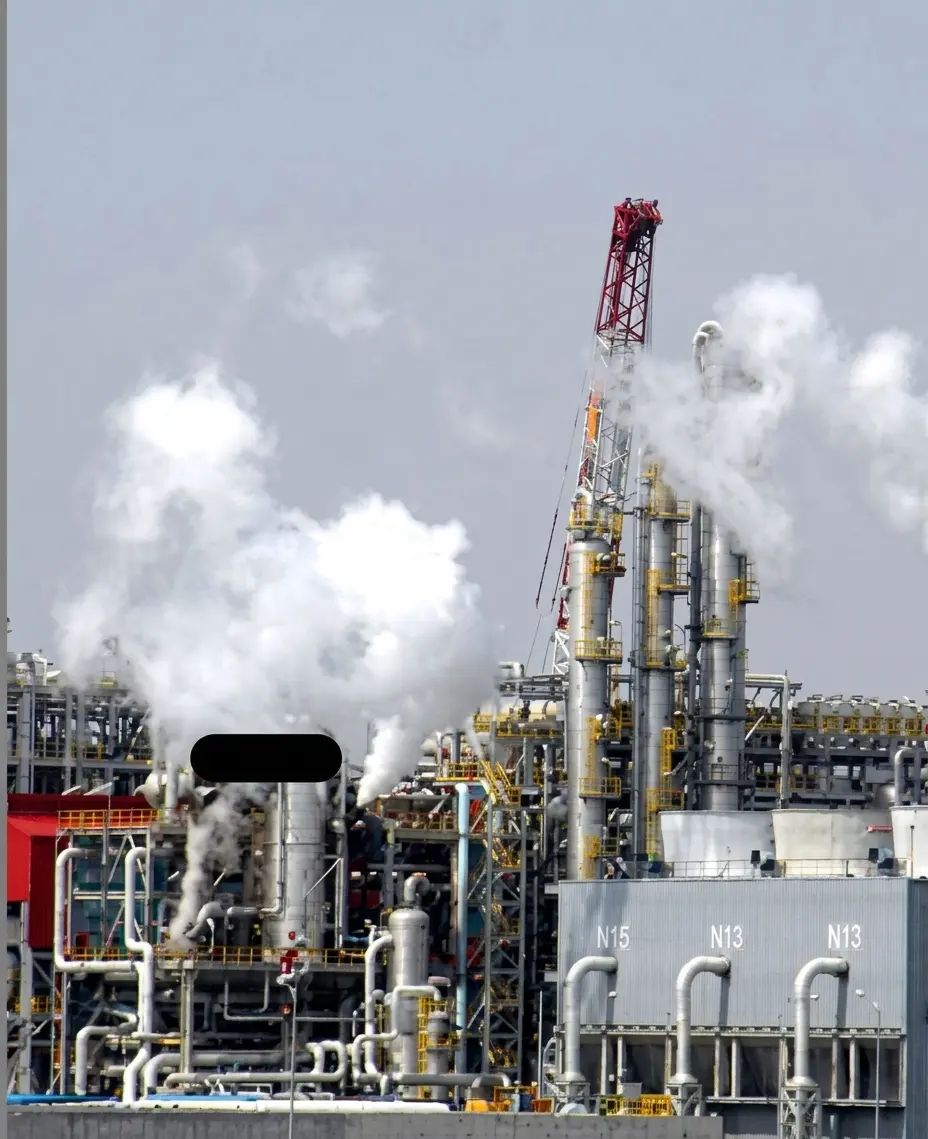
Chemical Industry
Mechanical dewatering of suitable chemical wastewater sludge following conditioning and compatibility evaluation.
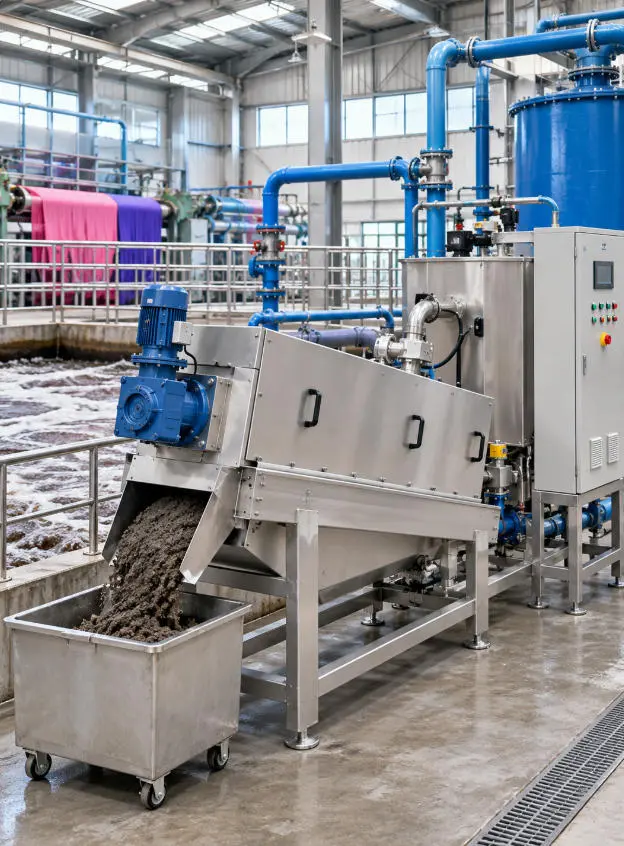
Textile & Dyeing Wastewater
Sludge handling in textile and dyeing wastewater treatment processes, subject to sludge testing.
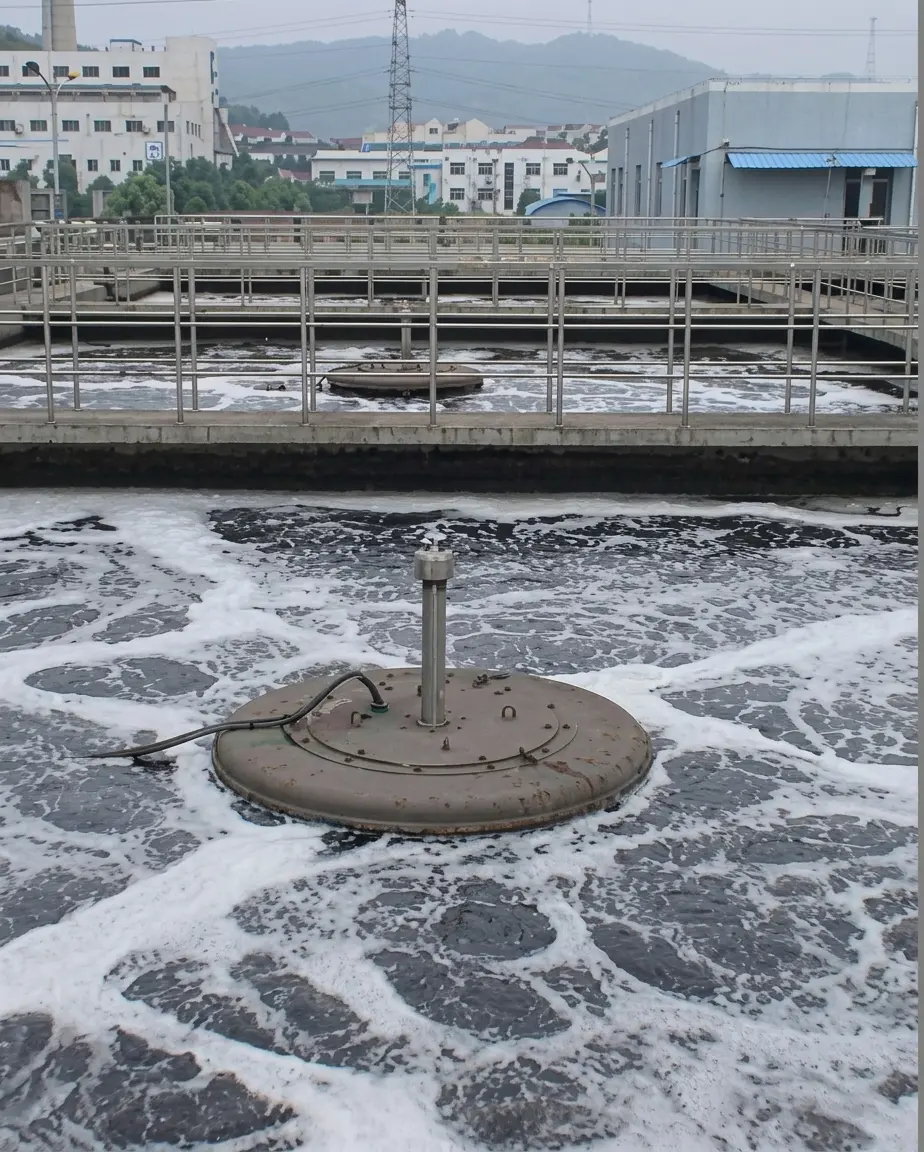
Municipal Wastewater Treatment
Dewatering of biological sludge and mixed sludge generated by municipal wastewater treatment plants.
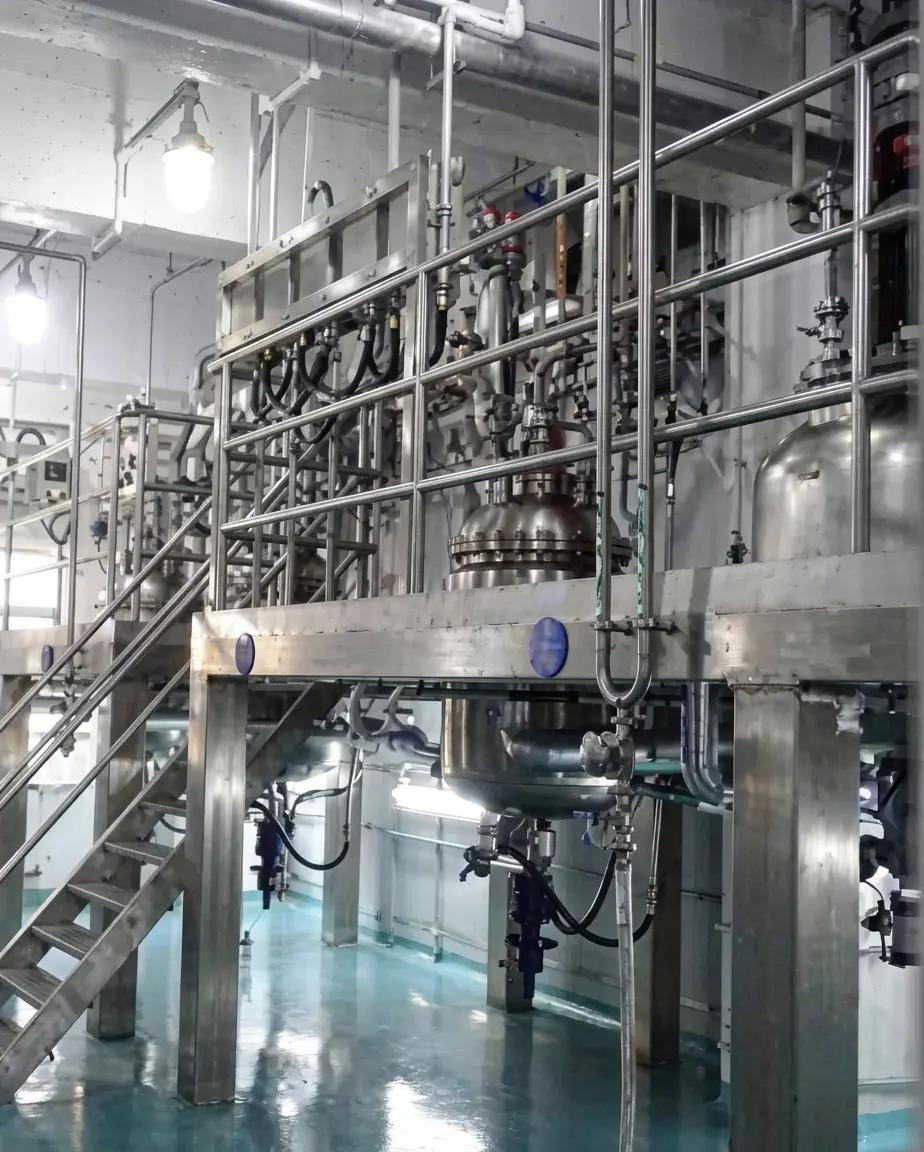
Food & Beverage Processing
Sludge treatment for food processing, beverage production and related industrial wastewater facilities.
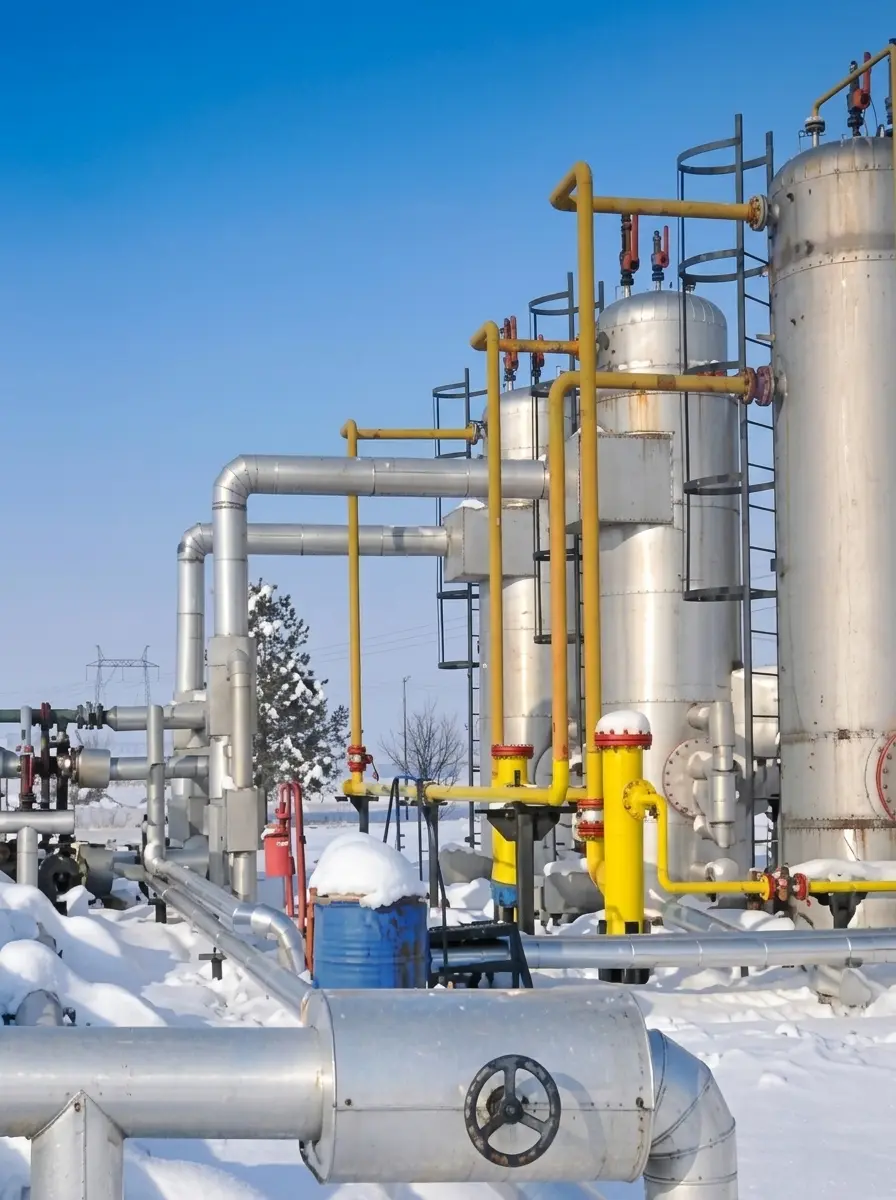
Petrochemical Wastewater
Dewatering of compatible sludge from petroleum processing and oil-containing wastewater treatment systems.
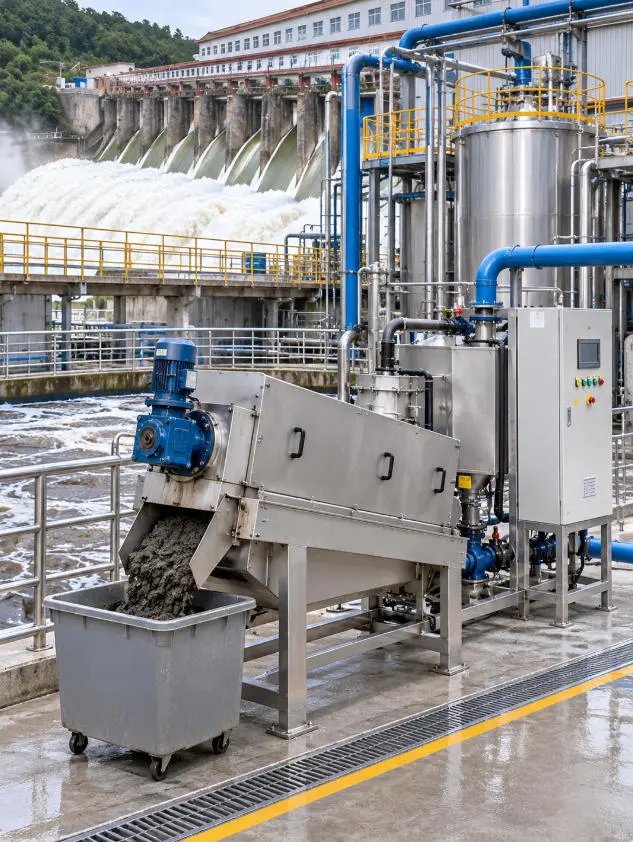
Pulp & Paper Industry
Dewatering of sludge from paper manufacturing and wastewater clarification processes.
Sludge characteristics vary significantly between industries. Feed solids content, oil and grease, fiber content, abrasiveness and polymer response should be evaluated before equipment selection.
Screw Press vs Belt Filter Press vs Centrifuge
| Feature | Multi-Disc Screw Press | Belt Filter Press | Decanter Centrifuge |
|---|---|---|---|
| Operation | Continuous | Continuous | Continuous |
| Operating speed | Low | Low to moderate | High |
| Energy demand | Generally low | Varies | Generally higher |
| Washing demand | Intermittent | Often substantial | Varies |
| Footprint | Compact | Often larger | Compact |
| Maintenance | Ring/screw components | Belts, rollers | High-speed rotating parts |
| Sludge cake dryness | Sludge-dependent | Sludge-dependent | Sludge-dependent |
Complete Screw Press Dewatering System Configuration
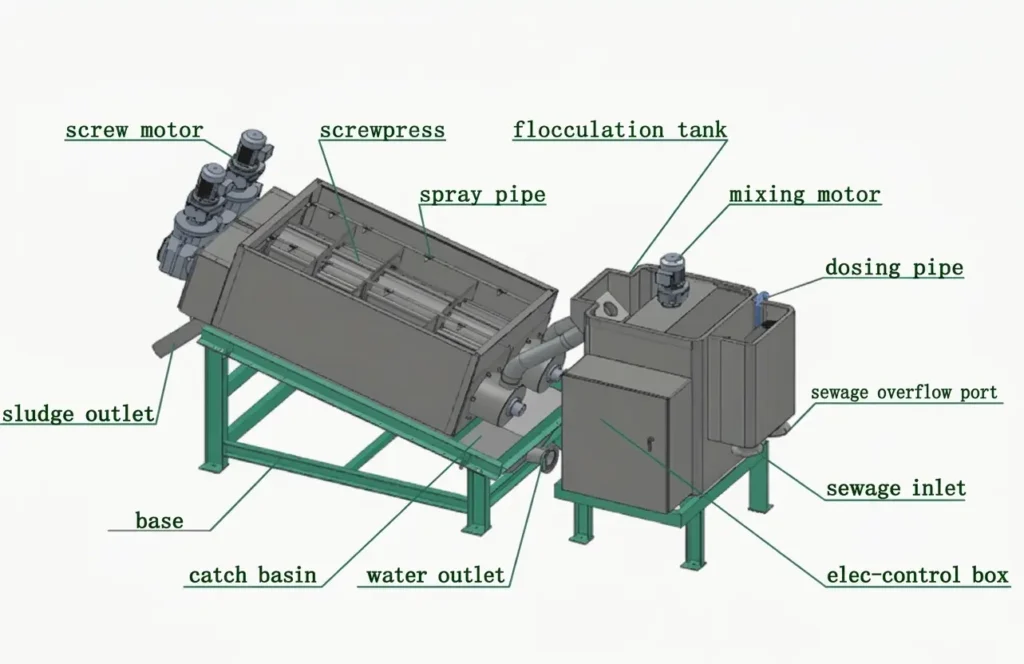
Clear Environment offers screw press dewatering equipment with project-specific auxiliary components to support integrated sludge treatment operations.

| Component | Function |
|---|---|
| Multi-Disc Screw Press | Thickens and dewaters conditioned sludge through continuous mechanical compression. |
| Screw Drive Motor | Drives the screw shaft to transport and compress sludge. |
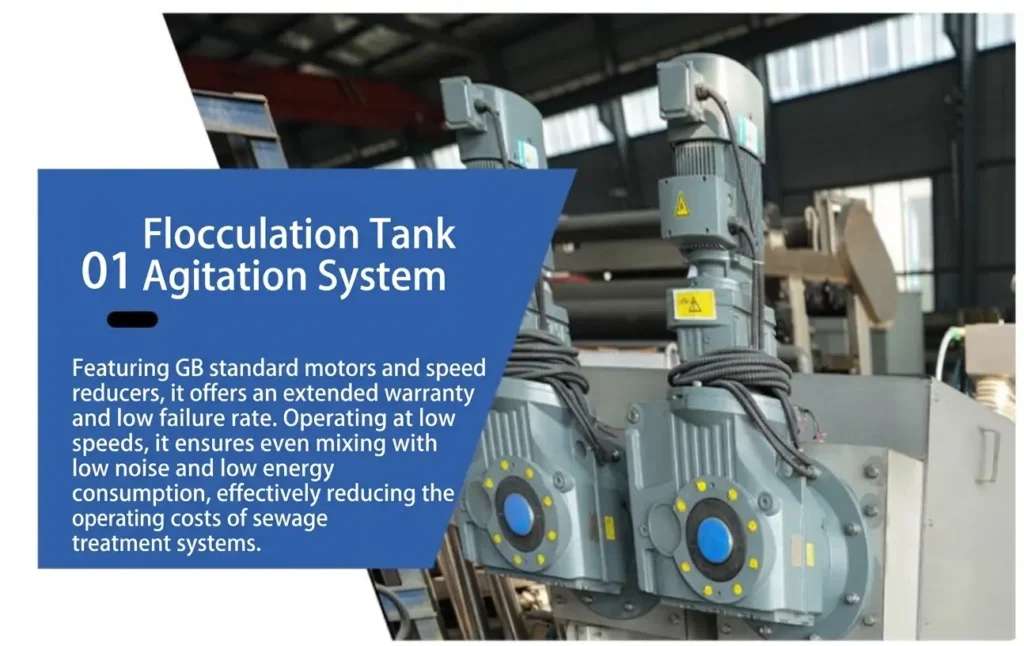
| Flocculation Tank | Mixes sludge with flocculant to promote floc formation before dewatering. |
| Mixing Motor | Provides agitation to ensure effective sludge and polymer mixing. |
| Polymer Dosing Inlet | Introduces prepared flocculant into the flocculation tank. |
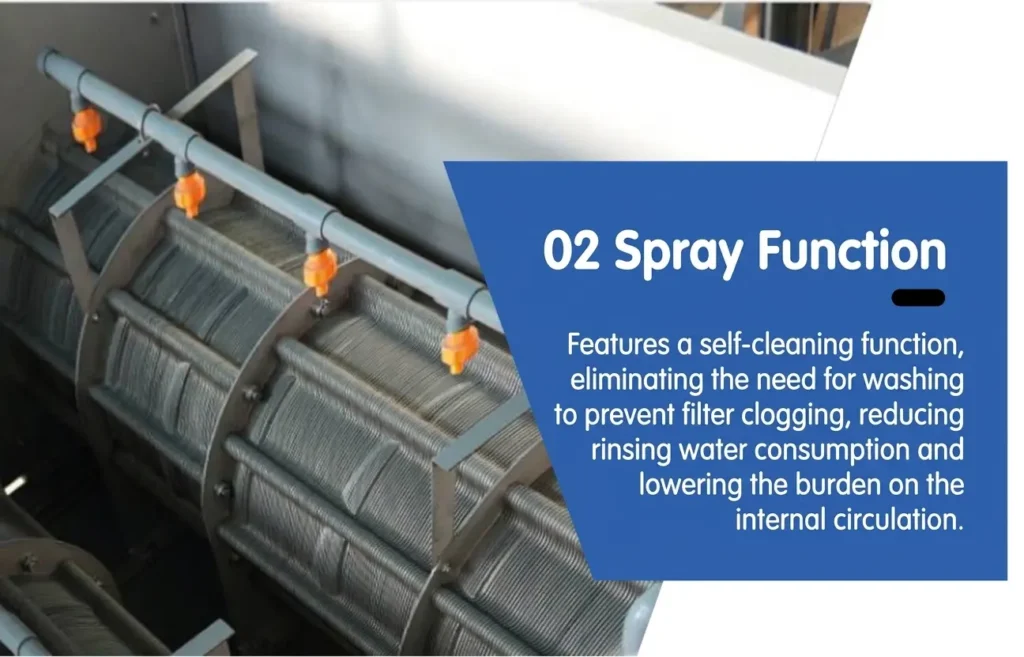
| Spray Pipe | Provides washing water to clean the dewatering section. |
| Sludge Inlet | Receives incoming sludge for flocculation and subsequent dewatering. |
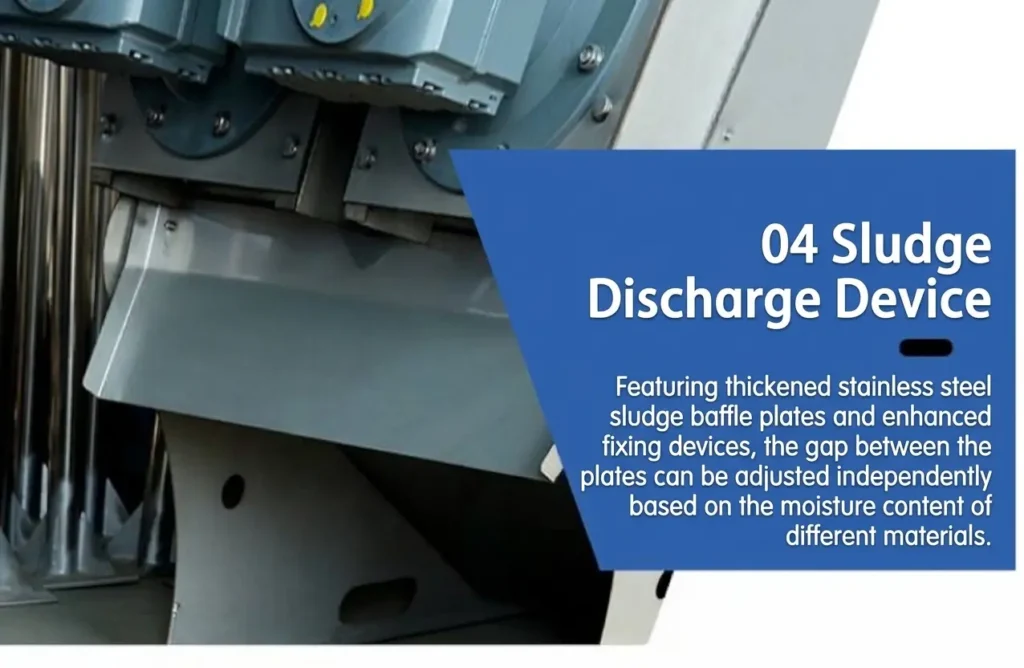
| Sludge Cake Outlet | Discharges dewatered sludge cake from the screw press. |
| Filtrate Collection Basin | Collects separated water during the dewatering process. |
| Filtrate Outlet | Discharges collected filtrate for further treatment or return to the wastewater treatment process. |
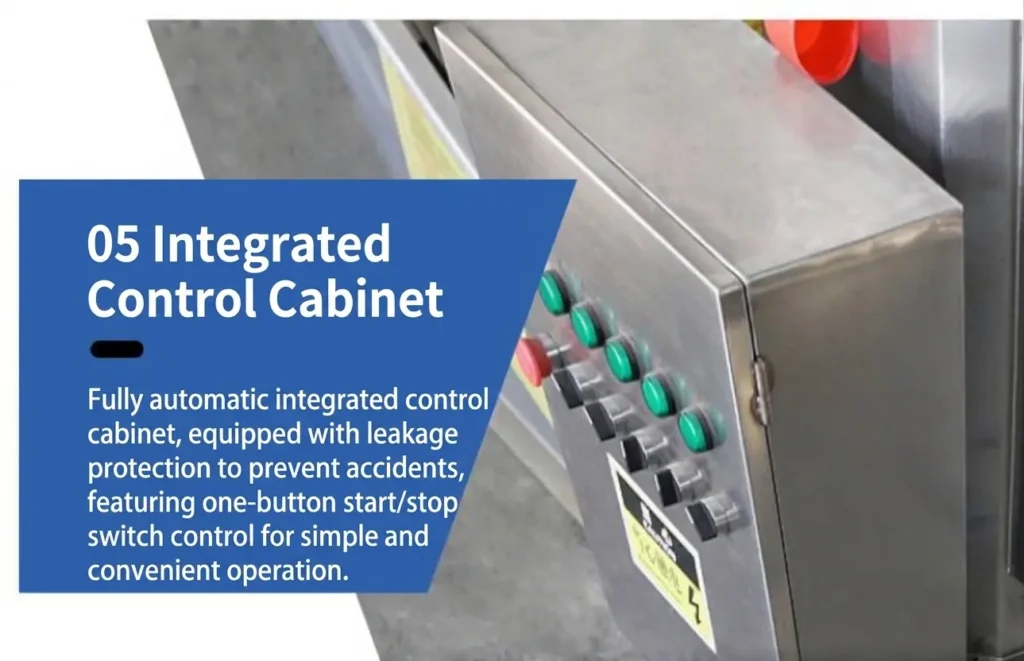
| Electrical Control Box | Houses electrical components for equipment operation and control. |
| Supporting Frame | Supports the main equipment and maintains structural stability. |
For sludge conditioning and polymer preparation, explore our Chemical Dosing Systems
Multi-Disc Screw Press – Detailed Views
Explore the key components of our multi-disc screw press sludge dewatering machine, including the flocculation tank agitation system, spray cleaning system, screw press assembly, adjustable sludge discharge device, and integrated control cabinet. These components work together to support efficient, continuous, and reliable sludge dewatering.


How to Select the Right Screw Press Dewatering Machine
Selecting the correct dewatering screw press requires more than knowing the daily sludge volume. The dry solids loading rate is one of the key parameters used to determine the appropriate machine size.
For preliminary equipment selection, please provide the following information:
Sludge source and industry
Sludge flow rate (m³/h or m³/day)
Feed solids concentration (%, or mg/L)
Operating hours per day
Target sludge cake dryness
Available electrical supply and installation space
Dry Solids Loading Calculation
DS (kg/h) = Q (m³/h) × TS (kg/m³)
Where:
DS = Dry solids loading (kg/h)
Q = Sludge flow rate (m³/h)
TS = Total solids concentration (kg/m³)
When Is a Multi-Disc Screw Press the Right Choice?
A multi-disc screw press can be a suitable sludge dewatering solution in the following situations:
Oily or sticky sludge: When conventional filter presses experience poor drainage or filter cloth clogging.
Limited operating budget: When the high initial investment and operating costs of belt filter presses are a concern, especially for small wastewater treatment facilities.
Limited manpower: When continuous, automated operation is preferred to reduce manual intervention.
Industrial sludge treatment: Suitable for sludge generated from food processing, chemical production, leather processing, paper mills, printing and dyeing, pharmaceutical manufacturing, petroleum processing, and coal-related industries, subject to sludge characteristics.
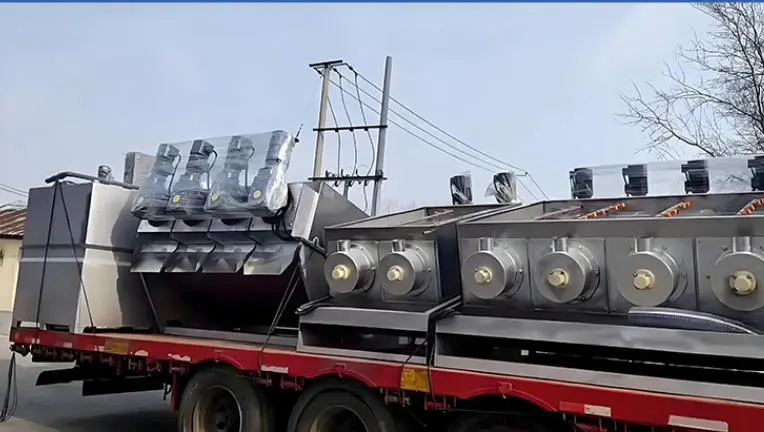
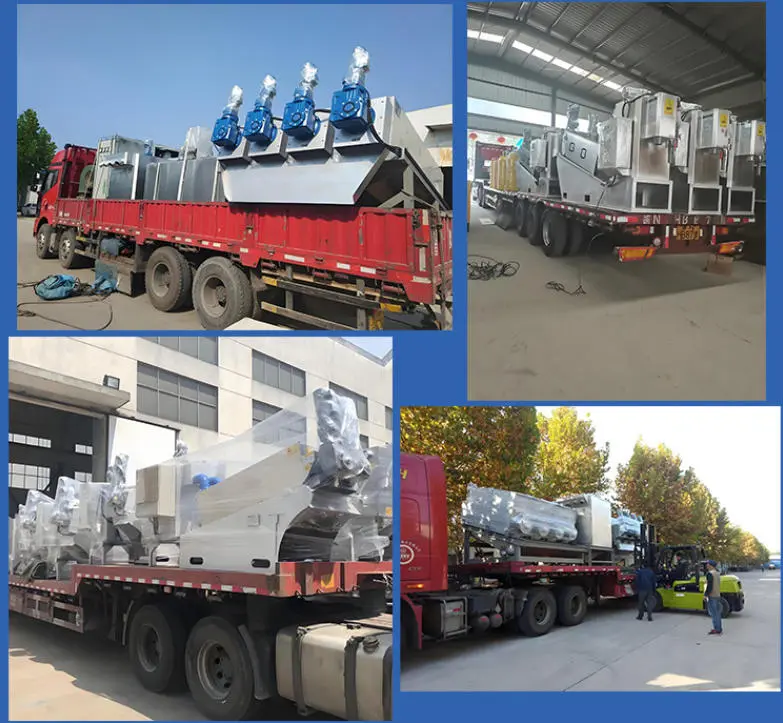
Multi-Disc Screw Press Packaging & Shipping


Why Choose Clear Environment for Your Sludge Dewatering Equipment?

Wide Model Selection & Reliable Production Capacity
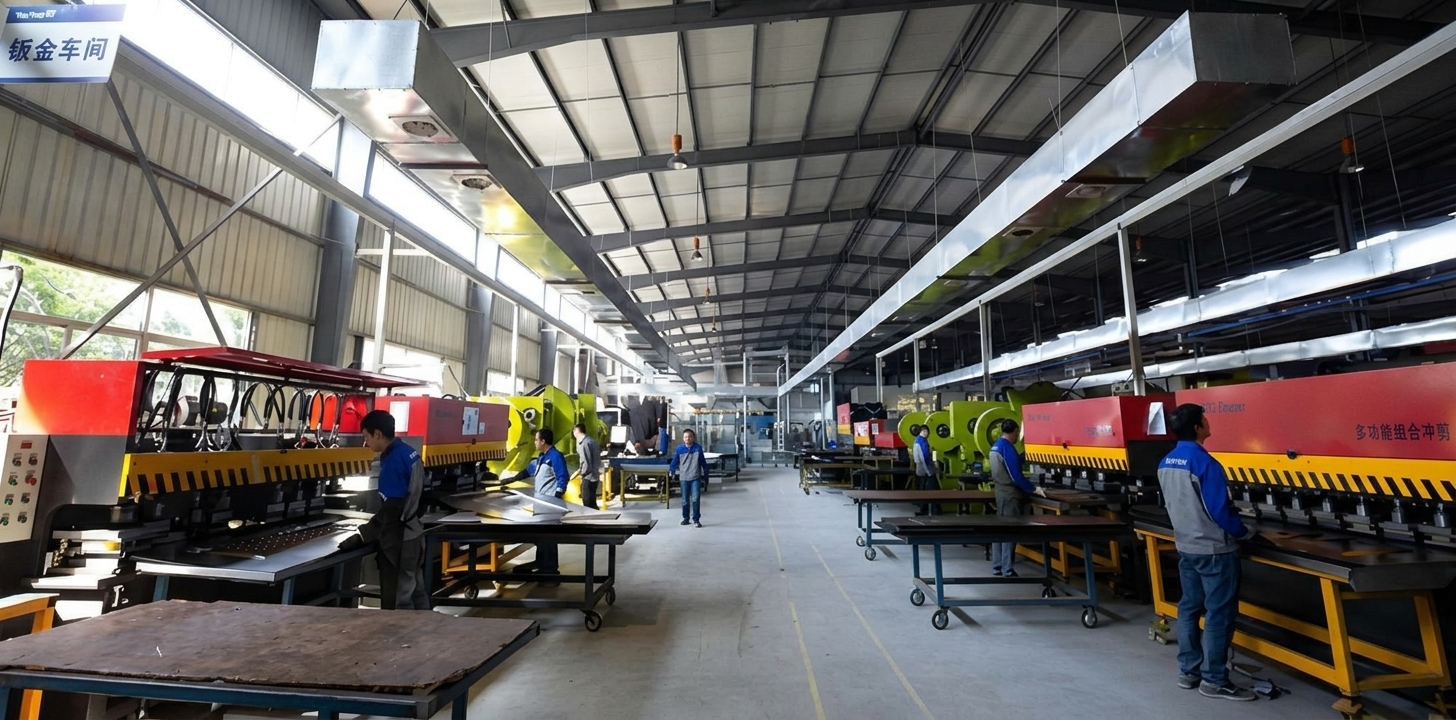
Clear Environment offers a wide range of multi-disc screw press sludge dewatering machines to meet different sludge treatment capacities and project requirements.Our production resources include a technical team of over 50 professionals, eight independent workshops, and a daily production capacity of more than 60 units. Common models are available with sufficient stock, with typical delivery times ranging from 1 to 20 days depending on the model and order quantity.
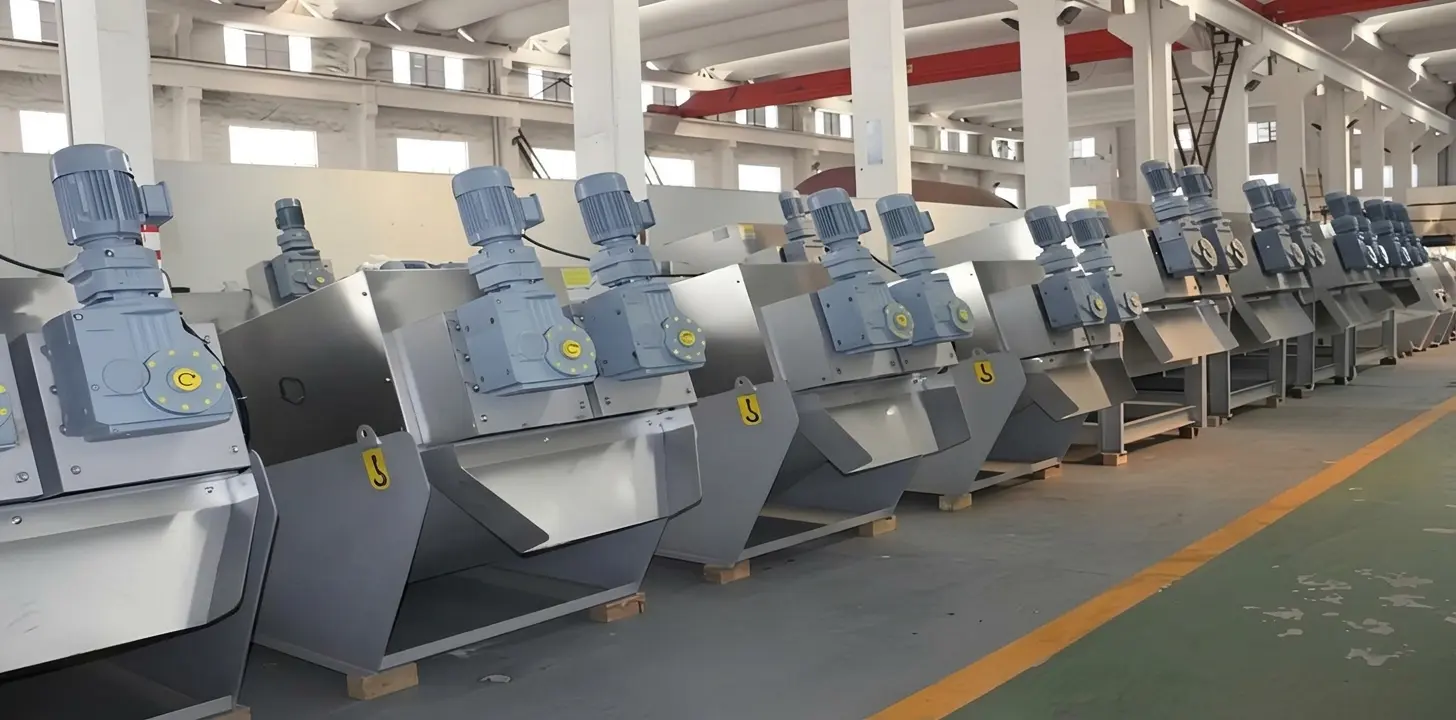
Advanced Manufacturing Technology & Durable 304 Stainless Steel Construction
The sludge dewatering equipment features high-standard manufacturing technology and a one-piece forming process using 304 stainless steel.This construction offers reliable corrosion resistance, high separation efficiency, safe and convenient operation, and low power consumption, supporting stable performance in demanding wastewater treatment applications.
Frequently Asked Questions
What is screw press dewatering?
Screw press dewatering is a mechanical process that separates water from sludge through gravity drainage and progressive compression. It produces a concentrated sludge cake and separated filtrate.
What is the difference between a multi-disc screw press and a conventional screw press?
A multi-disc screw press uses alternating fixed and moving rings around a rotating screw shaft. This structure helps maintain filtration gaps and reduce clogging. Other screw presses may use different screen designs.
Can a screw press handle low-concentration sludge?
Certain multi-disc screw press configurations can treat relatively dilute sludge. Actual suitability depends on feed solids concentration, sludge characteristics and flocculation performance.
How dry can the sludge cake become?
Final cake dryness varies with sludge type, feed solids concentration, polymer conditioning and machine settings. A specific cake solids guarantee should be based on representative testing or verified project data.
Does the machine require polymer dosing?
Polymer conditioning is commonly used to improve sludge flocculation and dewatering performance. The appropriate polymer type and dosage depend on the sludge characteristics.
What information is required for a quotation?
Please provide the sludge source, flow rate, feed solids concentration, operating hours, target cake dryness, electrical supply and installation requirements.
Can the equipment be customized for different projects?
Equipment models and auxiliary configurations can be selected according to project requirements. Available customization should be confirmed during technical review.
Looking for a Screw Press Dewatering Machine for Your Project?
Clear Environment supplies multi-disc screw press dewatering machines for wastewater treatment companies, engineering contractors and equipment distributors.
Share your sludge characteristics and treatment capacity requirements with us. We can help review suitable models, technical specifications and equipment configurations for your project.