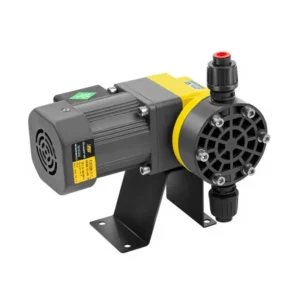
Electromagnetic Diaphragm Dosing Pump for Water Treatment
Electromagnetic diaphragm dosing pumps are used to inject controlled quantities of chemicals into water treatment and industrial process systems. They are commonly installed in reverse osmosis (RO) plants for antiscalant dosing, chemical pretreatment, and other applications requiring adjustable chemical feed rates.
Clear Environment supplies electromagnetic dosing pumps with different flow and pressure configurations to meet project requirements.
How Does an Electromagnetic Dosing Pump Work?
An electromagnetic dosing pump uses a solenoid-driven diaphragm to move liquid through the pump head. During each operating cycle, the diaphragm movement draws chemical solution into the pump chamber and then discharges it through the outlet check valve.
The dosing rate can be adjusted according to the pump’s control method and operating conditions.
Technical Specifications
Parameter Specification Pump Type Electromagnetic diaphragm metering pump Maximum Flow Rate 24 L/h Maximum Discharge Pressure 10 bar Adjustment Range 0–100% Maximum Suction Lift 1.5 m water column Applications RO systems, industrial water treatment, chemical dosing Maximum flow and maximum discharge pressure are series specifications and may not be available simultaneously on the same model.
Applications in Water Treatment Systems
RO Antiscalant Dosing
Electromagnetic dosing pumps are commonly used to inject antiscalant into RO feed water. The required dosing capacity depends on the feed water flow rate, antiscalant concentration, and recommended chemical dosage.
Disinfection Chemical Dosing
Suitable pump configurations can be used for sodium hypochlorite dosing in water treatment systems. Pump head, diaphragm, and seal materials must be compatible with the chemical concentration and operating temperature.
pH Adjustment
Electromagnetic dosing pumps can be used for controlled acid or alkali injection in industrial water treatment and wastewater treatment processes, subject to chemical compatibility.
How to Select an Electromagnetic Dosing Pump
The following operating information is important when selecting a dosing pump:
Required dosing flow: L/h
Discharge pressure: bar
Chemical name and concentration
Liquid temperature and density
Power supply: Voltage and frequency
Control requirements: Manual adjustment or other supported control options
The pump should be selected based on its performance at the required discharge pressure, rather than maximum flow capacity alone.
Dosing Pump Supply and Technical Support
Clear Environment works with water treatment engineering companies, system integrators, and distributors to source electromagnetic dosing pumps for industrial applications.
We can assist with model selection, technical specification confirmation, supplier coordination, and OEM requirements, subject to the available product configurations.
Please share your dosing requirements and operating conditions for pump selection and quotation.
Electromagnetic Dosing Pump Dimensions & Specifications
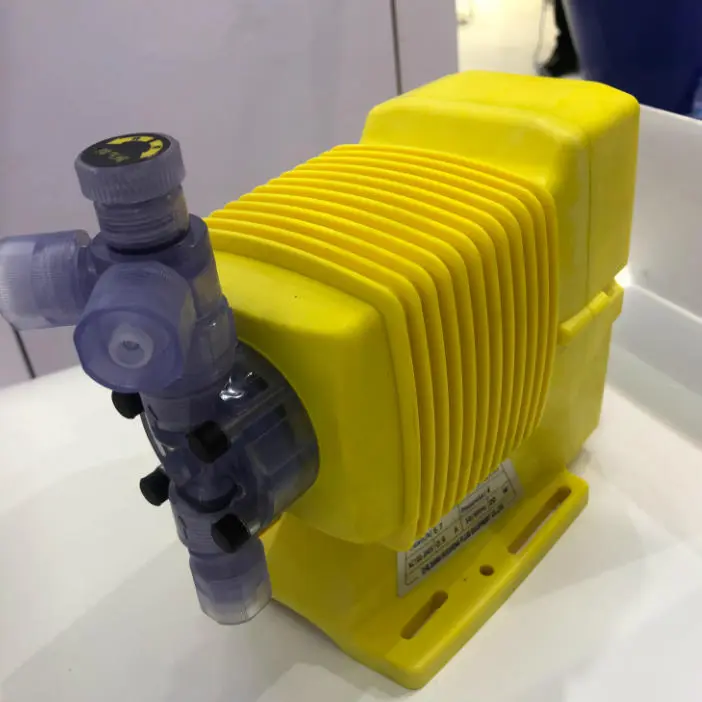
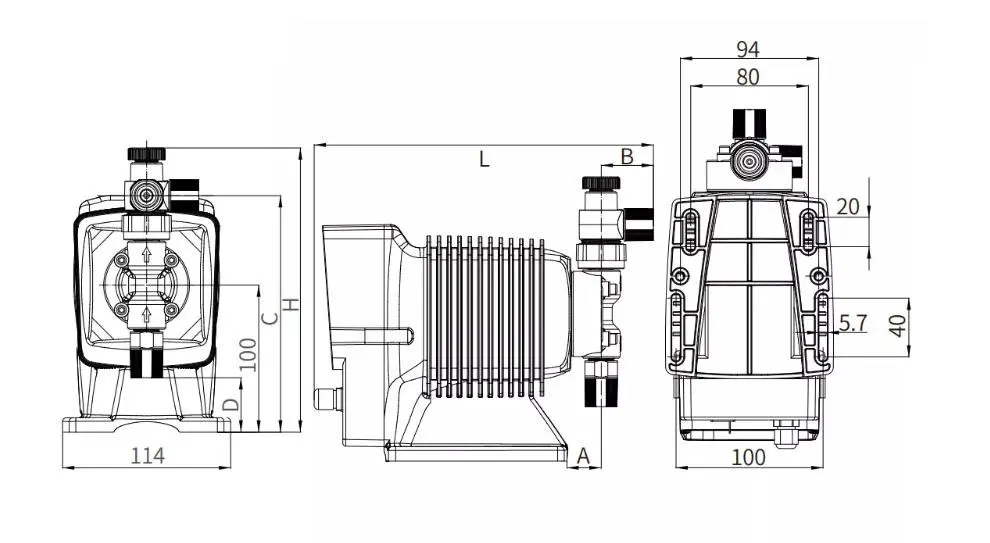
Electromagnetic Dosing Pump Dimensions
The following drawings and dimension table show the overall dimensions and mounting details of different electromagnetic dosing pump models.
Dimensions vary by model. Please confirm the selected model and connection specifications before installation or replacement.
| Model | H (mm) | L (mm) | A(mm) | B(mm) | C(mm) | D(mm) | Connection(mm) |
|---|---|---|---|---|---|---|---|
| 03 | 193 | 230 | 23 | 35 | 160 | 37 | Ø4*6 |
| 04 | |||||||
| 05 | |||||||
| 06 | |||||||
| 07 | Ø4*6 | ||||||
| 08 | |||||||
| 12 | 182 | 214 | 25 | 17 | / | 20 | Ø8*13 |
| 16 | |||||||
| 24 |
Model Selection and Inquiry
For replacement pumps or new dosing applications, please provide the required dosing capacity (L/h), discharge pressure (bar), chemical name and concentration, power supply, and tubing connection size.
If replacing an existing dosing pump, a photo of the original nameplate or model number will help us check the specifications and installation dimensions.
Electromagnetic Dosing Pump Models & Specifications
Dosing Pump Control Options
The electromagnetic dosing pump series includes manual control, digital pulse signal control, and 4–20 mA signal control options.
S series pumps are suitable for applications requiring manual dosing adjustment. P and Z series pumps provide additional signal control options for integration with compatible dosing control systems.
Please confirm the required control signal and liquid level input when selecting a pump model.
Dosing Pump Control Options
| Code | Description |
|---|---|
| S | Manual control series |
| P | Manual/digital pulse signal control series, with liquid level connection |
| Z | Manual/4-20mA signal control series, with liquid level connection |
Flow Rate, Pressure & Electrical Specifications
| Model | Max Flow (L/h) | Max. Pressure (bar) | SPM | Voltage (V) | Frequency (Hz) | Power (W) | Air Vent Valve (PVC head only) |
|---|---|---|---|---|---|---|---|
| S03 P03 Z03 | 2.3 | 10 | 360 | 100-240AC | 50/60 | 20 40 | ✔ ✖ |
| S04 P04 Z04 | 4.4 | 7 | |||||
| S06 P06 Z06 | 6 | 4 | |||||
| S12 P12 Z12 | 12.2 | 2 | |||||
| S05 P05 Z05 | 4.9 | 10 | ✔ ✖ | ||||
| S08 P08 Z08 | 7.8 | 7 | |||||
| S16 P16 Z16 | 16.4 | 4 | |||||
| S24 P24 Z24 | 24.2 | 2 |
Dosing Flow Rate at Different Discharge Pressures
| Code | 0 Bar | 2 Bar | 4 Bar | 6 Bar | 7 Bar | 8 Bar | 10 Bar |
|---|---|---|---|---|---|---|---|
| 03 | 5.4 | 3.4 | 3.2 | 3 | 2.9 | 2.7 | 2.3 |
| 04 | 6.3 | 5.4 | 5 | 4.5 | 4.4 | 3.7 | |
| 06 | 8.4 | 6.6 | 6 | 5.8 | |||
| 12 | 14.5 | 12.2 | |||||
| 05 | 8.7 | 6.6 | 6.3 5.9 | 5.7 5.5 | |||
| 08 | 14.7 | 8.7 | 8.6 | 8.1 | 7.8 | 7.7 | |
| 16 | 23.6 | 18.8 | 16.4 | ||||
| 25 | 27.5 | 24.2 | |||||
Pump Selection Note: Maximum dosing flow and maximum discharge pressure vary by model. For example, the 03 model is rated at 2.3 L/h and 10 bar, while the 24 model is rated at 24.2 L/h and 2 bar. Select the pump according to the required dosing flow at the actual discharge pressure.
Wetted Materials and Chemical Compatibility
Available liquid-end configurations include PVC, PVDF, and SS316, with different valve, O-ring, and diaphragm materials.
Material selection should be based on the chemical name, concentration, operating temperature, and discharge pressure. Chemical compatibility must be verified for all wetted components, including the pump head, valve seats, seals, and diaphragm.
| Code | Liquid End | Valve Ball | Valve Seat | Valve Bod | O Ring | Gasket | Diaphragm |
|---|---|---|---|---|---|---|---|
| P | PVC | Ceramic | FPM | PVC | FPM | PTFE | PTFE+EPDM |
| PVC | Ceramic | EPDM | PVC | EPDM | |||
| T | PVDF | Ceramic | PTFE | PVDF | PTFE | ||
| S | SS316 | SS316 | SS316 | SS316 | PTFE |
Dosing Pump Inlet & Outlet Connections
| Code | Description | Model | PVC | PVDF | SS316 | ||
|---|---|---|---|---|---|---|---|
| Inlet | Outlet | Inlet | Outlet | / | |||
| R | Hose Connection | 03-08 | PVC 4*6mm Hose | PE 4*6mm Hose | PTFE 4*6mm Hose PTFE 8*10mm Hose | ||
| 12-24 | PVC 8*13mm Hose | ||||||
| P | Thread Connection | 03-24 | NPT 1/4”F | ||||
Accessories: PVC and PVDF pump configurations are supplied with an accessory kit, including a foot valve, injection valve, 3 m suction hose, and 3 m discharge hose. Please confirm the included accessories and connection sizes for the selected model.
Electromagnetic Dosing Pump Applications
Electromagnetic diaphragm dosing pumps are commonly used for controlled chemical injection in reverse osmosis (RO) systems, industrial water treatment, and wastewater treatment applications.
Typical applications include:
RO Antiscalant Dosing: Injecting antiscalant into RO feed water to help control membrane scaling.
Water Disinfection: Dosing sodium hypochlorite or other compatible treatment chemicals.
pH Adjustment: Controlled acid or alkali dosing in water and wastewater treatment processes.
Dechlorination: Dosing sodium bisulfite into RO pretreatment systems to remove residual chlorine.
Industrial Chemical Dosing: Chemical injection in cooling water systems, chemical processing, power generation, and other compatible industrial applications.
Pump selection depends on the required dosing flow, discharge pressure, chemical concentration, and wetted-material compatibility.
Electromagnetic Dosing Pump FAQs
Are your electromagnetic dosing pumps manufactured in China?
Yes. The electromagnetic dosing pumps featured on this page are sourced from manufacturers in China. Clear Environment works with water treatment engineering companies, distributors, and system integrators to coordinate product sourcing, technical specifications, and order fulfillment.
What is the difference between an electromagnetic dosing pump and a mechanical diaphragm dosing pump?
An electromagnetic dosing pump uses a solenoid to drive the diaphragm and is commonly selected for relatively low-flow chemical dosing applications. A mechanical diaphragm dosing pump uses a motor-driven mechanism and is often preferred for higher dosing capacities or different operating requirements. The appropriate pump type depends on flow rate, discharge pressure, chemical properties, and control requirements.
Can the 24 L/h electromagnetic dosing pump operate at 10 bar?
No. The maximum flow rate and maximum discharge pressure refer to different models in this series. The 24 model is rated at 24.2 L/h and 2 bar, while the 03 model is rated at 2.3 L/h and 10 bar. Please refer to the flow and pressure tables to select a pump that meets your required operating conditions.
What control options are available for these electromagnetic dosing pumps?
- The S series provides manual dosing adjustment. The P series supports manual adjustment and digital pulse signal control, while the Z series supports manual adjustment and 4–20 mA signal control. P and Z series pumps also provide a liquid level input. Please specify your control requirements when requesting a quotation.
Which pump head material should I choose for chemical dosing?
Available liquid-end materials include PVC, PVDF, and SS316, with different valve and sealing material options. Selection depends on the chemical name, concentration, temperature, and operating conditions. For example, an RO antiscalant application and a sodium hypochlorite dosing application may require different material configurations. Chemical compatibility should be verified before ordering.
Can you supply OEM dosing pumps and related water treatment components?
Clear Environment can assist with OEM requirements and sourcing related water treatment components, subject to supplier capabilities and order quantities. We can also coordinate technical specification confirmation and multi-product procurement for water treatment projects. Please share your required models, quantities, and customization details for evaluation.