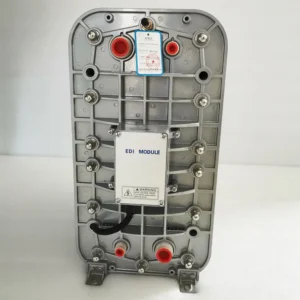
The mini EDI module is designed for continuous removal of dissolved ions from reverse osmosis (RO) permeate in laboratory water purification equipment and compact high-purity water systems. It combines ion exchange resins, ion-selective membranes, and a DC electric field to produce deionized water without routine chemical regeneration.
With available capacities ranging from 50 to 300 LPH, these compact electrodeionization modules are suitable for laboratory water purification systems, analytical instrument water supplies, and other low-flow applications requiring high-purity water.
In laboratory ultrapure water systems, the EDI module typically operates downstream of RO pretreatment. Additional polishing and purification stages may be required to achieve a final water resistivity approaching 18.2 MΩ·cm at 25°C, depending on the application and water quality requirements.
Actual EDI module performance depends on feedwater conductivity, hardness, dissolved CO₂, silica, operating temperature, and electrical conditions.
Clear Environment supports customers with mini EDI module selection for new RO + EDI installations and replacement projects. Please provide your required flow capacity, RO permeate quality, and existing module specifications when requesting a quotation.
Explore more options: EDI Modules & Replacement
Mini EDI Module Dimensions & Connection Details
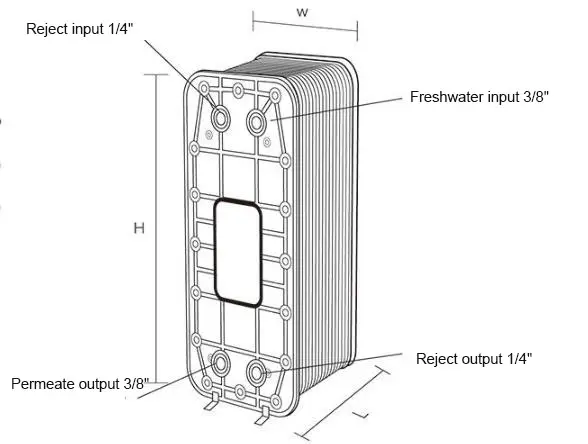
The mini EDI module features separate feedwater, product water, and concentrate connections. Please verify the selected model’s dimensions, port sizes, and connection positions before installation or replacement.
Mini EDI Module Models & Technical Specifications
| Model | Dimension | Fixed hole length Center pillar | Fixed hole width Center pillar | Base hole diameter | Operation Pressure (Bar) | Standard Produced water flow L/H | Lowest(Highest) Produced water flow L/H | Recovery rate % | Reject Flow (L/H) | Produced water resistivity (MΩ·cm) | Power Parameters | |||||||
|---|---|---|---|---|---|---|---|---|---|---|---|---|---|---|---|---|---|---|
| L(mm) | W(mm) | H(mm) | (mm) | (mm) | (mm) | Freshwater input | Freshwater output | Reject input | Reject output | Current range(A) | Suggested value | Voltage range | ||||||
| E-50 | 160 | 160 | 390 | 85 | 75 | 6 | 1.2-2.0 | 0.8-1.6 | 0.8-1.6 | 0-0.5 | 50 | 30-60 | 60-80 | 40-50 | ≥15 | 0.3-2.0 | 0.3 | 0-50 |
| E-100 | 175 | 160 | 390 | 95 | 75 | 6 | 1.2-2.0 | 0.8-1.6 | 0.8-1.6 | 0-0.5 | 100 | 60-110 | 60-80 | 40-50 | ≥15 | 0.3-2.0 | 0.3 | 0-50 |
| E-150 | 200 | 160 | 390 | 120 | 75 | 6 | 1.2-2.0 | 0.8-1.6 | 0.8-1.6 | 0-0.5 | 150 | 90-160 | 60-80 | 40-50 | ≥15 | 0.3-2.0 | 0.3 | 0-100 |
| E-200 | 215 | 160 | 390 | 120 | 75 | 6 | 1.2-2.0 | 1.0-1.6 | 1.0-1.6 | 0-0.5 | 200 | 120-210 | 60-80 | 40-80 | ≥15 | 0.3-2.0 | 0.4 | 0-100 |
| E-250 | 230 | 160 | 390 | 145 | 75 | 6 | 1.2-2.0 | 1.0-1.6 | 1.0-1.6 | 0-0.5 | 250 | 150-280 | 60-80 | 40-80 | ≥15 | 0.3-2.0 | 0.4 | 0-120 |
| E-300 | 250 | 160 | 390 | 175 | 75 | 6 | 1.2-2.0 | 1.0-1.6 | 1.0-1.6 | 0-0.5 | 300 | 180-350 | 60-80 | 80-120 | ≥15 | 0.3-2.0 | 0.4 | 0-120 |
Technical Notes
The dimensions and operating pressures listed above are provided for model selection and reference. Actual operating conditions may vary depending on feedwater quality, temperature, and electrical settings. Please confirm the final dimensions and technical specifications before ordering.
Operating Precautions
Establish the required feedwater and concentrate flow before switching on the DC power supply.
Do not energize the mini EDI module without adequate water flow.
Provide appropriate pressure and flow protection for the concentrate circuit.
Follow the selected module’s operating pressure limits and startup instructions.
Pressure Setting Principle
For the E-series mini EDI modules listed above, the specified pressure relationship is:
Dilute Feed Inlet > Product Water Outlet > Concentrate Inlet > Concentrate Outlet
Actual pressure settings should be verified against the manufacturer’s technical documentation.
Mini EDI Module Applications in Laboratory Water Treatment
1. Laboratory & Analytical Water Purification
Mini EDI modules are used in compact RO + EDI systems for laboratory water purification and analytical instrument water supplies. They provide continuous removal of dissolved ions from RO permeate, helping reduce conductivity before any additional polishing stages required by the application.
2. Pharmaceutical Research & Laboratory Water Systems
In pharmaceutical research laboratories and small-scale development facilities, mini EDI modules can be integrated into water purification systems requiring low-conductivity water. Additional treatment and monitoring may be necessary to meet specific pharmaceutical water quality requirements.
3. Electronics Research & Precision Manufacturing
Mini EDI modules can support high-purity water production for electronics research, component testing, and small-scale precision manufacturing. Their compact design makes them suitable for low-flow applications where continuous deionization is required. Final water quality depends on the complete purification system and its operating conditions.
Mini EDI Module – Frequently Asked Questions
1. What mini EDI module capacities are available?
Clear Environment supplies mini EDI modules with rated capacities of 50, 100, 150, 200, 250, and 300 LPH.
These modules are suitable for laboratory water purification equipment, compact RO + EDI systems, and other low-flow applications. Model selection depends on the required product water flow, RO permeate quality, and operating conditions.
2. Can you supply a mini EDI module with a testing setup?
A mini EDI module requires suitable RO-treated feedwater, a DC power supply, flow control, and appropriate piping connections for testing.
If you need a testing setup rather than a standalone module, please share your required flow capacity, available feedwater quality, and testing objectives. We can check the available options with our suppliers.
3. Can I purchase the mini EDI module with or without a DC power supply?
The DC power supply requirements depend on the selected mini EDI module model. Before ordering, please confirm the required operating voltage, current, and electrical connections.
If you already have a compatible power supply, please provide its specifications for review. We can also check whether a suitable DC power supply can be sourced together with the EDI module.