

As industry standards continue to rise, analytical instruments are becoming increasingly sensitive and capable of detecting substances at much lower limits. At the same time, laboratories now require much higher water quality standards. Conventional bottled water and standard purified water can no longer meet the demands of modern analytical testing. As a result, more laboratories are turning to a lab ultrapure water system for reliable high-purity water production.
However, with so many brands and different system configurations available on the market, selecting the right ultrapure water equipment has become a challenge for many users.
So, how can you choose a lab ultrapure water system that truly fits your laboratory requirements?
Today, let’s discuss the key factors to consider when selecting an ultrapure water system for laboratory applications.
Understand the Laboratory Water Supply Conditions
In most laboratories, there are generally two possible feed water sources:
- Tap water
- Purified water
If only tap water is available, you should select a lab ultrapure water system designed to use municipal tap water as the feed source.
At the same time, if the tap water quality is poor — for example, containing high turbidity, sediment, or excessive hardness — this information should be provided to the water system manufacturer in advance. Additional pretreatment filtration may be required; otherwise, the water quality and consumable lifespan of the ultrapure water system may be significantly affected.
If purified water is already available onsite, users may choose an ultrapure water system that uses purified water as the feed source. In this case, users should provide details about: - Existing purified water quality
- Whether the water supply is pressurized
Generally speaking, the feed purified water should at least meet the requirements of Type III laboratory water.
Clarify Laboratory Water Quality Requirements
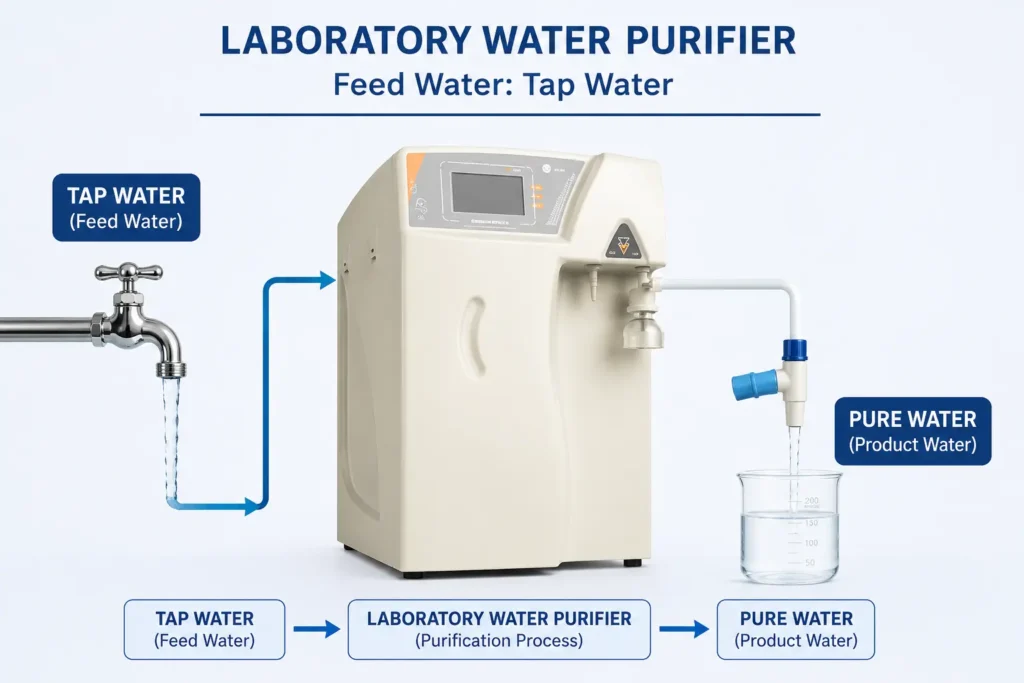
After determining the feed water conditions, the next step is understanding the actual laboratory water quality requirements.
Selection Based on Water Quality Grade
Laboratory water is typically classified into:
- Type I water
- Type II water
- Type III water
Most laboratories only require two grades of water:
- Type III water for glassware washing and general cleaning
- Type I ultrapure water for chemical analysis and precision instruments such as HPLC and atomic absorption spectroscopy
| Standard System | Water Grade | Electrical Resistivity (25°C) | TOC (Total Organic Carbon) | Microorganisms | Particles | Endotoxins | Typical Applications |
|---|---|---|---|---|---|---|---|
| ASTM D1193 | Type I (Ultrapure) | 18.2 MΩ·cm | ≤ 50 ppb | ≤ 10 CFU/mL | Submicron filtration required | ≤ 0.03 EU/mL | HPLC, LC-MS, ICP-MS, molecular biology, trace analysis |
| ASTM D1193 | Type II (Pure Water) | ≥ 1.0 MΩ·cm | ≤ 50–200 ppb | ≤ 100 CFU/mL | Fine filtration | Not strictly defined | Buffer preparation, general analytical chemistry |
| ASTM D1193 | Type III (RO Water) | ≥ 0.05 MΩ·cm (≥ 1 MΩ·cm typical modern systems) | Not strictly controlled | Not strictly controlled | Pre-filtered | Not defined | Feed water for Type I/II systems, glassware rinsing |
Users should select the appropriate lab ultrapure water system according to their required water quality grade.
If users are unsure about their actual water quality requirements, they may refer to the following application-based guidelines.
Selection Based on Experimental Applications
Laboratory applications can generally be divided into three categories:
- General physical and chemical experiments
- Inorganic trace analysis
- Organic analytical experiments
For ordinary physical and chemical experiments, Type II water with resistivity above 1 MΩ·cm is usually sufficient.
For inorganic trace analysis applications, ultrapure water with resistivity above 18 MΩ·cm is typically required. Common applications include: - IC
- AAS
- ICP
- ICP-MS
Organic analytical experiments usually require the removal of organic contaminants in addition to high resistivity. Therefore, besides resistivity above 18 MΩ·cm, total organic carbon (TOC) control is also essential.
Typical applications include: - Chromatography
- Mass
- spectrometry
- Spectrophotometry
- Reagent preparation
- Trace element analysis
For biological applications such as: - Protein purification
- Sterile pharmaceutical preparation
- Medical device rinsing
- Cell culture
- IVF
- General biochemical analysis
- NGS sequencing
- PCR
Users must also pay close attention to microbial and endotoxin control.
Selection Based on Instrument Type
Users can also select a lab ultrapure water system according to the instruments used in the laboratory.
Instrument Water Quality Requirements
| Instrument/Application | Water Quality Requirement |
|---|---|
| HPLC / LC-MS / IC / GC-MS | Resistivity >18 MΩ·cm and low organic content |
| Atomic absorption / atomic fluorescence / environmental monitoring | Resistivity >18 MΩ·cm |
| PCR and life science applications | Resistivity >18 MΩ·cm plus removal of microorganisms, organics, and endotoxins |
In China, besides the semiconductor industry standard GB/T 11446-2013 for electronic-grade water, the standard GB/T 33087-2016 Specifications and Test Methods for High Purity Water for Instrumental Analysis represents one of the highest water quality standards for analytical laboratories.
In other words, if the water quality produced by a lab ultrapure water system complies with GB/T 33087-2016, it can satisfy the water supply requirements of most analytical instruments.
The above recommendations are based on practical application experience and can serve as useful references. However, for accurate system selection, users should still provide detailed water quality requirements whenever possible, including:
- Resistivity
- Trace element limits
- Bacterial levels
- TOC requirements
It is also important to note that some systems marketed as “ultrapure water systems” may only meet Type I water standards but cannot actually achieve 18.2 MΩ·cm ultrapure water quality. Therefore, users should carefully review technical specifications and request water quality validation reports when necessary.
Determine Daily Water Consumption
Once the required water quality and application are confirmed, the next step is selecting the appropriate system capacity according to daily laboratory water consumption.
A common guideline is the “2× principle.”
For example:
- If daily water consumption is 40 L/day
- A system with a production capacity of 20 L/h is usually recommended
Choosing a system that is too small may result in: - Rapid consumable depletion
- Insufficient water supply
Choosing a system that is too large may cause unnecessary resource waste.
If the laboratory has large peak water demands, a larger purified water storage tank may also be necessary to prevent supply shortages during intensive experimental periods.
In colder regions, users should also consider seasonal temperature effects. Since water viscosity increases as temperature decreases, the permeate flow of RO membranes will decline during winter.
As a result, the water production rate of a lab ultrapure water system in winter is usually lower than in summer. Therefore, when selecting systems equipped with RO membranes, users should confirm whether the manufacturer has temperature compensation or low-temperature optimization functions.
Confirm Consumable Lifespan and Replacement Cost
For many years, frequent consumable replacement has remained one of the largest operating costs of laboratory water systems.
Most manufacturers specify:
- Maximum treated water volume
- Recommended replacement intervals
Users can estimate the long-term operating cost of a lab ultrapure water system based on these parameters.
After years of development, Chinese-made ultrapure water consumables now offer performance close to imported products while maintaining significantly lower prices. Therefore, choosing a domestic ultrapure water system may provide better overall cost performance.
Consider Ease of Operation and Maintenance
- Ease of operation is one of the most important indicators of a high-quality laboratory instrument.
In many cases, users prefer systems with: - Simple interfaces
- Clear operation logic
- Minimal parameter settings
- Easy water dispensing
For a lab ultrapure water system, the ideal user experience is one where operators simply press the dispensing button without needing complicated additional operations.
At the same time, consumable replacement and routine maintenance have a major impact on user satisfaction. Systems that support: - Automatic maintenance functions
- Easy self-replacement of consumables
can greatly improve the overall laboratory experience.
In addition, selecting a laboratory ultrapure water system is not only about producing qualified ultrapure water. Users also expect: - Stable operation
- Reliable performance
- Comprehensive monitoring functions
- Intelligent control systems
- Better long-term durability
A truly suitable lab ultrapure water system should combine water quality, operational reliability, and user-friendly design to fully support modern laboratory applications.