
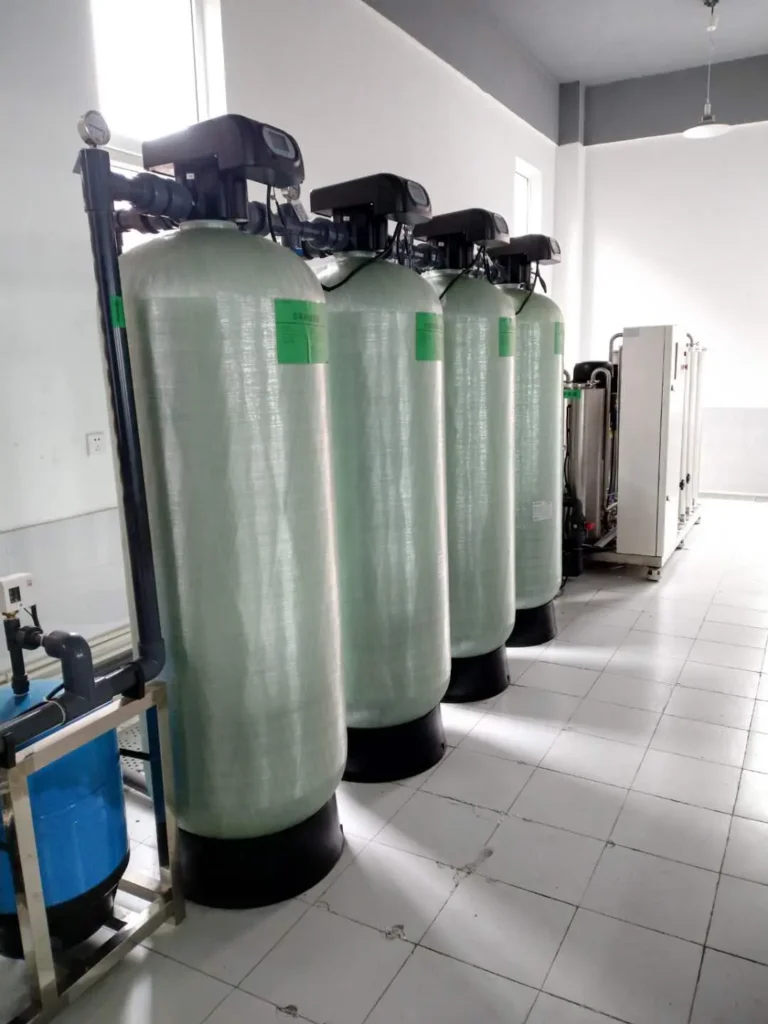
Water treatment is one of the most fundamental and critical components of hemodialysis treatment. Although the brands, configurations, treated water quality, and production capacities of water treatment systems may vary between dialysis centers, the basic structure of the system is generally similar.
Each component performs a specific function, and together they produce the purified water required for hemodialysis.
For many people, a complete dialysis water treatment system can look complicated, with several different tanks and components whose functions are not immediately obvious. In this article, we will explain the basic structure of the system and take a closer look at the pretreatment section of an RO plant for dialysis.
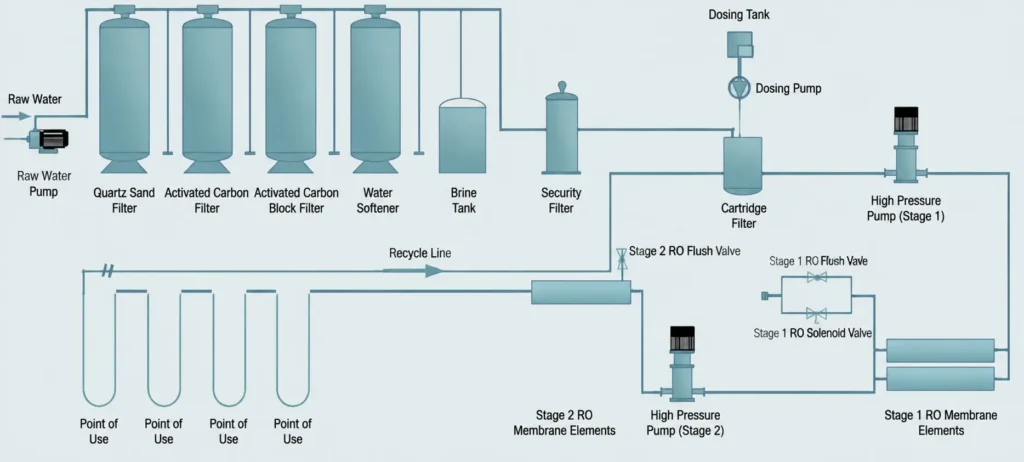
A typical RO plant for dialysis consists of three main sections:
Pretreatment system
Reverse osmosis unit
Purified water distribution loop
The pretreatment section of a hemodialysis water treatment system typically includes an automatic multimedia filter, water softener, and activated carbon filter.
What Is the Purpose of Pretreatment?
Pretreatment removes larger particles, iron, chlorine, and some organic contaminants from the feed water, reduces water hardness, and provides suitable feed water conditions for the reverse osmosis membrane.
Proper pretreatment is essential for meeting the feed water requirements of the RO membrane. It helps ensure stable RO performance, including permeate flow, salt rejection, and recovery, while also extending the service life of the RO membranes.
In practical terms, pretreatment is designed to:
Prevent Fouling of the RO Membrane
Pretreatment helps prevent microorganisms, colloids, suspended solids, and other contaminants from accumulating on the membrane surface or blocking the flow channels of the membrane elements.
Prevent Scaling on the RO Membrane
During RO operation, water is concentrated as it passes through the membrane. Poorly soluble salts such as CaCO₃, CaSO₄, and MgCO₃ may precipitate on the membrane surface and form scale.
Pretreatment helps reduce the risk of scaling and protects the RO membrane from performance loss.
Protect the RO Membrane from Mechanical and Chemical Damage
Removing coarse particles and other contaminants from the feed water helps prevent physical damage and excessive fouling of the RO membrane, allowing the membrane to maintain stable performance and achieve a longer operating life.
Understanding the Pretreatment Tanks
Multimedia Filter – The Sand Filter
Principle
A multimedia filter, commonly referred to as a sand filter, is mainly used to remove suspended solids and colloidal particles from the feed water.
This is primarily a physical filtration process. As water flows through the filter media bed, suspended particles and colloids are retained by the media through mechanisms such as interception, attachment, and filtration.
The filtration performance depends on factors including the size, surface characteristics, and shape of the contaminants and filter media.
Filter Media
Quartz sand is one of the most commonly used filter media.
A typical effective particle size is approximately 0.5–1.2 mm, while the minimum design depth of the filter media bed is generally around 0.8 m.
The design filtration velocity is typically kept below approximately 10–20 m/h, depending on the feed water quality and system design.
Backwashing
As water passes through the filter bed, suspended solids gradually accumulate within the media. This causes the pressure drop across the filter to increase and eventually reduces its ability to remove suspended solids effectively.
When the differential pressure reaches a certain level, typically around 30–60 kPa, or when the filtered water quality deteriorates, the filter should be backwashed.
Backwashing uses a reverse flow of water to remove the contaminants trapped in the filter media.
The period between two backwash cycles is referred to as the filter operating cycle.
The appropriate backwash frequency should be determined according to the raw water quality, required RO feed water quality, and water production capacity. In general applications, the filter may be backwashed once or twice per week, although the actual frequency should be determined according to operating conditions.
Equipment Configuration
A filtration unit used in hospital hemodialysis water treatment systems generally consists of:
A cylindrical pressure vessel
Granular filter media
Inlet and outlet connections
Automatic backwash controller
Water collection/distribution components
The automatic controller can be programmed to perform backwashing at predetermined times.
For example, the system may be programmed to backwash every Monday and Thursday. The controller will automatically start the backwash cycle at the preset time.
Backwashing is often scheduled during periods of low water demand, such as after midnight, although manual backwashing can also be initiated when required.
The filter media is normally filled to approximately two-thirds of the vessel volume, leaving sufficient freeboard for proper backwashing and media expansion.
Note on Cartridge Filtration
Cartridge filters can also be used to remove suspended particles from water. They are more suitable for water with relatively low levels of suspended solids.
During operation, the pressure differential across the cartridge filter should normally be kept below approximately 40 kPa. Cartridges are generally replaced periodically, often around once a month, depending on feed water quality and operating conditions.
Cartridge filters can provide effective removal of mechanical particles, turbidity, and certain particulate forms of iron.
Routine maintenance of the multimedia filter and cartridge filter mainly involves checking the operation of the automatic controller and monitoring the inlet and outlet pressures.
Water Softener – The Resin Tank
Principle
Water hardness is mainly caused by dissolved calcium and magnesium ions, although other ions such as iron, manganese, and strontium can also contribute.
Calcium and magnesium can react with certain anions to form poorly soluble compounds. In an RO system, these compounds may precipitate on the membrane surface and cause scaling, resulting in reduced permeate production and membrane performance.
The process of removing calcium and magnesium ions from water through ion exchange is known as water softening.
Ion exchange uses a material called an ion exchange resin. The resin exchanges ions contained within its structure with ions of the same electrical charge present in the water.
Sodium-Ion Softening
There are several methods of water softening. Sodium-ion softening is one of the most common methods used as RO pretreatment.
It uses a cation exchange resin in the sodium form.
When hard water passes through the softener, calcium and magnesium ions in the water are exchanged for sodium ions held by the resin.
As a result, most of the calcium and magnesium ions are removed, significantly reducing the residual hardness of the treated water.
This helps reduce the risk of scale formation on the downstream RO membrane.
Resin Regeneration
After operating for a certain period, the sodium-form cation exchange resin becomes progressively exhausted.
As the resin approaches exhaustion, hardness leakage into the treated water gradually increases. Once the resin reaches its exchange capacity, it must be regenerated to restore its ion exchange capability.
A concentrated sodium chloride (NaCl) brine solution is commonly used for regeneration.
During regeneration, sodium ions from the brine replace the calcium and magnesium ions accumulated on the resin, restoring the resin to its sodium form.
How Is the Regeneration Cycle Determined?
The softener’s performance depends mainly on:
Feed water hardness
Feed water flow rate
Volume of sodium-form cation exchange resin
Resin exchange capacity
Regeneration frequency
Under normal operating conditions, feed water hardness and resin characteristics remain relatively stable. Therefore, the regeneration cycle can often be estimated based on the volume of water treated.
In actual dialysis applications, however, the regeneration cycle should be verified by measuring the hardness of the softener outlet water.
For dialysis water treatment systems, hardness testing is commonly performed after the day’s dialysis treatment and after the dialysis machines have completed their cleaning and disinfection procedures.
Activated Carbon Filter
Municipal water supplies commonly use chlorine or other disinfectants to control microbial contamination.
Residual chlorine can damage RO membranes and, if not adequately removed, may pass through the RO system and potentially affect the quality of water used for dialysis.
Therefore, activated carbon filtration is an important part of the pretreatment section of an RO plant for dialysis.
Activated carbon is mainly used to remove:
Free chlorine
Some organic compounds
Odor and taste compounds
Color-causing substances
For medical water treatment applications, high-quality activated carbon is normally selected to provide good mechanical strength, rapid adsorption kinetics, and sufficient adsorption capacity.
Principle of Chlorine Removal
Chlorine removal by activated carbon is not simply a conventional adsorption process.
Activated carbon promotes catalytic reactions on its surface, allowing chlorine compounds to be rapidly reduced as water passes through the carbon bed.
For dechlorination applications, activated carbon does not behave in exactly the same way as it does when removing organic contaminants by adsorption. Its catalytic activity is gradually reduced over time, and the carbon may eventually need to be replaced.
For this reason, an activated carbon filter can often operate for a relatively long period when its primary purpose is chlorine removal, provided that the operating conditions are properly controlled.
Chlorine Removal and Contact Time
The effectiveness of activated carbon dechlorination is strongly related to the contact time between the water and the carbon media.
When the carbon volume is fixed, excessive flow velocity can reduce contact time and result in inadequate chlorine removal.
Therefore, the actual water flow rate should not exceed the design capacity of the activated carbon filter.
Regular backwashing can also help maintain proper hydraulic conditions and contact between the water and carbon media.
A simple way to monitor activated carbon performance is to measure the total chlorine concentration downstream of the carbon filter.
For dialysis water treatment systems, chlorine testing should be performed routinely under normal operating conditions. If continuous chlorine breakthrough is detected, possible corrective actions include:
Reducing the water flow rate
Increasing the backwash frequency
Increasing the activated carbon volume
Replacing the activated carbon when necessary
Other Functions of Activated Carbon
Activated carbon can also remove odors, color, and various organic compounds from water.
When activated carbon is used for these adsorption functions, its adsorption capacity gradually decreases over time. Depending on the application and operating conditions, the carbon may need to be backwashed, chemically treated, or replaced.
The porous structure of activated carbon, combined with accumulated organic matter, can also provide favorable conditions for bacterial growth.
Therefore, regular backwashing, proper maintenance, and appropriate disinfection or carbon replacement are important parts of maintaining an activated carbon filter in a dialysis water treatment system.
Conclusion
The pretreatment section is the first line of protection for an RO plant for dialysis.
The multimedia filter removes suspended solids and colloidal particles, the water softener reduces hardness and helps prevent scaling, while the activated carbon filter removes residual chlorine and selected organic contaminants.
These pretreatment stages work together to provide suitable feed water for the RO membrane and help maintain stable RO performance.
For a dialysis water treatment system, pretreatment should not be regarded simply as a collection of tanks installed before the RO unit. The correct selection, sizing, monitoring, and maintenance of each pretreatment stage are essential for the long-term reliability of the entire dialysis water treatment system.
Related Articles
- Characteristics of Reverse Osmosis Membrane Fouling and Reverse Osmosis Membrane Cleaning Methods
- RO Plant in Dialysis: A Detailed Guide to the Reverse Osmosis System
- How to Design a Dialysis Water Distribution Loop When a 40-machine Center Opens with Only 10 Machines
- Vertical vs Horizontal RO Membranes: Does Installation Orientation Matter?
- Optimizing Circulating Cooling Water Systems Using Reverse Osmosis Membrane Filtration Permeate
- Control and Prevention of Silica Fouling on RO Membranes
- RO Membrane Antiscalant Dosing: From Calculation Principles to Practical Application
- RO System Design: Series Staging or Concentrate Recirculation for Small RO Systems?
- Winter Maintenance Tips for Water Vending Machines
- Small Reverse Osmosis Plant Process Details (0.5m3/Hour)
- Besides reverse osmosis membrane flux, what other key design parameters are easily overlooked but can significantly impact membrane life?
- NF Membrane VS RO Membrane VS Forward Osmosis Membrane
- How to Calculate Recovery Rate RO System?
- Relationship Between RO Membrane Element Pressure Limits and Recovery Rate in Water Reuse and Zero Liquid Discharge Applications
- How to Choose RO Membranes from China: 3 Key Factors to Consider