
Abstract
This article discusses the advantages of reusing reverse osmosis (RO) permeate in circulating cooling water systems and summarizes practical optimization measures. When RO permeate produced through reverse osmosis membrane filtration is used as makeup water, key parameters such as pH, cycles of concentration, hardness, and alkalinity should be carefully managed to ensure stable and reliable system operation.
Introduction
China is a country with relatively limited freshwater resources, making water conservation and reuse increasingly important. Today, reverse osmosis permeate is widely reused in circulating cooling water systems across industries such as chemical processing, power generation, and steel manufacturing. These sectors consume large volumes of water and require consistent water quality. Reusing RO permeate helps meet these demands while improving water-use efficiency and reducing environmental impact.
The reverse osmosis membrane filtration process utilizes the selective permeability of semi-permeable membranes. Under pressure, water molecules pass through the membrane while dissolved salts, suspended solids, and other impurities are rejected, producing high-quality permeate. Because RO permeate contains very low concentrations of contaminants and dissolved salts, it generally meets the water quality requirements for circulating cooling water makeup.
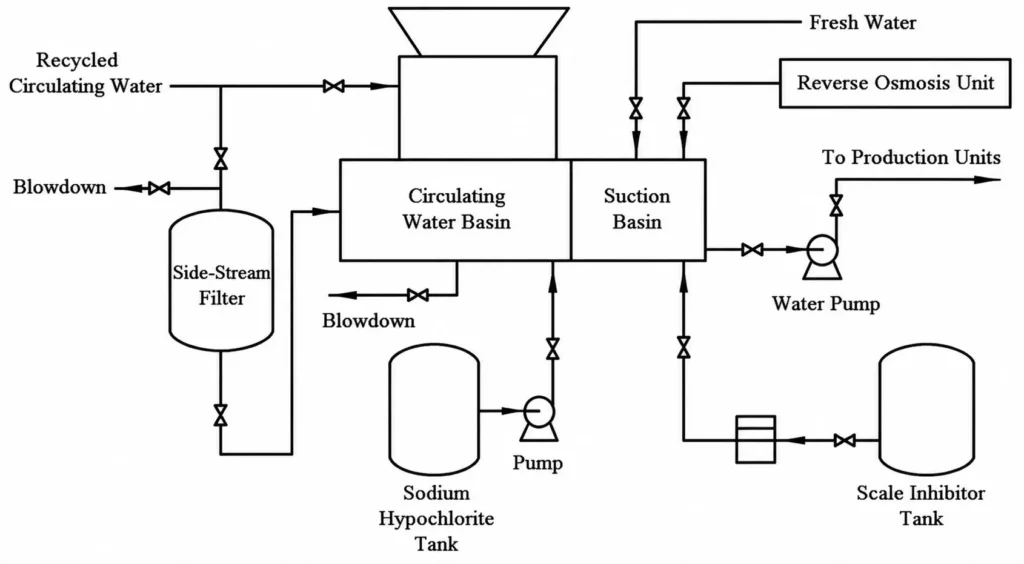
In a typical application, RO permeate is pumped into the cooling water system as partial makeup water and mixes with the recirculating water before being reused throughout the system.
A case study project included two open-loop circulating cooling water systems.
The first cooling water system was designed with a circulation capacity of 60,500 m³/h and consisted of hydrogen-ammonia and air separation water supply sections. Actual average operating flows were 39,592 m³/h and 19,321 m³/h, respectively. Freshwater makeup rates were 351 m³/h and 163 m³/h, while blowdown was maintained at 176 m³/h, corresponding to a blowdown rate of 0.30%.
The second cooling water system was designed with a circulation capacity of 121,000 m³/h and was divided into two operating trains. Actual average operating flows were 48,834 m³/h and 51,076 m³/h. Freshwater makeup rates were 265 m³/h and 390 m³/h, while 450 m³/h of RO permeate was reused as makeup water. Blowdown was reduced to only 94 m³/h, resulting in a blowdown rate of 0.09%.
The first cooling water system used only industrial freshwater as makeup water. The second system utilized reclaimed water from a wastewater treatment plant, where treated water was further purified through reverse osmosis membrane filtration and then reused as cooling water makeup.
Advantages of Reusing Reverse Osmosis Membrane Permeate
Conserving Water Resources
The standardized makeup water rates for Train 1 and Train 2 of the second cooling water system were 0.968% and 0.979%, respectively. During the same period, the first cooling water system required a standardized makeup rate of 1.585%.
These figures clearly demonstrate that reusing RO permeate significantly reduces freshwater consumption. This benefit is especially valuable in regions facing water shortages.
Lower Operating Costs
Compared with using freshwater as makeup water, reusing RO permeate can significantly reduce water purchase costs.
Because permeate generated through reverse osmosis membrane filtration is a high-quality water source, it also provides several operational benefits:
- Reduced blowdown requirements
- Lower wastewater discharge volumes
- Fewer side-stream filter backwash cycles
- Extended filter operating periods
- Reduced chemical consumption
In actual operation, the blowdown rate of the first cooling water system was approximately 3.33 times higher than that of the second system.
Once the baseline treatment program is established, reduced blowdown directly lowers the consumption of corrosion inhibitors, scale inhibitors, and other water treatment chemicals, generating additional cost savings.
In practice, however, factors such as seasonal temperature changes, chemical purity, variations in cooling water quality, and chemical degradation rates should be considered when adjusting makeup water rates and chemical dosing programs.
Improved System Stability
RO permeate provides stable and consistent water quality. However, its chemistry differs significantly from conventional cooling water makeup sources.
To maintain system performance, parameters such as pH, hardness, and alkalinity must be carefully adjusted. Appropriate dosing of corrosion inhibitors and scale inhibitors can effectively reduce:
- Scale formation
- Corrosion
- Microbiological growth
As a result, system efficiency improves, equipment life is extended, and operational reliability increases.
Water Quality Characteristics and Optimization Strategies
When RO permeate is reused in circulating cooling water systems, its unique water chemistry requires operational adjustments to achieve optimal treatment performance.
Impact on pH and Recommended Solutions
Conventional makeup water sources for cooling systems include freshwater, reclaimed water, recycled water, and desalinated seawater.
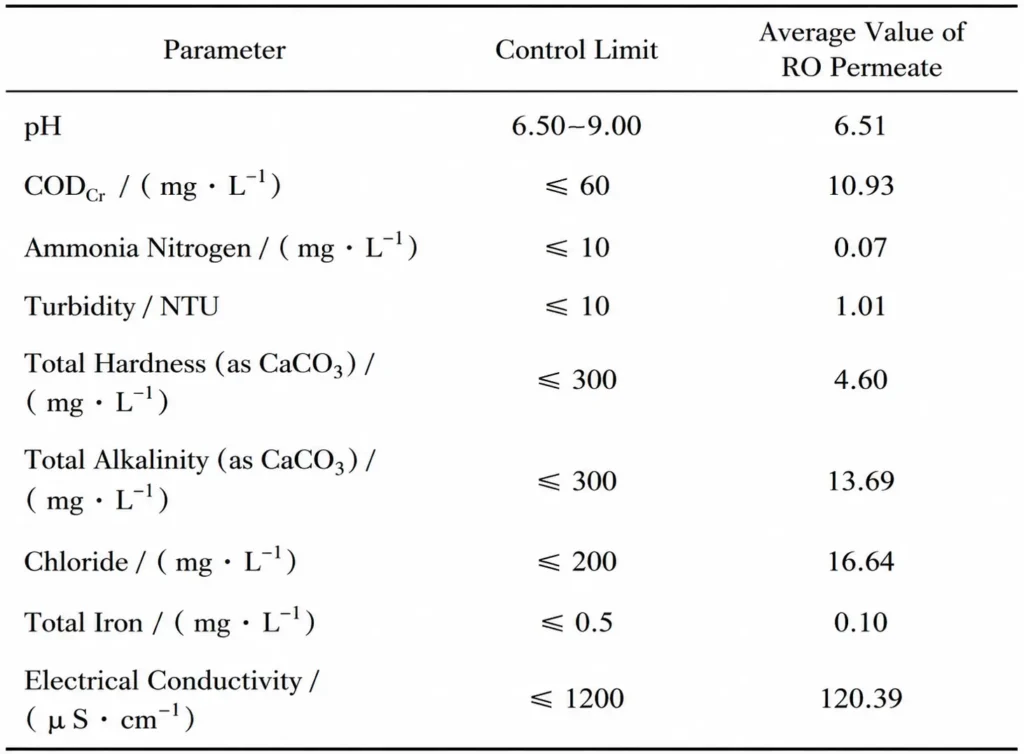
Table 1 Make-up Water Quality Control Indexes and RO Product Water Quality
Water quality analysis shows that RO permeate generally exhibits a relatively low pH, often approaching the lower control limit. In other words, permeate produced by reverse osmosis membrane filtration is typically slightly acidic.
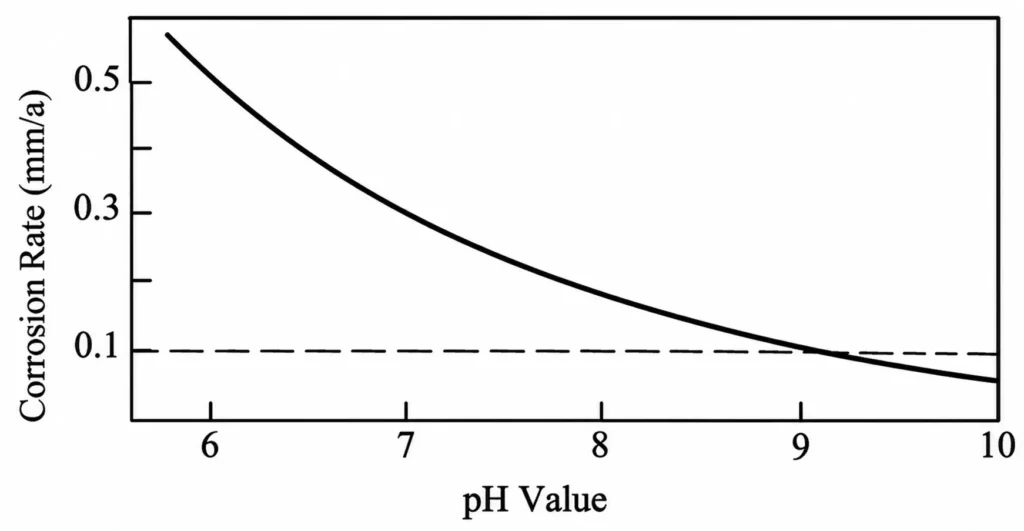
Effect of Circulating Water pH on Corrosion Rate of Carbon Steel
When introduced into a cooling water system, this lower pH may increase water corrosivity.
At higher pH levels, the concentration of hydrogen ions (H⁺) decreases, suppressing cathodic depolarization reactions and promoting the formation of protective oxide films on carbon steel surfaces. Consequently, lower pH values may accelerate corrosion of metal equipment such as:
- Heat exchangers
- Pipelines
- Cooling system components
Studies show that carbon steel corrosion rates generally decrease as pH increases. Maintaining cooling water pH within the range of 8.0–9.5 is beneficial for corrosion control.
However, excessively high pH values can increase scaling tendencies and lead to heat exchanger fouling.
In open recirculating cooling systems, water in the cooling tower is continuously exposed to air. Dissolved oxygen approaches saturation levels, and carbon dioxide gradually strips from the water during aeration. This natural degassing process raises the water’s pH.
At the same time, bicarbonates and carbonates present in the makeup water become concentrated as evaporation occurs, further increasing pH.
For this reason, most open cooling systems operate under a natural pH balance strategy. Rather than adding acid for routine pH control, operators allow cooling tower aeration to establish a natural equilibrium pH, typically between 8.0 and 9.5.
Operational data showed the following equilibrium pH ranges:
Makeup Water Source | Natural Equilibrium pH |
100% RO permeate | 7.89–8.10 |
100% Freshwater | 8.61–9.20 |
Freshwater : RO permeate = 1.5 : 1 | 8.53–9.13 |
Therefore, although RO permeate initially lowers makeup water pH, open cooling systems generally achieve acceptable equilibrium pH levels naturally, making additional pH adjustment unnecessary in most cases.
Differences in Cycles of Concentration Calculations
Cooling water is continuously recirculated within a circulating cooling water system. As a large volume of water evaporates during operation, dissolved ions in the circulating water become increasingly concentrated. Scale-forming ions (such as Ca²⁺ and Mg²⁺) gradually increase in concentration, and once their solubility limits are exceeded, scale can form on equipment surfaces, increasing the scaling tendency of the system. Meanwhile, the concentrations of corrosive ions (such as Cl⁻ and SO₄²⁻) also rise, which can damage the protective film on metal surfaces, accelerate corrosion, and shorten equipment service life.
Therefore, during the operation of a circulating water system, makeup water must be continuously added and concentrated water must be discharged to prevent the salt concentration in the circulating water from exceeding allowable limits after evaporation concentration. Establishing an appropriate control range for the cycles of concentration is an effective way to maintain salinity within a controllable range and ensure stable water quality.
Under a natural pH operating regime, the recommended cycles of concentration for open recirculating cooling water systems in the middle and lower reaches of the Yangtze River are typically maintained between 4.0 and 7.5. Under sulfuric acid dosing conditions, the allowable cycles of concentration should be determined according to the specific water treatment formulation requirements.
The cycles of concentration can be calculated using the following equations.
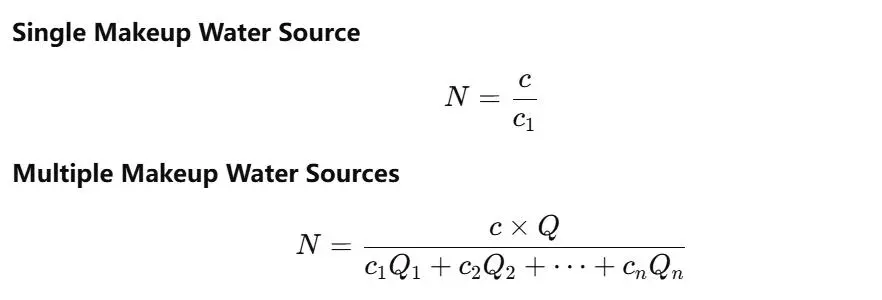
Where:
- N = Cycles of concentration
- c = K⁺ concentration in circulating water, mg/L
- c₁ = K⁺ concentration in Makeup Water Source 1, mg/L
- c₂ = K⁺ concentration in Makeup Water Source 2, mg/L
- cₙ = K⁺ concentration in Makeup Water Source n, mg/L
- Q = Total makeup water flow rate, m³/h
- Q₁ = Flow rate of Makeup Water Source 1, m³/h
- Q₂ = Flow rate of Makeup Water Source 2, m³/h
- Qₙ = Flow rate of Makeup Water Source n, m³/h
The first circulating water system uses only fresh water as makeup water; therefore, the cycles of concentration should be calculated using Equation (1).
The second circulating water system uses a mixture of fresh water and reverse osmosis membrane filtration permeate at a ratio of 1.5:1 as makeup water; therefore, the cycles of concentration should be calculated using Equation (2).
Managing Low Hardness and Low Alkalinity
One characteristic of water produced through reverse osmosis membrane filtration is its low hardness and low alkalinity.
While this high purity is advantageous in many applications, it may create challenges in cooling water systems if not properly managed.
Dynamic simulation testing is recommended to optimize corrosion inhibitor and scale inhibitor formulations before full-scale implementation.
Routine microbiological control is typically achieved through oxidizing biocides.
For open cooling systems using RO permeate as makeup water:
High Cycles of Concentration
When microbiological growth is adequately controlled and the system operates at high concentration cycles:
- Cooling tower aeration naturally increases pH.
- Continuous dosing of specialized scale inhibitors helps maintain water stability.
Low Cycles of Concentration
When operating at lower concentration cycles, additional alkalinity and hardness may be required.
Alkalinity can be increased through controlled addition of:
- Sodium carbonate (Na₂CO₃)
- Sodium hydroxide (NaOH)
- Sodium bicarbonate (NaHCO₃)
Hardness can be increased by adding:
- Calcium chloride (CaCl₂)
- Calcium sulfate (CaSO₄)
- Magnesium sulfate (MgSO₄)
Care must be taken to avoid overdosing, which may cause other water quality parameters to exceed acceptable limits.
Throughout operation, continuous monitoring of the following parameters is essential:
- Alkalinity
- Hardness
- pH
- Cycles of concentration
Treatment strategies and chemical programs should always be selected based on actual operating conditions and process requirements to prevent scaling, corrosion, and other operational issues.
Conclusion
The reuse of RO permeate as makeup water in open recirculating cooling water systems offers significant advantages in water conservation, cost reduction, and operational sustainability.
However, successful implementation requires careful management of water chemistry. Factors such as makeup water quality, makeup water volume, cooling system requirements, and operating costs should all be considered when designing treatment programs.
By optimizing corrosion inhibitor and scale inhibitor formulations, adjusting chemical dosing strategies, and establishing appropriate blowdown control programs, facilities can maximize the benefits of reverse osmosis membrane filtration while maintaining stable water quality and reliable long-term cooling system performance.
Related Articles
- Characteristics of Reverse Osmosis Membrane Fouling and Reverse Osmosis Membrane Cleaning Methods
- RO Plant in Dialysis: A Detailed Guide to the Reverse Osmosis System
- RO Plant for Dialysis: A Detailed Guide to the Pretreatment System
- How to Design a Dialysis Water Distribution Loop When a 40-machine Center Opens with Only 10 Machines
- Vertical vs Horizontal RO Membranes: Does Installation Orientation Matter?
- Control and Prevention of Silica Fouling on RO Membranes
- RO Membrane Antiscalant Dosing: From Calculation Principles to Practical Application
- RO System Design: Series Staging or Concentrate Recirculation for Small RO Systems?
- Winter Maintenance Tips for Water Vending Machines
- Small Reverse Osmosis Plant Process Details (0.5m3/Hour)
- Besides reverse osmosis membrane flux, what other key design parameters are easily overlooked but can significantly impact membrane life?
- NF Membrane VS RO Membrane VS Forward Osmosis Membrane
- How to Calculate Recovery Rate RO System?
- Relationship Between RO Membrane Element Pressure Limits and Recovery Rate in Water Reuse and Zero Liquid Discharge Applications
- How to Choose RO Membranes from China: 3 Key Factors to Consider