

When designing a reverse osmosis system, improving water recovery is often one of the key objectives. In practice, two common approaches are used: series staging without concentrate recirculation and parallel configuration with concentrate recirculation.
For many water treatment engineers, the choice is not always straightforward, especially when designing small RO systems with fewer than six membrane elements. Selecting the wrong configuration can lead to unnecessary energy consumption, higher salt passage, and increased operating costs throughout the life of the system.
Using performance data from ESPA-4040 membrane elements, this article compares the strengths and limitations of both approaches and discusses where each design makes the most sense.
Understanding the Two Recovery Improvement Methods
Series Staging Without Concentrate Recirculation
In a series configuration, membrane elements are connected end-to-end. Feed water passes through each element sequentially, becoming more concentrated as it moves downstream.
The increase in recovery is achieved naturally through the staged concentration process. Since there is no concentrate recirculation loop, no additional pumps or recirculation piping are required. The system remains relatively simple and energy-efficient.
Parallel Configuration with Concentrate Recirculation
In this arrangement, membrane elements are fed in parallel. Part of the concentrate stream is discharged, while the remaining portion is returned to the feed side through a recirculation pump.
By blending the concentrate back into the feed stream, the system can operate at a higher overall recovery while reducing localized concentration effects on individual membrane elements. However, this design requires additional piping, control valves, and pumping power, increasing both capital and operating costs.
Performance Comparison: Two ESPA-4040 Elements at the Same Recovery Rate
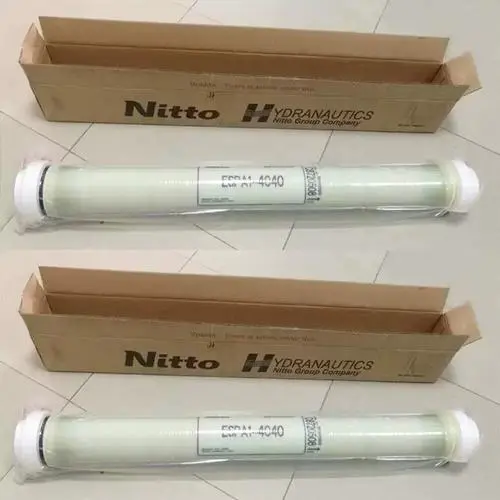
To provide a direct comparison, both configurations were evaluated at an overall system recovery of 32%.
The following data were collected from actual membrane performance testing.
| Membrane Model | Configuration | Salt Passage | Energy Consumption Index | Concentrate Recirculation Flow |
|---|---|---|---|---|
| ESPA1-4040 | Series, No Recirculation | 1.68% | 1.03% | 0 |
| ESPA1-4040 | Parallel with Recirculation | 1.84% | 1.77% | 22 m³/day |
| ESPA2-4040 | Series, No Recirculation | 0.32% | 1.37% | 0 |
| ESPA2-4040 | Parallel with Recirculation | 0.36% | 2.37% | 22 m³/day |
| ESPA3-4040 | Series, No Recirculation | 2.89% | 0.90% | 0 |
| ESPA3-4040 | Parallel with Recirculation | 3.17% | 1.56% | 22 m³/day |
| ESPA4-4040 | Series, No Recirculation | 1.03% | 0.79% | 0 |
| ESPA4-4040 | Parallel with Recirculation | 1.16% | 1.37% | 22 m³/day |
What the Data Tell Us
Lower Salt Passage with Series Staging
Across all four membrane models, the series configuration consistently delivered lower salt passage than the recirculation design.
The reason is straightforward. Returning concentrate to the feed stream increases feed-water salinity. As feed TDS rises, the membrane faces a greater desalination challenge, resulting in slightly higher salt passage and lower permeate quality.
For applications requiring stable water quality, this difference can be significant.
Lower Energy Consumption
The recirculation configuration required an additional 22 m³/day of concentrate circulation.
That extra flow must be moved by a pump, which translates directly into higher power consumption. In every test case, the recirculation system consumed more energy than the equivalent series arrangement.
Although the difference may appear small initially, the additional electricity cost accumulates over years of operation.
Design Recommendations: When to Use Each Approach
Small RO Systems (Fewer Than Six Membrane Elements)
For small systems, series staging is generally the preferred solution.
Benefits include:
- No recirculation pump required
- Simpler piping and control arrangement
- Lower equipment and installation costs
- Better permeate quality
- Reduced load on downstream EDI or mixed-bed polishing units
- Lower operating energy consumption
Typical applications include:
- Small industrial RO plants
- Bottled water systems
- Laboratory water purification systems
- RO units using two to four 4040 or 8040 membrane elements
Large Systems Requiring Very High Recovery
Concentrate recirculation becomes more attractive in larger systems where extremely high recovery rates are required.
As more membrane elements are placed in series, concentration polarization becomes increasingly severe toward the tail end of the array. Scaling risk rises rapidly, limiting the practical recovery that can be achieved through staging alone.
In many conventional single-stage RO systems, recovery rates around 75% are already approaching operational limits.
For larger systems with more than six membrane elements, concentrate recirculation can help dilute feed salinity, reduce concentration polarization, and push overall recovery into the 80–85% range or even higher.
Typical applications include:
- Municipal water reuse projects
- Industrial wastewater reclamation
- Large-scale industrial pure water plants
Common Design Mistakes
Mistake 1: Adding Concentrate Recirculation to Every Small RO System
Some designers assume that concentrate recirculation automatically improves performance.
In reality, for small systems with only two to four membrane elements, the additional pump and piping often increase energy consumption while slightly reducing permeate quality. The added complexity rarely delivers sufficient benefits to justify the cost.
Mistake 2: Excessive Series Staging in Large Systems
At the opposite extreme, some engineers attempt to achieve higher recovery simply by adding more membrane elements in series.
Beyond a certain point, concentration polarization and scaling risk increase dramatically. This often leads to more frequent membrane fouling, additional chemical cleaning, and higher maintenance costs.
A more balanced approach is usually preferable.
Final Thoughts
There is no universal answer in reverse osmosis system design.
The best configuration depends on system size, recovery targets, water quality requirements, and long-term operating costs. For most small RO systems, series staging remains the simpler and more efficient option. Concentrate recirculation becomes valuable only when larger systems need to push recovery beyond what conventional staging can reasonably achieve.
Understanding these trade-offs during the design stage can help avoid excessive energy consumption, unstable water quality, and costly operational issues later in the life of the system.
Related Articles
- Characteristics of Reverse Osmosis Membrane Fouling and Reverse Osmosis Membrane Cleaning Methods
- RO Plant in Dialysis: A Detailed Guide to the Reverse Osmosis System
- RO Plant for Dialysis: A Detailed Guide to the Pretreatment System
- How to Design a Dialysis Water Distribution Loop When a 40-machine Center Opens with Only 10 Machines
- Vertical vs Horizontal RO Membranes: Does Installation Orientation Matter?
- Optimizing Circulating Cooling Water Systems Using Reverse Osmosis Membrane Filtration Permeate
- Control and Prevention of Silica Fouling on RO Membranes
- RO Membrane Antiscalant Dosing: From Calculation Principles to Practical Application
- Winter Maintenance Tips for Water Vending Machines
- Small Reverse Osmosis Plant Process Details (0.5m3/Hour)
- Besides reverse osmosis membrane flux, what other key design parameters are easily overlooked but can significantly impact membrane life?
- NF Membrane VS RO Membrane VS Forward Osmosis Membrane
- How to Calculate Recovery Rate RO System?
- Relationship Between RO Membrane Element Pressure Limits and Recovery Rate in Water Reuse and Zero Liquid Discharge Applications
- How to Choose RO Membranes from China: 3 Key Factors to Consider