

The maximum pressure rating of a reverse osmosis membrane element is one of the key limits that determines the achievable recovery rate of an RO system. As the recovery rate increases, the concentrate becomes more concentrated, its TDS level rises, and its osmotic pressure increases. Consequently, a higher operating pressure is required to maintain water production.
However, the operating pressure must not exceed the membrane element’s maximum continuous operating pressure.
Basic Pressure Equation for a Single-Stage RO System
A simplified relationship is:
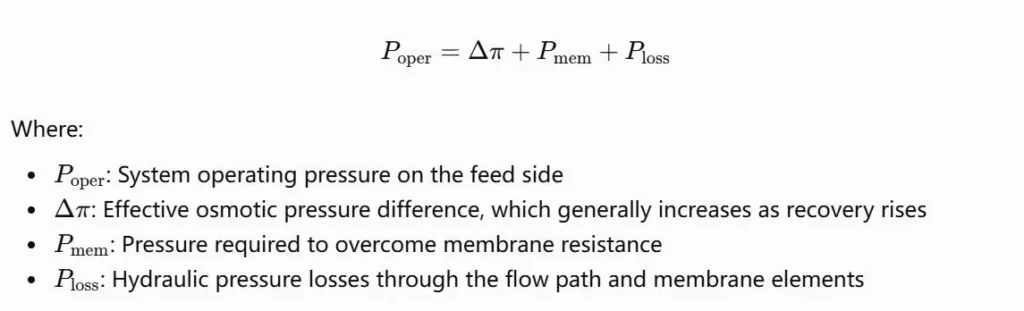
As recovery increases, the concentrate becomes progressively more concentrated. Its TDS and osmotic pressure rise, requiring a higher feed pressure to maintain permeate production.
The operating pressure must remain within the manufacturer’s specified maximum continuous operating pressure for the reverse osmosis membrane element. Exceeding this limit can accelerate membrane compaction, damage adhesive bonds, and potentially damage the central permeate tube.
How Pressure Limits Constrain RO Recovery
Higher pressure ratings may allow higher recovery
Under the same feed-water conditions, a membrane element with a higher pressure rating can tolerate a higher operating pressure. This may allow the system to handle higher concentrate osmotic pressure and potentially achieve a higher recovery rate.
Typical pressure-rating categories include:
400 psi brackish-water RO membranes: Commonly used in water reuse applications, with recovery determined by feed-water quality and system design.
600 psi seawater RO membranes: Designed for higher-salinity applications.
1200 psi high-pressure RO membranes: Used in certain high-salinity wastewater concentration and zero liquid discharge (ZLD) pretreatment applications.
These are illustrative pressure classes, not universal recovery limits. The appropriate reverse osmosis membrane element must be selected according to feed-water chemistry, scaling potential, operating conditions, and the manufacturer’s specifications.
A higher pressure rating does not mean unlimited recovery
Maximum operating pressure is only one of several constraints. Two other important factors are scaling potential and pressure drop across an individual membrane element.
Scaling limits
Lorem ipsum dolor sit amet, consectetur adipiscing elit. Ut elit tellus, luctus nec ullamcorper mattis, pulvinar dapibus leo.
Maximum pressure drop across an individual membrane element
Each membrane element also has a specified maximum allowable feed-to-concentrate pressure drop. At excessive recovery or insufficient concentrate flow, the pressure drop may exceed this limit, potentially causing membrane telescoping, displacement of the membrane leaves, or other mechanical damage.
This limit is different from the membrane element’s maximum operating pressure.
Two typical operating scenarios illustrate the difference:
Low-hardness wastewater with low scaling potential: After effective hardness removal, the pressure rating and osmotic pressure may become important constraints on recovery.
Conventional reclaimed water or wastewater without advanced softening: Scaling may limit recovery well before the membrane’s maximum pressure rating is reached.
How Multistage RO Systems Use Different Pressure Ratings
Multistage RO systems, such as two-stage or three-stage configurations, manage increasing concentrate salinity through staged membrane arrangements.
First stage: Feed water enters the first stage, and its concentrate feeds the second stage.
Second stage: The feed has a higher TDS concentration and osmotic pressure, so it may require a higher operating pressure to maintain permeate production.
In some wastewater ZLD applications, a higher-pressure reverse osmosis membrane element may therefore be selected for the second stage, depending on the calculated operating pressure and the membrane’s pressure rating.
However, adding more stages also reduces concentrate flow through downstream elements. This can increase the risk of exceeding the allowable pressure drop across individual elements. Adding stages alone cannot overcome every recovery limitation.
Key Engineering Considerations
When designing an RO system for water reuse or wastewater ZLD, engineers should consider the following steps.
- Calculate concentrate TDS at different recovery rates. Estimate the corresponding osmotic pressure and determine the operating pressure required.
- Maintain a suitable pressure margin. The design operating pressure should remain below the membrane element’s maximum continuous operating pressure. A margin of approximately 0.3–0.5 MPa may be used as an initial design consideration where appropriate, but the final margin must follow the membrane manufacturer’s specifications and the system’s operating conditions.
- Consider alternatives if the required pressure exceeds the membrane rating. Potential options include:
Selecting a higher-pressure-rated membrane element.
Improving pretreatment to reduce scaling potential, such as through hardness removal.
Using partial concentrate recirculation or nanofiltration pretreatment to manage the RO concentration load, where technically appropriate.
Reducing the target recovery rate and sending the concentrate to an evaporation or crystallization unit.
The choice depends on the feed-water composition, concentrate chemistry, energy consumption, and the overall treatment objective.
Simplified Example: Feed TDS of 5,000 mg/L
Assume the feed-water TDS is 5,000 mg/L and its approximate osmotic pressure is 0.35 MPa.
For illustration, the following estimates show how increasing recovery can raise concentrate salinity and pressure requirements. Actual values depend on water chemistry, temperature, membrane performance, staging, and concentration polarization.
| Recovery rate | Approximate concentrate TDS | Engineering implication |
|---|---|---|
| 70% | 16,667 mg/L | The pressure requirement may remain within the rating of a 600 psi membrane, subject to detailed design. |
| 85% | 33,333 mg/L | Higher osmotic pressure may bring the required operating pressure closer to the rating of a 600 psi membrane. |
| 90% | 50,000 mg/L | The pressure requirement may exceed the rating of a 600 psi membrane, making a higher-pressure membrane or lower recovery necessary. |
A 600 psi pressure rating corresponds to approximately 4.14 MPa (often rounded to 4.16 MPa in engineering discussions).
Important: These values are illustrative, not a validated membrane-design calculation. Concentrate TDS estimates based on a simple salt balance do not establish the actual operating pressure. The pressure requirement must be calculated using the effective osmotic pressure difference between the feed/concentrate and permeate, together with membrane flux requirements and hydraulic losses.
Conclusion
The maximum pressure rating of a reverse osmosis membrane element is an important constraint on achievable RO recovery, particularly in high-salinity wastewater reuse and ZLD applications. As recovery increases, concentrate osmotic pressure generally rises, increasing the pressure required to produce permeate.
However, membrane pressure rating, scaling potential, and the maximum allowable pressure drop across individual membrane elements must all be considered together. A higher-pressure membrane may enable higher recovery under suitable conditions, but it does not eliminate scaling risks or hydraulic limitations.
The key engineering principle is to select the membrane element based on the required recovery, concentrate chemistry, operating pressure, and allowable element pressure drop—not pressure rating alone.
Related Articles
- Characteristics of Reverse Osmosis Membrane Fouling and Reverse Osmosis Membrane Cleaning Methods
- RO Plant in Dialysis: A Detailed Guide to the Reverse Osmosis System
- RO Plant for Dialysis: A Detailed Guide to the Pretreatment System
- How to Design a Dialysis Water Distribution Loop When a 40-machine Center Opens with Only 10 Machines
- Vertical vs Horizontal RO Membranes: Does Installation Orientation Matter?
- Optimizing Circulating Cooling Water Systems Using Reverse Osmosis Membrane Filtration Permeate
- Control and Prevention of Silica Fouling on RO Membranes
- RO Membrane Antiscalant Dosing: From Calculation Principles to Practical Application
- RO System Design: Series Staging or Concentrate Recirculation for Small RO Systems?
- Winter Maintenance Tips for Water Vending Machines
- Small Reverse Osmosis Plant Process Details (0.5m3/Hour)
- Besides reverse osmosis membrane flux, what other key design parameters are easily overlooked but can significantly impact membrane life?
- NF Membrane VS RO Membrane VS Forward Osmosis Membrane
- How to Calculate Recovery Rate RO System?
- How to Choose RO Membranes from China: 3 Key Factors to Consider