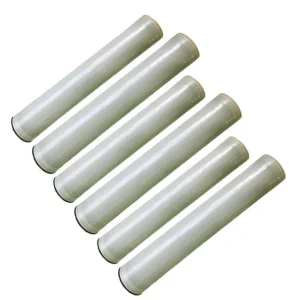
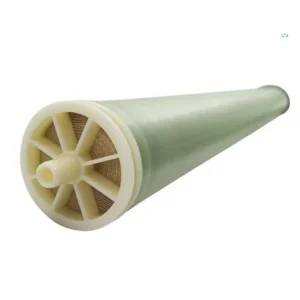
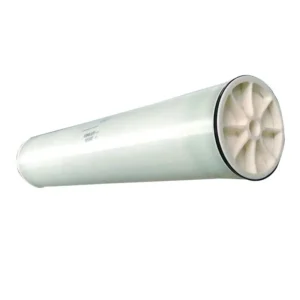
Nanofiltration membranes and water purification in the NF 280 series offer high flux, effectively removing TOC and THM precursors while efficiently retaining multivalent salts and allowing partial to moderate passage of monovalent salts. They are ideal membrane elements for removing organic matter from surface water and groundwater, as well as for moderate softening, concentration, separation, or purification of inorganic salts, organic compounds, natural pharmaceuticals, and fermentation broths.
The NF280 series delivers high permeate output, providing a wide range of water treatment, concentration, and separation applications for industrial production. Under ultra-low-pressure conditions, in nanofiltration membrane application it can remove TOC, THM precursors, and salts with low energy consumption, while enabling efficient material separation for municipal and industrial water treatment.- For nanofiltration membrane price, just send us inquiry.
MODEL
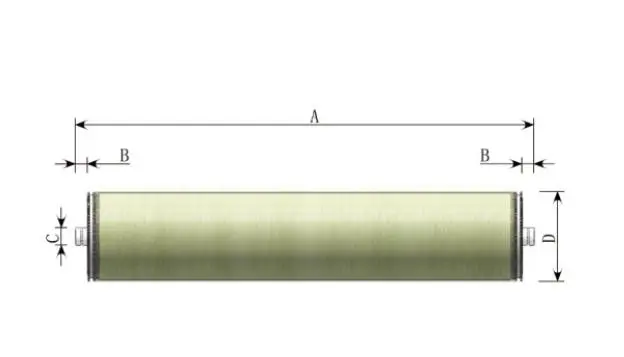
| Dimension | ||||
|---|---|---|---|---|
| Model | A inch(mm) | B inch(mm) | C inch(mm) | D inch(mm) |
| NF-280-400 | 40(1016) | / | 1.125(29) | 7.9 (201) |
| NF-280-82 | 37.9(963) | 1.05(26.7) | 0.75(19) | 3.9 (99) |
| Parameters | |||
|---|---|---|---|
| Model | Effective area ft (m2) | Stable desalination rate% | Water Production gpd(m3/d) |
| NF-280-400 | 400(37.2) | >97 | 12410(47) |
| NF-280-82 | 82(7.6) | >97 | 2430(9.2) |
APPLICATION

Treatment of natural water sources
Nanofiltration membranes and water purification play a critical role in treating surface water and groundwater, which commonly contain natural organic matter (NOM) such as humic acids and fulvic acids. These compounds are the main contributors to water color and taste issues and serve as precursors for carcinogenic disinfection by-products, such as trihalomethanes (THMs).
Thanks to nanofiltration membrane pore size, these nanofiltration membranes act like a fine sieve, efficiently retaining high-molecular-weight organic compounds, significantly reducing TOC, color, and UV absorbance in the permeate, and fundamentally improving the biological safety and sensory quality of the water.
At the same time, the charged properties of the membrane’s selective layer (typically negative) strongly repel divalent cations such as calcium and magnesium through the Donnan effect, achieving effective “moderate softening” and reducing scaling tendencies in downstream pipes and equipment.
For material concentration, such as fermentation products and pharmaceutical extracts.
In terms of material concentration, these types of nanofiltration membranes allow water and small-molecule solvents to pass through while effectively retaining and concentrating valuable target substances, such as fermentation products and pharmaceutical extracts. The process is gentle and requires no heating, greatly minimizing the loss of activity of heat-sensitive materials.
For separation and purification, its precise pore size distribution and surface charge enable selective separation of different components based on molecular size and charge properties. For example, in fermentation broths, it can separate target products from small-molecule impurities such as residual sugars and inorganic salts; in natural pharmaceutical extractions, it can remove high-molecular-weight pigments and tannins, achieving product refinement and decolorization; in chemical processes, it can even be used for the preliminary fractionation of different valuable inorganic salts.