
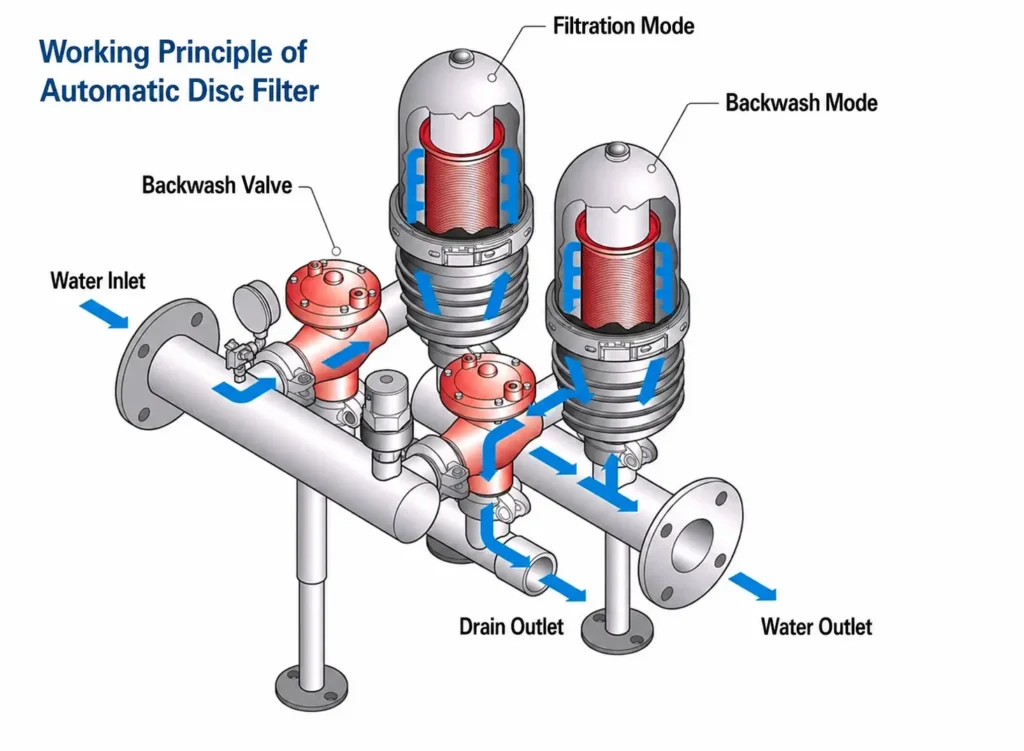
Disc Filter Principle
In the pretreatment process chain, when raw water carries a large number of visible suspended solids, what is most needed is a sturdy coarse screen – one that can block sharp, large particles from the very beginning, preventing them from scratching equipment or clogging the system. The filter disc system is precisely designed for this purpose. It is strategically positioned just ahead of the ultrafiltration (UF) membrane module, acting as a loyal bodyguard to protect the delicate UF membrane fibers.
How does a disc filter work: Precision Interception Through Deep Grooves
The core element of a filter disc system is a set of precision-engineered plastic discs, each surface covered with grooves of specific dimensions. When these discs are tightly compressed during operation, the grooves form countless precisely sized filtration channels between them. As raw water passes through the disc stack, solid impurities are accurately intercepted at the outer edges of the discs, while clean water flows through the channels. What makes this system unique is that filtration occurs throughout the entire depth of the disc stack, making it a highly efficient three-dimensional filtration process.
How to clean a disc filter : Release, Flush, Reset – A Clean Physical Cycle
As trapped impurities accumulate over time, the pressure differential across the inlet and outlet gradually increases. When the differential reaches the trigger point – typically 0.1–0.15 MPa – the control system automatically initiates a regeneration cycle. The filter disc stack is instantly released, and high-pressure water flushes from the reverse and tangential directions, sweeping away all impurities captured in the disc grooves. Once thoroughly cleaned, the disc stack is re-compressed, and the system returns to normal filtration mode. The entire process takes only 1–3 minutes, and because only the impurities are flushed away, water consumption is extremely low – typically around 1% of the total output.
Key Engineering Considerations: Correct Positioning and Precision Selection
Define its tactical role
The greatest value of a filter disc system is not to replace a sand filter, but to shield the downstream UF system from sudden spikes in coarse debris – such as sand or shell fragments carried by stormwater – thereby preventing accidental damage to the UF membrane.
Select the right filtration precision
Filtration accuracy should be chosen based on the characteristics of impurities in the water. In most cases, a precision of 50–200 μm is sufficient to provide reliable protection for UF membranes. This range offers high contaminant-holding capacity and moderate backwash frequency. Selecting an overly fine precision (e.g., 5 μm) for high-turbidity water can easily lead to frequent clogging.
Core Maintenance Practices
Regularly inspect the filter discs for any cracks or deformation, and check that the compression mechanism remains reliable. Insufficient compression can create shortcuts between discs, allowing large amounts of impurities to pass straight through and causing the entire filtration system to fail.
The essence of a filter disc system lies in its precise coarse-filtration positioning and its highly automated self-cleaning capability. When applied correctly, it establishes a reliable, unattended frontline defense for the entire system.