

The PN rating or pressure rating of an RO pressure vessel should not be selected simply by looking up the feed water TDS in a table. The correct approach is to estimate the maximum system pressure based on water quality and recovery rate, account for water hammer, cleaning conditions, and interstage boosting, and then select a pressure vessel with an appropriate pressure rating and safety margin. Material compatibility, temperature, pH, seals, and applicable certifications must also be verified.
Let’s take a closer look at how to choose the right pressure rating for RO pressure vessels.
1. Understand the Different Pressure Ratings Before Selecting a Vessel
RO pressure vessel specifications may include several different pressure values. These values are not interchangeable.
Rated or maximum operating pressure: The pressure that a vessel is designed to withstand under specified operating conditions. Common ratings include 300, 450, 600, 1,000, and 1,200 psi.
Hydrostatic test pressure: The pressure applied during factory testing. Some pressure vessels are tested at approximately 1.5 times their rated pressure, depending on the applicable standard and manufacturer requirements.
Burst pressure: Some high-quality FRP pressure vessels may have a burst-pressure target of several times their rated operating pressure. However, burst pressure is not an allowable operating pressure and must never be used as the basis for system design.
Transient peak pressure: Pump starts and stops, rapidly closing valves, and interstage boosting can cause pressure spikes. Water hammer may significantly exceed steady-state pressure. Proper soft starting and controlled valve closure can help reduce these pressure surges.
When selecting an RO pressure vessel, consider the maximum expected operating pressure plus the pressure surges that the vessel may experience—not just the average operating pressure.
2. Estimate the Required System Pressure from Feed Water Quality
For a spiral-wound RO system, the required feed pressure depends on osmotic pressure, the desired permeate flux, hydraulic losses, and operating conditions.
Step 1: Estimate osmotic pressure from feed water composition or TDS
As a rough estimate for dilute sodium chloride solutions, every 1,000 mg/L of TDS corresponds to approximately 0.7–0.8 bar of osmotic pressure. Actual values vary with ionic composition, temperature, and concentration. Water with high sulfate levels or high hardness may deviate from this approximation.
For preliminary estimation:
TDS of 2,000 mg/L: approximately 1.4–1.6 bar osmotic pressure.
TDS of 8,000 mg/L: approximately 5.6–6.4 bar osmotic pressure at that concentration.
Seawater at approximately 35,000 mg/L TDS: roughly 25–28 bar osmotic pressure.
Important: These figures refer to the osmotic pressure at the stated concentration. As water passes through the RO system, the concentrate becomes more saline, increasing its osmotic pressure. A proper system design must account for the concentration profile along the membrane array.
For accurate calculations, use the membrane manufacturer’s design software, such as ROSA or WAVE, or an equivalent validated design tool.
Step 2: Estimate the required feed pressure
The required RO feed pressure must overcome the osmotic pressure difference across the membrane while providing sufficient net driving pressure to achieve the target permeate flow.
It must also account for pressure losses through the cartridge filter, piping, fittings, and membrane stages.
The required pressure is therefore influenced by:
Concentrate-side osmotic pressure and permeate-side osmotic pressure.
Target permeate flux and membrane performance.
Pressure losses through the system.
Recovery rate and the number of membrane stages.
Do not simply add a single osmotic pressure value to a fixed pressure allowance and treat the result as a final design pressure. Use membrane design software to calculate the required pressure under the actual operating conditions.
Step 3: Allow for changes in operating conditions
The required operating pressure may change as the system ages or operating conditions vary.
Consider the following scenarios:
New membranes versus membranes approaching the end of their service life.
Summer versus winter operation. Lower feed water temperatures generally reduce membrane permeability and may require higher feed pressure to maintain the target permeate flow.
Clean membranes versus membranes approaching the allowable fouling or pressure-drop limits.
A preliminary design may include an operating margin, often around 10–15%, where appropriate. However, this is not a universal safety factor and should not replace a proper design calculation.
Step 4: Account for transient pressure
Pressure surges can occur during pump startup and shutdown, rapid valve closure, and changes in system operation.
The appropriate transient allowance depends on the pump, piping layout, valve characteristics, control system, and surge protection measures. Variable-frequency drives, soft starts, and controlled valve closure can help reduce pressure spikes.
Where transient pressure is a concern, perform a hydraulic surge assessment rather than automatically applying a generic multiplier.
Example: RO treatment of high-TDS reclaimed water
Consider feed water with a TDS of 8,000 mg/L and a recovery rate of 75%.
A simplified concentration-factor estimate gives:
Concentrate TDS ≈ 8,000 / (1 − 0.75) = 32,000 mg/L.
The concentrate therefore has a much higher osmotic pressure than the original feed water. The required system pressure must be determined from the osmotic pressure profile, target permeate flow, membrane performance, and hydraulic losses.
The final design pressure should then be checked under low-temperature conditions, end-of-run membrane conditions, and any relevant transient scenarios before selecting the pressure vessel rating.
Do not select a 600 psi vessel solely because a simplified calculation produces a pressure close to that value. Confirm the maximum design pressure and required margin against the manufacturer’s pressure-vessel specifications.
3. Select the Pressure Vessel Rating for Different Water Qualities and RO Applications
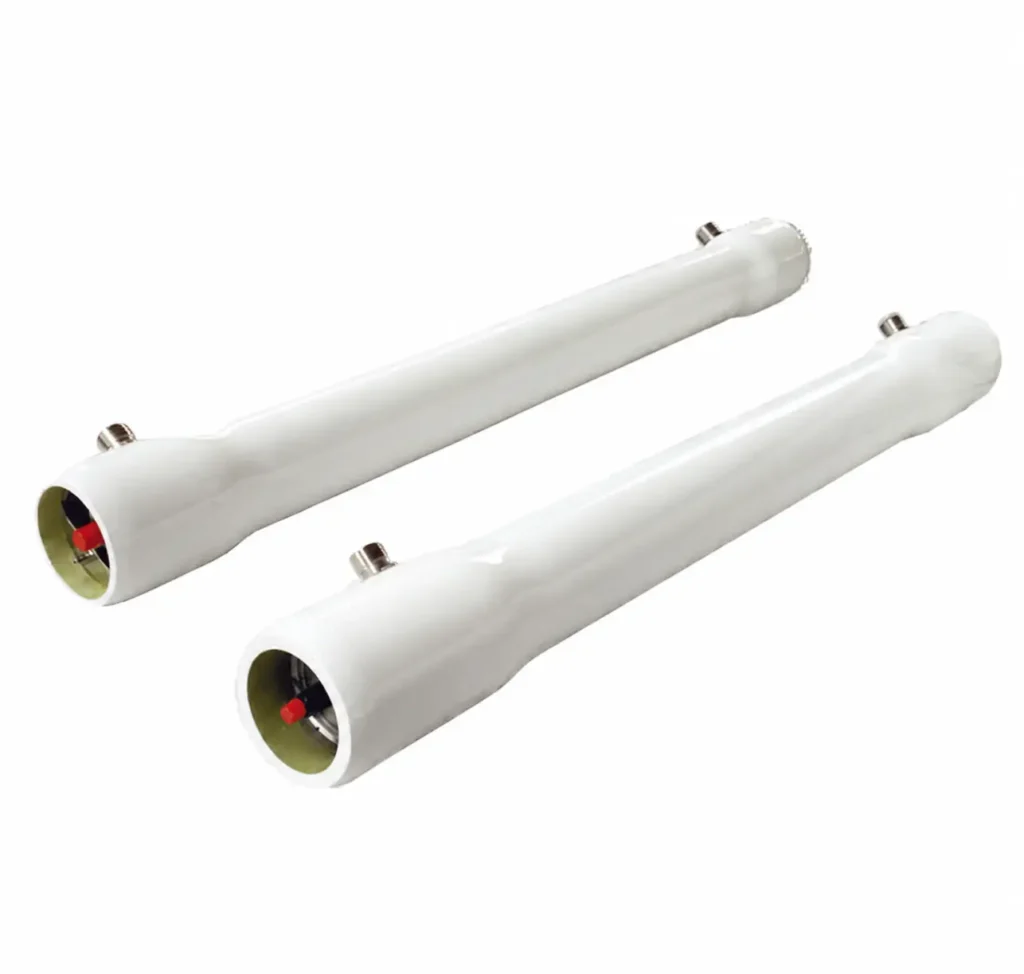
Industrial FRP RO pressure vessels are available in a range of pressure ratings, including 150, 300, 450, 600, 800, 1,000, 1,200, and higher-pressure options. Availability varies by manufacturer, vessel size, and design.
The following table provides an initial screening guide, not a substitute for pressure calculations or manufacturer approval.
| Feed Water or RO Application | Typical Pressure Range | Preliminary Vessel Rating to Investigate | Notes |
|---|---|---|---|
| Low-TDS drinking water or small commercial RO, TDS below approximately 500–1,000 mg/L | Often below 10 bar | 150 psi | Suitable only where the complete system pressure remains within the vessel's rating |
| Well water or mildly brackish water, TDS 1,000–3,000 mg/L, moderate recovery | Approximately 10–20 bar in some applications | 300 psi | Confirm required pressure at the lowest operating temperature |
| Brackish water or reclaimed water, TDS 3,000–8,000 mg/L | May be approximately 20–35 bar | 450 or 600 psi, depending on design | Higher recovery may substantially increase concentrate-side osmotic pressure |
| High-TDS brackish water, TDS 8,000–15,000 mg/L, or high-recovery systems with interstage boosting | May be approximately 35–55 bar | 600 psi or a higher rating, as required | Verify the maximum pressure at every stage |
| High-salinity water or concentrate treatment, TDS 15,000–30,000 mg/L | Application-dependent; potentially high | 1,000 psi or another suitable rating | Requires a detailed design calculation |
| Seawater RO, feed TDS approximately 30,000–45,000 mg/L | Commonly around 55–83 bar, depending on the design | Often a dedicated high-pressure seawater vessel, such as a 1,200 psi model where suitable | Check the actual maximum pressure, vessel rating, and membrane-element limits |
| High-pressure RO for concentrate reduction (HPRO) | May operate at elevated pressures, sometimes around 60–83 bar or more | Dedicated high-pressure FRP or steel-lined vessels | Selection depends on the specific process and equipment limits |
| DTRO for landfill leachate or highly concentrated wastewater | May operate at approximately 75–120 bar, depending on the application | Dedicated DTRO pressure columns, commonly specified by their design pressure | Conventional spiral-wound RO pressure vessels are not interchangeable with DTRO columns |
Key point: The vessel’s allowable operating pressure must be suitable for the maximum pressure expected under the specified conditions. The membrane element’s pressure limit must also be respected.
For example, if a brackish-water RO membrane element has a maximum allowable pressure of 41 bar, selecting a vessel rated for a higher pressure does not authorize operation above the membrane element’s limit. The same principle applies to seawater RO systems.
Always verify the pressure ratings of the vessel, membrane elements, piping, fittings, valves, and other pressure-containing components as a complete system.
4. Choose the Vessel Material and Seals Based on Water Chemistry

Selecting the correct pressure rating is only part of the process. The vessel material and sealing components must also be compatible with the feed water and cleaning chemicals.
FRP pressure vessels
Fiber-reinforced plastic (FRP) vessels are widely used in brackish-water RO and seawater desalination.
Their chemical resistance depends on the resin system, internal liner, temperature, and exposure conditions. Some products specify an operating pH range of approximately 3–11 and a temperature range around −10°C to 66°C, but these limits are product-specific and must be confirmed with the manufacturer.
Before using an FRP vessel in a clean-in-place (CIP) system, verify compatibility with the cleaning chemicals, concentrations, temperatures, and exposure times.
Stainless steel pressure vessels
Stainless steel vessels, including 304 and 316L, may be suitable for food processing, pharmaceutical applications, and high-purity water systems.
However, stainless steel is not automatically the best choice for every application. High-chloride seawater and certain acidic waste streams can cause localized corrosion. Material selection must consider chloride concentration, temperature, pH, and other corrosive species.
Special coatings and corrosion-resistant alloys
For highly corrosive applications, including high-chloride seawater, landfill leachate, and high-pressure concentrate treatment, specialized coatings or corrosion-resistant alloys may be necessary.
Duplex stainless steel, including grade 2205, may be considered where its corrosion resistance is appropriate for the actual water chemistry and operating conditions. Specialized high-pressure DTRO columns may also use stainless steel or other engineered materials.
Select the correct sealing material
The seal material must be compatible with both the process water and the cleaning chemicals.
EPDM: Commonly used in water-treatment applications, subject to compatibility with the actual chemicals and operating conditions.
FKM (fluoroelastomer): Offers good resistance to many chemicals, but compatibility must be checked for each chemical and concentration.
Silicone: May be suitable for certain temperature-sensitive applications, but it should not be assumed suitable for every high-pressure RO application.
For food, pharmaceutical, or other regulated applications, confirm that the seals meet the required material and compliance standards.
Check temperature, pH, and chemical compatibility
Before confirming a vessel specification, verify:
Free chlorine and other oxidants. Polyamide RO membranes are sensitive to free chlorine, so appropriate pretreatment or dechlorination is normally required. The allowable exposure depends on the membrane manufacturer’s specifications.
Operating and cleaning pH ranges.
CIP chemicals, such as hydrochloric acid, citric acid, sodium hydroxide, and approved disinfectants.
Feed water temperature and any temperature increase during cleaning.
Organic compounds, oils, and other contaminants that may affect the vessel liner, seals, or other wetted components.
The allowable limits must come from the actual vessel, membrane, and seal manufacturers—not from generic material descriptions.
5. A Practical Engineering Procedure for Selecting RO Pressure Vessels
Follow these steps when specifying pressure vessels for RO systems.
Step 1: Collect the design data.
Obtain a complete feed water analysis, operating temperature range, SDI, target permeate flow, recovery rate, and system configuration.
Step 2: Calculate the maximum steady-state pressure.
Use the membrane manufacturer’s design software to evaluate the required feed pressure, membrane-stage pressure losses, interstage pressure, and concentrate-side conditions.
Step 3: Evaluate the critical operating scenarios.
Check the maximum expected pressure under relevant conditions, including low-temperature operation, end-of-run membrane performance, and the allowable fouling limit.
Step 4: Assess transient pressure.
Evaluate pump startup and shutdown, valve closure, check-valve behavior, and other potential pressure surges. Include appropriate surge protection where necessary.
Step 5: Check each stage separately.
For systems with interstage boosting, second-pass RO, or concentrate recirculation, evaluate the pressure requirements of every stage. The second stage or concentrate section may experience different pressure conditions from the first stage.
Step 6: Verify the membrane-element pressure limit.
If the required operating pressure exceeds the membrane element’s allowable limit, consider reducing recovery, changing the membrane type, or redesigning the process. Depending on the application, options may include seawater RO, HPRO, or DTRO. Installing a higher-rated pressure vessel alone does not solve the problem.
Step 7: Select the pressure vessel.
Choose a vessel whose rated operating pressure is adequate for the maximum design pressure and specified transient conditions. Compare the available ratings and select the most appropriate option without paying unnecessarily for a rating that the system does not require.
Also confirm the vessel diameter (4040 or 8040), the number of membrane elements (typically one to seven, depending on the vessel design), end-port or side-port configuration, end caps, connection types, materials, and applicable standards or certifications.
6. Common Mistakes When Selecting RO Pressure Vessel Ratings
Mistake 1: Selecting the vessel based only on first-stage feed pressure
This can overlook interstage boosting or higher-pressure concentrate sections. The pressure conditions of every stage must be checked independently.
Mistake 2: Using a 300 psi vessel for a high-recovery brackish-water system without checking worst-case conditions
The system may operate at a relatively low pressure initially, but lower winter temperatures or membrane fouling may increase the required feed pressure. The vessel rating must accommodate the actual design conditions.
Mistake 3: Checking the membrane's pressure limit but ignoring pressure surges
A system may remain within the steady-state pressure limit yet experience damaging transients during pump startup, shutdown, or rapid valve closure. Evaluate the hydraulic system and implement suitable surge protection.
Mistake 4: Increasing recovery too much in high-silica or high-hardness water
Even if the vessel pressure rating is adequate, excessive recovery can cause scaling and increase pressure drop across the membrane array. The solution may involve reducing recovery, improving pretreatment, or adjusting the antiscalant program—not simply choosing a higher-rated vessel.
Mistake 5: Using a conventional spiral-wound FRP vessel for DTRO
DTRO systems can operate at substantially higher pressures and use a different membrane and pressure-column configuration. A conventional spiral-wound RO vessel, even one rated at 1,200 psi, is not automatically suitable as a replacement for a dedicated DTRO pressure column.
Conclusion
Choosing the right pressure rating for RO pressure vessels requires more than matching feed water TDS to a pressure table. Water chemistry and recovery rate influence osmotic pressure and the required system pressure, while temperature, membrane condition, hydraulic losses, and transient events affect the final design requirements.
Calculate the pressure requirements for the actual system, verify the limits of the membrane elements and other components, and select a vessel with a suitable rated operating pressure, compatible materials, and the required certifications. When in doubt, obtain the manufacturer’s technical approval before finalizing the specification.