
Ultrafiltration technology is a key separation process in the water treatment industry, and its operating performance directly affects the economics and stability of the entire system. Among the many operating parameters, water temperature has a particularly significant and direct impact on permeate flow, making it a critical factor that must be fully understood in both engineering design and daily operation of ultrafiltration water treatment systems.

Mechanisms by Which Temperature Affects Permeate Flow
Changes in water temperature mainly influence the permeate flow of ultrafiltration water treatment systems by altering the physical properties of water and the characteristics of the membrane itself.
Changes in Water Viscosity
This is the most important influencing factor. The dynamic viscosity of water decreases significantly as temperature rises. According to the basic principles of fluid mechanics, the flow rate of water through membrane pores is inversely proportional to viscosity.
Specifically, the viscosity of water decreases from 1.519 mPa·s at 5°C to 0.890 mPa·s at 25°C, representing a reduction of approximately 41%.
This means that, under the same operating pressure, increasing the water temperature from 5°C to 25°C can theoretically improve water permeability by approximately 70%.
In practical ultrafiltration water treatment systems, the relationship between permeate flow and temperature is commonly described using an empirical Temperature Correction Factor (TCF):
Q∝TCFQ \propto TCFQ∝TCF
where TCF is often expressed as:
TCF=η25ηtTCF=\frac{\eta_{25}}{\eta_t}TCF=ηtη25
Here, η25\eta_{25}η25 is the viscosity at 25°C and ηt\eta_tηt is the viscosity at the actual operating temperature.
Microscopic Changes in Membrane Material and Pore Structure
Most polymer ultrafiltration membranes, such as PVDF and PES membranes, exhibit slight thermoplastic behavior. As temperature increases, the movement of polymer chains becomes more active, causing relaxation of the membrane pore walls. The effective pore size may expand slightly, and pore tortuosity may decrease marginally, further improving water permeability.
However, compared with viscosity changes, this effect is secondary. Excessively high temperatures may also cause irreversible membrane swelling or structural damage.
Increase in Diffusion Coefficient
Higher temperatures increase the kinetic energy of water molecules, thereby increasing their diffusion coefficient. This not only helps water molecules pass through membrane pores more rapidly but also improves mass transfer within the membrane surface boundary layer.
As a result, concentration polarization can be partially mitigated, helping ultrafiltration water treatment systems maintain higher effective filtration driving force.
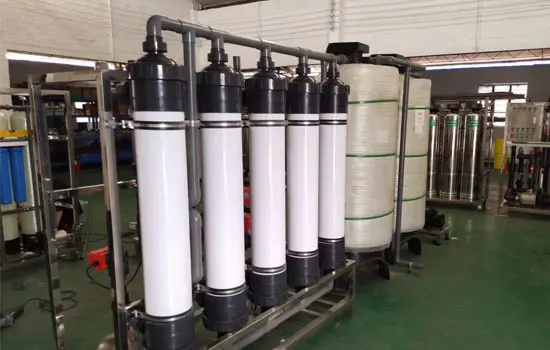
Quantitative Description of Temperature Impact
In practical engineering applications, the effect of water temperature on permeate flow is not strictly linear. It is commonly quantified using the Arrhenius equation or empirical formulas.
A widely used simplified empirical formula is:
Q2=Q1×1.03(T2−T1)Q_2=Q_1\times1.03^{(T_2-T_1)}Q2=Q1×1.03(T2−T1)
or, more conservatively:
Q2=Q1×1.02(T2−T1)Q_2=Q_1\times1.02^{(T_2-T_1)}Q2=Q1×1.02(T2−T1)
Where:
Q1Q_1Q1 = permeate flow at temperature T1T_1T1 (°C)
Q2Q_2Q2 = permeate flow at temperature T2T_2T2 (°C)
For example, using 1.03 as the coefficient, when water temperature decreases from 20°C to 10°C, the permeate flow is expected to decrease to:
1.03(10−20)≈74%1.03^{(10-20)}\approx74\%1.03(10−20)≈74%
This means the permeate flow may decrease by approximately one quarter.
Depending on membrane material and feed water quality, the coefficient may vary between 1.02 and 1.05. Accurate values should be determined through field testing or membrane supplier performance curves.
Challenges in Practical Operation
Seasonal Variations
In northern regions of China, for example, surface water temperature may drop to 1–5°C in winter and rise to 25–30°C in summer.
If an ultrafiltration water treatment system is designed for a summer permeate flow of 100 m³/h, the winter flow under the same conditions may decrease to only 55–70 m³/h.
To maintain stable water supply capacity, operators often need to:
- increase the number of membrane modules,
- raise operating pressure,
- or reduce recovery rate.
These measures directly affect both capital investment and operating cost.
Interaction with Membrane Fouling
Temperature effects are closely related to membrane fouling behavior.
On one hand, increased viscosity at low temperature promotes contaminant deposition on the membrane surface, increasing filtration resistance. At the same time, weaker Brownian motion of foulant particles reduces diffusion capability and accelerates cake layer formation.
On the other hand, lower temperature generally suppresses biological activity, which may reduce biofouling, although chemical fouling and colloidal fouling may become more severe.
As a result, ultrafiltration water treatment systems operating at low temperature often require more frequent chemical cleaning to restore membrane flux, while cleaning efficiency may also decrease under cold conditions.
Adjustment of Operating Pressure
To compensate for reduced permeate flow at low temperature, increasing Transmembrane Pressure (TMP) is a common operational approach.
However, this method has several limitations:
- Higher pressure accelerates membrane fouling and flux decline.
- Membrane modules have maximum allowable operating pressure limits.
- Increased pressure significantly raises energy consumption and operating cost.
Therefore, a better strategy is to consider the worst-case water temperature during the design stage and reserve sufficient membrane area.
Operational Optimization Strategies
Temperature Considerations During Design
When designing ultrafiltration water treatment systems, the baseline permeate flow should be determined according to the historical minimum feed water temperature, and membrane area should be calculated accordingly.
Design flux should be selected conservatively, especially for systems using low-temperature surface water sources.
Feed water preheating systems may also be considered, such as heat exchange with cooling water systems. Although this increases initial investment, it can significantly improve year-round operational stability and energy efficiency.
Intelligent Control of Operating Parameters
Implementing temperature-based intelligent operating strategies is highly recommended.
Through PLC or DCS systems, feed water temperature can be monitored in real time, allowing automatic adjustment of:
- permeate pump frequency,
- backwash cycle,
- and Chemically Enhanced Backwash (CEB) frequency.
For example, when water temperature drops below 15°C, the backwash frequency can automatically increase by 20–30%, while backwash duration can also be extended appropriately.
Optimization of Cleaning Strategy
During low-temperature operation, increasing cleaning solution temperature to 25–35°C can significantly improve chemical cleaning efficiency and foulant removal performance.
Using cleaning formulations specifically designed for low-temperature conditions may also improve cleaning effectiveness in ultrafiltration water treatment systems.
Optimization of Water Source and Process Flow
Where multiple water sources are available, it is preferable to use sources with relatively higher temperatures, such as industrial cooling tower blowdown water after heat exchange.
In addition, natural temperature increases within pretreatment processes, such as aeration, should be utilized whenever possible to improve the operating efficiency of ultrafiltration water treatment systems.
Related Articles
- Pre-ultra Filtration(UF)System Selection Based on Raw Water Quality Indicators (Turbidity/SDI/DOC)
- Introduction to UF Membrane Cleaning Procedure
- The Role of Terminal UF Membrane in Ultrapure Water Systems and Key Design Parameters
- Sharing a Design Calculation Example for an Ultrafiltration System
- PTFE vs PVDF Hollow Fiber UF Membranes: Revisiting Performance Boundaries and Applications