
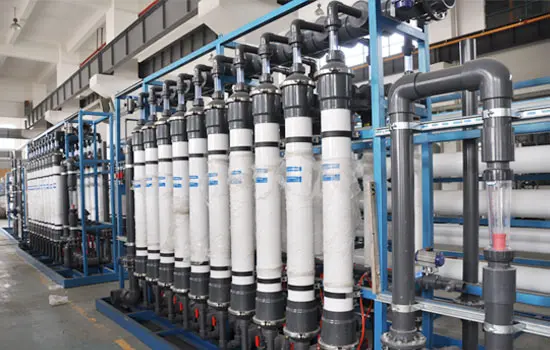
Terminal UF membrane is the final membrane barrier installed at the end of an ultrapure water system, typically located between the storage tank and the point of use. Positioned downstream of polishing mixed beds, EDI units, or degassing membranes, the terminal UF membrane directly protects critical processes such as wafer cleaning, pharmaceutical formulation, and high-purity rinsing applications.
Although it is physically installed at the very end of the system, its role is far more important than simply “final filtration.” In many ultrapure water applications, it is the last safeguard preventing particles, bacteria, endotoxins, and colloids from reaching sensitive production processes.

Core Functions of Terminal UF Membrane Systems
Particle and Colloid Removal
Even in highly purified water systems, downstream components such as polishing mixed beds may release tiny resin fragments during operation. Piping systems, valves, and pumps can also generate micron or submicron particles over time.
A terminal UF membrane uses a highly uniform sponge-like pore structure to provide absolute particle retention, typically removing contaminants ≥0.03 μm. In semiconductor-grade ultrapure water systems, this helps maintain particle counts larger than 0.05 μm below 1 particle per mL.
Colloidal contaminants such as colloidal silica or iron are another concern. These substances may not significantly affect conductivity, but they can still create haze defects on wafer surfaces. Terminal ultrafiltration effectively captures these colloidal materials before they reach the process tools.
Removal of Microorganisms and Endotoxins
Even low-nutrient ultrapure water systems can support oligotrophic bacteria growth. Most bacterial cells are larger than 0.2 μm, well above the retention capability of a pharmaceutical-grade UF membrane.
More importantly, terminal ultrafiltration removes bacterial endotoxins released during bacterial metabolism or cell death. These endotoxins, mainly lipopolysaccharide aggregates, are a major concern in pharmaceutical water systems.
For pharmaceutical applications, terminal UF membranes commonly use a molecular weight cut-off (MWCO) between 6,000 and 10,000 Daltons. This allows complete retention of endotoxin aggregates above approximately 10 kDa, enabling endotoxin levels below 0.03 EU/mL and bacterial log reduction values (LRV) greater than 7.
In semiconductor applications, dead bacterial residues can also become a source of fine particles. A properly selected terminal ultrafiltration system helps prevent these contaminants from entering the final process.
TOC Reduction and Water Quality Stability
Most total organic carbon (TOC) in ultrapure water systems is reduced through UV oxidation followed by membrane degassing. However, trace amounts of high-molecular-weight organics may still enter the system through piping extractables or microbial activity.
A terminal UF membrane provides an additional polishing effect by removing organic molecules larger than roughly 10 kDa. In practice, it can contribute approximately 10–20% additional TOC buffering capacity, helping protect sensitive wafer surfaces and pharmaceutical formulations from sudden organic contamination events.
It also minimizes transient particle release caused by pump starts, valve switching, or hydraulic disturbances, improving overall water quality stability.
Final Protection at Critical Process Points
In advanced semiconductor lithography, wafer cleaning, and pharmaceutical water distribution systems, even nanoscale contamination can lead to major product defects.
Terminal ultrafiltration is typically installed at the end of the recirculation loop or directly before the point of use, creating a near “zero-distance” physical barrier between the water system and the process equipment.
In ambient-temperature pharmaceutical water systems, terminal UF membranes are also widely used as the final safeguard for pyrogen-free water distribution.
Key Design Parameters for Terminal UF Systems
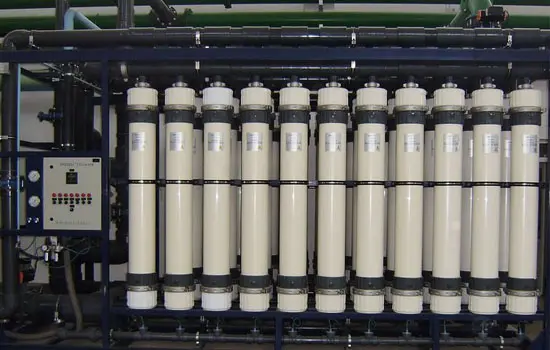
esigning a terminal ultrafiltration system requires balancing retention performance, flux, operating life, and hygienic requirements. Proper parameter selection directly affects final ultrapure water quality.
Membrane Material and Configuration
The most commonly used membrane materials are hydrophilic polyethersulfone (PES) and hydrophilic modified PVDF.
PES offers:
- excellent oxidation resistance
- low extractables
- broad pH tolerance (1–14)
- very low protein adsorption
Because of these properties, PES is widely preferred in both pharmaceutical and semiconductor ultrapure water systems.
PVDF provides excellent chemical stability and strong ozone resistance, making it suitable for ozone-sanitized systems, although aging control becomes important under strong alkaline or high-temperature conditions.
All membrane materials should comply with ANSI/NSF or USP biological safety standards, and TOC extractables should typically remain below 10 ppb.
Most terminal UF systems use hollow fiber membrane configurations. Inside-out flow designs are commonly preferred because they provide smoother flow paths with fewer dead zones and lower particle accumulation risk.
Typical hollow fiber specifications include:
- inner diameter: 0.8–1.2 mm
- wall thickness: 0.15–0.25 mm
This design balances mechanical strength with high membrane packing density, often reaching 500–900 m²/m³.
Industry-Specific Retention Requirements
Semiconductor Industry
The primary objective is submicron particle removal. Terminal UF membrane systems commonly use nominal pore sizes of 0.03–0.05 μm, corresponding roughly to a MWCO around 500,000 Da.
Particle count control is the main performance target.
Pharmaceutical and Biotechnology Applications
Pyrogen removal becomes the critical requirement. Systems generally use 10 kDa or 6 kDa UF membranes and require endotoxin challenge validation.
Typical targets include:
- endotoxin <0.25 EU/mL for pharmaceutical water
- many systems aiming for stable operation below 0.03 EU/mL
Some advanced semiconductor immersion lithography processes also adopt 10 kDa membranes to simultaneously control particles and organic macromolecules.
Operating Mode and Recovery Rate
Dead-End Filtration
Dead-end operation is widely used in electronics-grade ultrapure water systems because of its simpler configuration.
The system periodically performs automatic backwashing using its own permeate water. Typical design flux ranges from 60–120 LMH, with recovery rates between 95–98%.
Backwash cycles are commonly set every 30–60 minutes and may include air scouring to improve foulant removal.
Crossflow Filtration
Crossflow operation is more common in pharmaceutical water systems and applications with strict endotoxin control requirements.
Typical concentrate-side flow velocity is maintained at 0.5–1.5 m/s to reduce concentration polarization. Design flux can reach 80–150 LMH, while recovery rates are usually 85–95%.
The concentrate stream is continuously discharged or recycled to remove concentrated endotoxins from the system.
Transmembrane Pressure (TMP)
During normal operation, TMP should generally remain between 0.3 and 1.0 bar.
Low TMP may not sustain the required flux, while excessive pressure can compress membrane pores or damage hollow fibers. Under no circumstances should TMP exceed the membrane module limit, typically around 2.0 bar.
Backpressure protection on the permeate side is particularly important. Hollow fiber membranes usually have limited backpressure resistance, so permeate-side pressure should never exceed feed pressure.
For this reason, terminal UF systems should include:
- check valves
- anti-backpressure protection devices
- controlled flushing sequences
to prevent fiber breakage caused by operational errors or hydraulic shocks.
Integrity Testing
Each membrane module should include connections for automatic integrity testing.
Before commissioning and during routine validation, the membrane fibers are wetted and pressurized with clean compressed air to approximately 1.0–1.5 bar. After stabilization, the air supply is isolated and pressure decay is monitored over a specified period, typically 5 minutes.
A pressure drop below 0.05 bar is commonly used as the acceptance criterion.
This test can detect even a single broken membrane fiber and is considered essential for validating terminal barrier integrity.
Hygienic Design and System Materials
A 0.1 μm prefilter is often installed upstream of the terminal ultrafiltration unit.
Membrane housings and piping should use low-extractable materials such as:
- PVDF
- high-purity polypropylene
- PFA
PVC and plasticized materials should be avoided in ultrapure water applications.
All wetted instrumentation surfaces are typically polished to Ra ≤0.8 μm.
Modern systems also monitor:
- feed and permeate pressure
- permeate flow
- temperature
- particle count
- endotoxin levels
to ensure immediate alarm and isolation in the event of abnormal conditions.
Related Articles
- Pre-ultra Filtration(UF)System Selection Based on Raw Water Quality Indicators (Turbidity/SDI/DOC)
- Introduction to UF Membrane Cleaning Procedure
- Sharing a Design Calculation Example for an Ultrafiltration System
- Effect of Water Temperature on Permeate Flow of Ultrafiltration Water Treatment Systems and Operational Optimization
- PTFE vs PVDF Hollow Fiber UF Membranes: Revisiting Performance Boundaries and Applications