
What Is EDI?
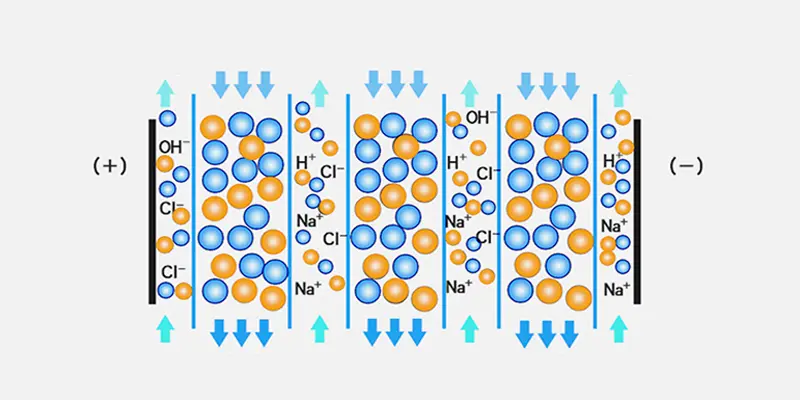
EDI stands for Electrodeionization, also known as electrodeionization technology or electrodeialysis with ion exchange resin beds.
EDI combines two established water treatment technologies: ion exchange and electrodialysis. It was developed from electrodialysis technology and has become increasingly popular as a method for producing high-purity water.
EDI combines the advantages of both processes. Like electrodialysis, it can continuously remove ions from water. At the same time, the ion exchange resin inside the EDI module provides deeper deionization.
This combination also solves some of the limitations of traditional electrodialysis when treating low-concentration solutions. The ion exchange resin improves ion transfer, while the electrical field allows the resin to be continuously regenerated. As a result, EDI does not require the regular use of acid and caustic chemicals for resin regeneration, reducing chemical consumption and secondary pollution.
In simple terms, EDI enables continuous deionization without conventional chemical regeneration.
The basic EDI deionization process involves three main mechanisms:
Electrodialysis
Under an external electric field, ions in the water selectively migrate through the ion exchange resin and ion-selective membranes. The ions are transferred into the concentrate stream and discharged, removing them from the product water.
Ion Exchange
The ion exchange resin captures impurity ions in the water and exchanges them with hydrogen and hydroxide ions, helping to remove dissolved ions from the water.
Electrochemical Regeneration
The electric field causes water molecules to split at the resin and membrane interfaces, producing H⁺ and OH⁻ ions. These ions continuously regenerate the ion exchange resin during operation.
This continuous regeneration is one of the key differences between EDI and traditional ion exchange systems.
Factors Affecting EDI Performance and How to Control Them
The performance of an EDI system depends heavily on the quality of its feed water. The main factors include the following.
Feed Water Conductivity
At the same operating current, increasing feed water conductivity generally reduces the removal rate of weak electrolytes and increases the conductivity of the product water.
When the feed water has a low ion concentration, a stronger electric potential gradient can develop on the surfaces of the resin and membranes in the dilute chambers. This promotes water splitting and increases the production of H⁺ and OH⁻ ions, improving the regeneration of the ion exchange resin.
For this reason, the feed water conductivity must be controlled. In general, EDI feed water conductivity should be below 40 μS/cm to ensure stable product water quality and effective removal of weakly ionized substances.
Operating Voltage and Current
Increasing the operating current usually improves product water quality up to a certain point.
However, if the current is increased beyond the optimal range, excessive H⁺ and OH⁻ ions may be generated. Once the resin regeneration requirements have been met, the excess ions can act as charge carriers in the system.
Excessive ion migration may also cause accumulation, blockage or even back-diffusion, ultimately reducing product water quality.
Therefore, the EDI system must operate within an appropriate voltage and current range.
Turbidity and SDI
EDI modules contain ion exchange resin in the product water channels. Excessive turbidity or a high Silt Density Index (SDI) can cause channel blockage, leading to increased pressure drop and reduced product water flow.
Proper pretreatment is therefore essential. In most cases, RO permeate is suitable as EDI feed water, provided that other water quality parameters are also within the required limits.
Hardness
Excessive residual hardness in the EDI feed water can cause scaling on the membrane surfaces in the concentrate channels.
This may result in:
- Reduced concentrate flow
- Lower product water resistivity
- Deterioration of product water quality
- Blockage of the concentrate and electrode rinse channels
- Internal overheating and damage to the EDI module in severe cases
Depending on the water quality, hardness can be controlled through appropriate pretreatment, such as softening or the use of CO₂ removal.
When the feed water has a relatively high salt concentration, additional RO or nanofiltration may also be used to help control the overall ionic load and hardness.
TOC (Total Organic Carbon)
High levels of organic matter in the feed water can cause organic fouling of the ion exchange resin and ion-selective membranes.
This may increase the operating voltage and reduce product water quality. Organic colloids may also accumulate in the concentrate channels and cause blockage.
Depending on the overall water quality requirements, additional pretreatment, including another RO stage, may be necessary.
Iron, Manganese and Other Metal Ions
Metal ions such as iron and manganese can cause irreversible fouling or “poisoning” of the ion exchange resin.
This can quickly deteriorate EDI product water quality. In particular, the removal rate of silica may decrease significantly.
Variable-valence metal ions may also catalyze oxidation reactions that permanently damage the ion exchange resin.
As a general guideline, the iron concentration in EDI feed water should be controlled below 0.01 mg/L.
CO₂
CO₂ in the feed water can form bicarbonate ions (HCO₃⁻), which are weakly ionized species.
These ions can pass through the ion exchange resin more easily and negatively affect product water quality.
A degasification system can be installed upstream of the EDI unit to remove CO₂.
Total Equivalent Anions (TEA)
A high total equivalent anion concentration can reduce EDI product water resistivity or require a higher operating current.
However, excessive current can increase the overall system current and raise the residual chlorine concentration in the electrode rinse water, which may negatively affect electrode membrane life.
In addition to these eight factors, feed water temperature, pH, silica (SiO₂) and oxidizing substances can also affect EDI performance.
Key Advantages and Disadvantages of EDI
EDI has been widely used in industries with demanding water quality requirements, including power generation, chemical processing and pharmaceutical manufacturing.
Long-term experience with EDI systems has demonstrated several important advantages.
High and Stable Product Water Quality
EDI combines the continuous ion removal capability of electrodialysis with the deep deionization capability of ion exchange.
The process can continuously remove dissolved ions from the water and produce high-purity water with stable quality.
Compact Design and Simple Installation
Compared with conventional ion exchange beds, EDI systems are generally more compact and lighter.
They do not require large acid and caustic storage tanks, which helps save valuable floor space.
EDI modules are also supplied as compact, integrated units. Installation is relatively simple, with a shorter construction period and less on-site work.
Simple Operation and Maintenance
EDI systems can be designed as modular units and regenerate the ion exchange resin continuously during operation.
No large or complex chemical regeneration system is required, making operation and maintenance relatively straightforward.
Easy Automation
Multiple EDI modules can be connected in parallel to form a complete system.
The modules can operate continuously and reliably, making the overall system suitable for automatic control and PLC-based operation.
No Regular Acid or Caustic Regeneration
Unlike conventional ion exchange systems, EDI does not require regular chemical regeneration with large quantities of acid and caustic soda.
This significantly reduces the generation of chemical wastewater and helps reduce the environmental impact of the water treatment process.
High Water Recovery
EDI systems can typically achieve a water recovery rate of 90% or higher, depending on the specific system design and operating conditions.
Despite these advantages, EDI also has some limitations.
The technology requires relatively high-quality feed water, and the initial investment in EDI equipment and associated infrastructure can be higher than that of a conventional mixed-bed ion exchange system.
However, the initial investment is only part of the total cost.
When chemical consumption, labor, wastewater treatment, maintenance and long-term operation are taken into account, EDI can offer significant economic advantages over traditional ion exchange in many applications.
In some cases, the higher initial investment in EDI can be recovered within a relatively short operating period.
RO + EDI vs. Traditional Ion Exchange
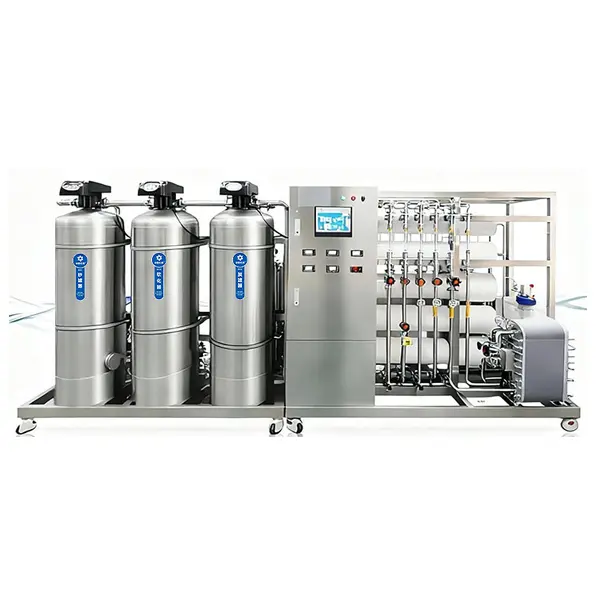
When comparing the advantages and disadvantages of electrodeionization vs ion exchange, it is important to consider not only the technology itself but also the complete water treatment process.
Initial Investment
In smaller water treatment systems, the initial investment for an RO + EDI system can be comparable to that of a traditional ion exchange system.
The main reason is that RO + EDI eliminates the large regeneration system required by conventional ion exchange processes, including acid and caustic storage tanks.
This can significantly reduce equipment costs and save approximately 10%–20% of the required floor space.
The smaller footprint may also reduce building construction and land-related costs.
Traditional ion exchange regeneration equipment is often more than 5 meters high, while RO and EDI equipment is generally less than approximately 2.5 meters high. This can allow the water treatment building to be designed with a lower ceiling height, further reducing construction costs.
However, the RO + EDI process also requires a larger pretreatment capacity because of RO reject water.
When all factors are considered, the initial investment for RO + EDI and traditional ion exchange can be broadly comparable in small water treatment systems.
For large systems, however, the cost comparison can be different.
Operating Costs
In terms of chemical consumption, RO-based systems generally have lower operating costs than traditional ion exchange systems.
Traditional ion exchange systems require regular resin regeneration, including acid and caustic consumption and the treatment of regeneration wastewater.
RO + EDI systems do not require this type of regular chemical regeneration.
However, RO + EDI systems may have higher electricity consumption and replacement costs for certain components.
As a result, the overall operating and maintenance cost of an RO + EDI system may be higher than that of a traditional ion exchange system in some applications.
The actual cost difference depends heavily on:
- Feed water quality
- System capacity
- Electricity prices
- Chemical costs
- Resin replacement frequency
- Wastewater treatment requirements
- Local operating conditions
Therefore, the total life-cycle cost should be evaluated rather than comparing only the initial equipment price.
Better Adaptability, Higher Automation and Lower Chemical Pollution
RO + EDI systems can handle a wide range of feed water sources.
With appropriate pretreatment, RO can be used for:
- Seawater
- Brackish water
- Mine drainage water
- Groundwater
- Surface water
Traditional ion exchange becomes less economical when the total dissolved solids concentration of the feed water is high.
RO and EDI also do not require the large-scale acid and caustic regeneration processes used by traditional ion exchange systems.
Only limited quantities of chemicals such as antiscalants, reducing agents or other treatment chemicals may be required, depending on the water quality and system design.
In addition, RO and EDI systems are highly suitable for automatic operation and PLC-based control, reducing the need for manual intervention.
Higher Equipment Cost and More Difficult Repairs
RO + EDI systems also have some disadvantages.
If key components such as the RO membranes or EDI modules are seriously damaged, the system may need to be shut down for replacement.
Replacing these components may require trained technical personnel, and the resulting downtime can be relatively long.
Another challenge is the management of RO concentrate.
Although RO does not generate large quantities of acid or caustic wastewater, a single-pass RO system typically has a recovery rate of around 75%. The remaining concentrate contains a significantly higher salt concentration than the original feed water.
Depending on local regulations and site conditions, the treatment or disposal of this concentrate can be challenging.
Some facilities reuse RO concentrate for applications such as equipment washing or ash handling, while other treatment options, including evaporation and crystallization, are technically possible but can be expensive.
Conclusion
EDI and traditional ion exchange are both established technologies for producing demineralized and high-purity water. Neither technology is universally better than the other.
The best choice depends on factors such as:
- Feed water quality
- Required product water quality
- System capacity
- Available space
- Chemical costs
- Electricity costs
- Wastewater treatment requirements
- Automation requirements
- Long-term operating costs
EDI offers continuous operation, stable high-purity water quality, high automation and minimal chemical regeneration. Its main limitations are the strict feed water requirements and relatively high initial equipment cost.
Traditional ion exchange can be attractive in certain large-scale applications or where the feed water and operating conditions are more suitable for resin-based treatment. However, it requires regular chemical regeneration and generates acid and caustic wastewater.
For smaller high-purity water systems, the combination of RO + EDI can often be an attractive alternative to traditional ion exchange because of its compact design, continuous operation, automation and reduced chemical handling.
The right choice should always be based on a complete technical and economic evaluation rather than simply comparing the equipment prices of EDI and ion exchange.