
Designing an electrodeionization (EDI) system requires careful consideration of water quality, system configuration, hydraulic conditions, and operational safety.
EDI technology is widely used in pharmaceutical water systems, laboratory pure water systems, power plants, and other high-purity water applications. However, improper system design can lead to unstable operation, reduced module performance, or even premature damage.
Based on practical experience with RO EDI systems, we summarize 20 key design considerations to help engineers avoid common mistakes and improve the reliability of electrodeionization EDI systems.
Dual-pass RO + EDI is the Preferred System Configuration
An EDI system requires a stable and consistent feed water quality for long-term operation.
Compared with other pretreatment methods, a two-pass RO system combined with EDI provides the most stable water quality control.
For example, softeners and ion exchange systems require periodic regeneration. These regeneration cycles introduce fluctuations in water quality, which may affect EDI system stability.
A single-pass RO system combined with additional treatment processes may also experience variations due to changes in RO performance, which are difficult for downstream processes to fully compensate for.
Therefore, using a dual-pass RO system as the pretreatment process for an EDI system is considered one of the most advanced and reliable configurations for high-purity water production.
Install Alkali Dosing Before the Second-Pass RO System
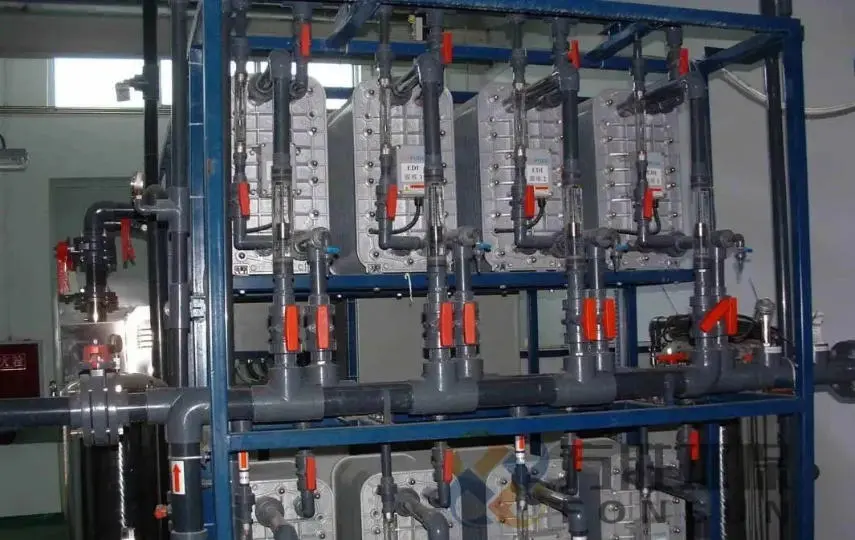
When a two-pass RO system is used as EDI pretreatment, it provides better control of carbon dioxide levels entering the EDI module.
Installing an alkali dosing system before the second-pass RO helps:
- Reduce dissolved CO₂ in the second-pass RO permeate
- Improve EDI feed water quality
- Minimize scaling risks inside the RO system
This design further improves the advantages of using a dual-pass RO system before EDI.
Install a Cartridge Filter Before the EDI System
Currently, most pure water systems install a storage tank between the RO system and the EDI system.
However, during long-term operation, problems may occur due to:
- Material particles released from storage tanks
- Pipe welding residues
- Dust and debris
- Filter material shedding
Without a final cartridge filter before the EDI system, these contaminants may enter the EDI modules and cause fouling.
Therefore, installing a 1 μm security filter before the electrodeionization system is highly recommended.
Consider Pipeline Pressure Loss When Selecting the Feed Pump Head
When selecting the EDI feed pump, engineers should consider not only the EDI operating pressure but also pressure losses throughout the system.
The pressure loss may come from:
- Piping resistance
- Cartridge filters
- Valves and fittings
- Elevation differences of product water piping
If the product water pipeline is installed at a higher elevation, additional back pressure will also be generated.
Therefore, sufficient pump head should be selected to ensure stable EDI system operation.
Select Feed Pump Flow Based on Recovery Rate and Adjustment Margin
An EDI system includes:
- Product water flow
- Concentrate flow
- Electrode (polarized) water flow
The typical recovery rate of an EDI system is around 87%-95%.
Therefore, when selecting the feed pump flow rate, engineers should consider:
- Required product water capacity
- Concentrate discharge flow
- Electrode water flow
- Future adjustment requirements
A suitable flow margin helps maintain stable operation under different conditions.
Design According to the Rated Product Water Flow of Individual EDI Modules
Each EDI module has a recommended operating flow range with maximum and minimum limits.
For stable operation, system design should preferably be based on the rated product water flow of the selected EDI module.
Even when designing close to the maximum module capacity, the flow rate should generally not exceed approximately 120% of the rated capacity.
Operating within the recommended range improves:
- Water quality stability
- Current distribution
- Module lifetime
One Rectifier Power Supply for One EDI Module is Recommended
EDI modules require DC power supplied by rectifiers.
There are two common designs:
- One rectifier for one EDI module
- One rectifier for multiple EDI modules
Although multi-module power supply designs may reduce initial costs, they often create problems after long-term operation.
Uneven current distribution between modules can occur, and adjusting individual modules becomes difficult.
Therefore, a one-to-one rectifier design is recommended for better control and reliability.
Install Low-Flow Protection Switches for Product, Concentrate, and Electrode Water
An EDI system requires minimum flow rates for:
- Product water
- Concentrate water
- Electrode water
If the flow drops below the required level, the EDI modules may be damaged.
Therefore, low-flow switches should be installed to stop system operation when abnormal flow conditions occur.
Among the three flow channels, insufficient electrode water flow has the greatest impact on EDI module performance.
Ground the Main Product, Concentrate, and Electrode Water Pipes
During operation, EDI modules use DC power to remove ions from water.
Because the water inside the module becomes electrically conductive during operation, proper grounding is required according to electrical safety standards.
The main piping systems for:
- Product water
- Concentrate water
- Electrode water
should be properly grounded to reduce the risk of electrical leakage.
Install Manual Valves on Each Module's Product and Concentrate Water Connections
For easier maintenance and replacement of individual EDI modules, manual isolation valves should be installed on:
- Product water inlet/outlet
- Concentrate water inlet/outlet
These valves are designed for isolation purposes only and should not be used for adjusting flow rate or pressure.
Install Check Valves on Product, Concentrate, and Electrode Water Lines
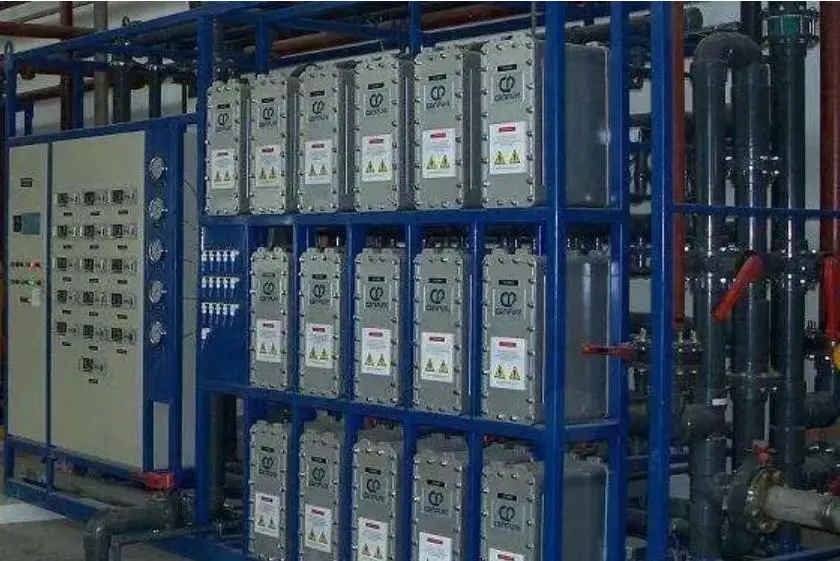
The product water generated by an EDI system is high-purity water, which is highly sensitive to external contamination.
Whether the system is operating or shut down, maintaining system isolation is very important.
Installing check valves on:
- Product water outlet
- Concentrate water outlet
- Electrode water outlet
can prevent backflow and reduce the possibility of external contamination entering the system.
This helps maintain the water quality of the electrodeionization EDI system during both operation and standby conditions.
The Recommended Maximum Capacity of a Single EDI System is 100 m³/h
As the capacity of an EDI system increases, the number of EDI modules also increases.
A large number of modules creates challenges in:
- Hydraulic distribution
- Flow balancing
- Pressure control
To ensure uniform water distribution among all modules, the capacity of a single EDI system should not be excessively large.
For practical EDI system design, a maximum product water flow of approximately 100 m³/h per system is generally recommended.
For larger requirements, multiple EDI systems can be installed in parallel
The Reject Water Pneumatic Valve and Product Water Pneumatic Valve Should Be Installed at the Same Height
An EDI system usually includes an automatic product water valve and an automatic reject water valve.
The installation height of these two pneumatic valves should be approximately the same.
If the reject water discharge valve is installed too low, air may accumulate inside the pipeline, which can cause water hammer problems.
Proper valve positioning helps maintain stable hydraulic conditions and protects the EDI system.
Install a Manual Adjustment Valve on the Reject Water Discharge Line
When the automatic reject water valve opens, the discharge flow may become much higher than the normal operating product water flow.
This can cause:
- Excessive pressure loss
- Loss of product water back pressure
- Unstable EDI operation
An EDI system requires a certain amount of back pressure during both normal operation and reject discharge conditions.
Therefore, a manual adjustment valve should be installed on the reject water discharge line to control the discharge flow and maintain stable pressure.
EDI Systems Do Not Require Start-up and Shutdown Flushing Programs
Unlike RO systems, EDI systems generally do not require low-pressure flushing procedures before start-up or shutdown.
The automatic reject water valve should only be activated when:
- Product water quality is below the set value
When the product water quality returns to the required level, the reject valve does not need to remain activated.
This is the actual purpose of the EDI reject water control system.
For Multiple EDI Systems, Individual Feed Pumps are Recommended
When several EDI systems are installed together, it is recommended that each EDI system has its own dedicated feed pump.
This design is similar to the one-to-one rectifier configuration.
Compared with one pump supplying multiple EDI systems, individual pumps provide:
- Better flow control
- More stable operation
- Easier maintenance
Therefore, separate feed pumps are preferred for multiple electrodeionization systems.
Consider an Anti-Siphon Design for the Electrode Water Discharge Pipeline
During EDI system shutdown, siphoning may occur.
This means electrode water continues flowing even when the feed pump has stopped.
Continuous electrode water discharge during shutdown may negatively affect system operation.
To prevent this issue:
- An anti-siphon design should be considered
- The electrode water discharge pipeline should be routed above the EDI system before going downward to the drain
This helps avoid unwanted water flow caused by siphon effects.
Use a Header Pipe Design for Product, Concentrate, and Electrode Water Connections
For systems containing multiple EDI modules, a header pipe design is recommended.
The following connections should preferably use common headers:
- Product water inlet/outlet
- Concentrate water inlet/outlet
- Electrode water discharge
Especially for concentrate water, combining individual module connections into a common header helps:
- Balance pressure between modules
- Improve flow distribution
- Increase system stability
This is an important consideration in professional EDI system design.
Always Follow the Principle: Water First, Electricity Second
One of the most important operating principles for an EDI system is:
Water flow must be established before DC power is applied.
If electrical power is supplied before water enters the module, the EDI module may be permanently damaged.
Therefore, the start-up sequence should be:
- Start the EDI feed pump
- Confirm stable water flow
- Wait approximately 10-15 seconds
- Activate the rectifier power supply
This sequence protects the EDI module and extends its service life.
Ensure Chemical Cleaning Pipeline Design for Future Maintenance
Although EDI systems operate continuously with low chemical consumption, EDI modules may still require chemical cleaning after long-term operation.
Cleaning helps remove:
- Organic contaminants
- Mineral deposits
- Ionic contamination
Therefore, the electrodeionization EDI system design should include proper cleaning connections and pipelines.
A well-designed cleaning system makes future maintenance easier and reduces downtime.
Conclusion: Key Points for Reliable EDI System Design
A reliable electrodeionization EDI system depends on more than selecting high-quality EDI modules.
Successful system design requires consideration of:
- Stable RO pretreatment
- Proper feed water quality
- Correct hydraulic design
- Suitable pump selection
- Flow and pressure control
- Electrical safety
- Maintenance requirements
For high-purity water applications, a properly designed RO + EDI system can provide stable operation, high water quality, and long service life.
Clear Environment provides customized RO and EDI water treatment solutions, including EDI modules, RO EDI systems, and pure water treatment equipment for industrial and pharmaceutical applications.