
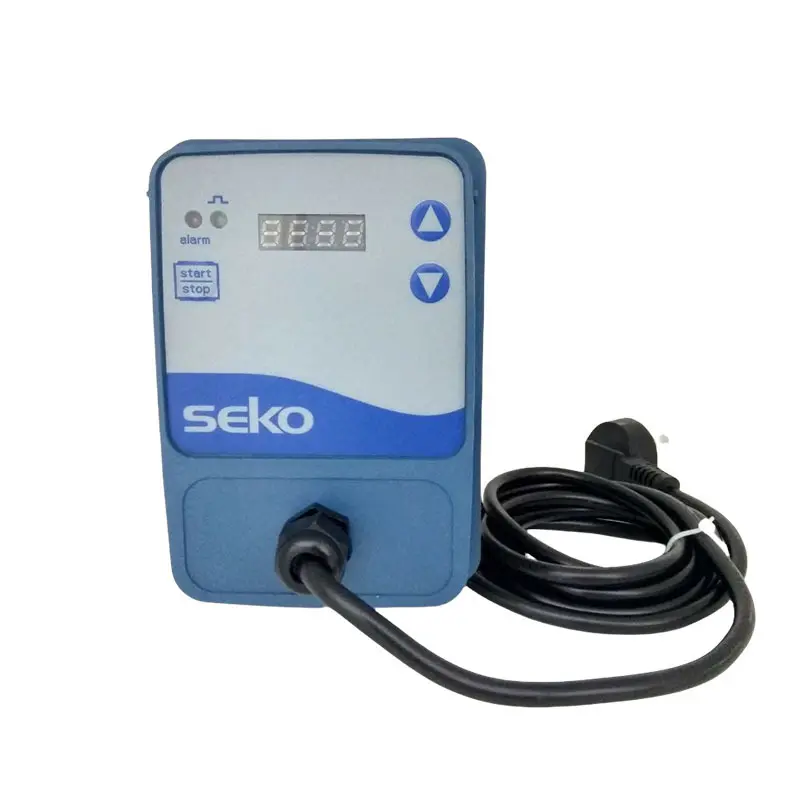
In semiconductor ultrapure water (UPW) production, sodium bisulfite is dosed primarily to protect reverse osmosis (RO) membranes from chlorine damage. Although sodium hypochlorite is commonly added upstream for disinfection, any residual chlorine must be completely removed before the water reaches the RO membranes.
This is why metering dosing pumps play such an important role. They ensure sodium bisulfite is injected at the correct dosage and at the right point in the treatment process. Even a minor dosing error can lead to expensive membrane damage or long-term operational problems.
Why Is Sodium Bisulfite Added?
The purpose of sodium bisulfite is simple: it acts as a reducing agent that rapidly neutralizes residual chlorine in the water.
The chemical reaction converts free chlorine into harmless chloride ions, preventing oxidation of the RO membrane surface.
This step is essential because the polyamide material used in RO membranes is highly sensitive to oxidizing agents. Even very low concentrations of residual chlorine, if present continuously, can permanently damage the membrane structure, resulting in a sharp decline in salt rejection performance.
Where Should Sodium Bisulfite Be Dosed?
For effective dechlorination, sodium bisulfite should be injected after the activated carbon filter and before the RO security (cartridge) filter.
This location ensures that any chlorine remaining after carbon filtration is completely removed before the water enters the RO membrane, providing the last line of chemical protection.
Accurate dosing at this stage depends on reliable metering dosing pumps, which continuously deliver the required chemical dosage according to system demand.
What Happens If Metering Dosing Pumps Fail?
Failures of metering dosing pumps generally fall into two categories:
Insufficient or no dosing
Excessive dosing
Although opposite in nature, both situations can seriously affect RO system performance.
Pump Stops or Under-Doses
Immediate Consequence
Residual chlorine reaches the RO membranes and causes irreversible oxidation.
Typical Symptoms
Rapid increase in RO permeate conductivity
Possible increase in permeate flow due to membrane degradation
Permanent loss of salt rejection
Membrane replacement becomes necessary, as chemical oxidation cannot be reversed by membrane cleaning
Among all chemical failures in an ultrapure water system, chlorine attack on RO membranes is one of the most costly and severe.
Risk Assessment
The severity depends largely on the amount of residual chlorine entering the RO unit.
If sodium hypochlorite dosing upstream is relatively high and the activated carbon filter is approaching exhaustion, a failed sodium bisulfite dosing system can expose the membranes to high chlorine concentrations. In extreme cases, irreversible membrane damage may occur within only a few hours.
Pump Over-Doses Sodium Bisulfite
Immediate Consequence
Excessive sodium bisulfite may increase scaling potential and encourage microbial growth.
Scaling Risk
Excess sodium bisulfite is gradually oxidized into sulfate ions.
When feed water contains elevated calcium hardness, these sulfate ions can promote calcium sulfate scale formation on the membrane surface, leading to:
Higher differential pressure
Reduced permeate production
Increased cleaning frequency
Microbiological Risk
Overdosing also leaves excess reducing chemicals in the system, creating favorable conditions for sulfate-reducing bacteria and other anaerobic microorganisms.
Over time, this can accelerate biological fouling inside pipelines and on membrane surfaces, reducing overall system efficiency.
Why Accurate Chemical Dosing Matters
Sodium bisulfite serves as the chemical bodyguard for RO membranes. By sacrificing its own reducing capacity, it eliminates oxidizing chlorine before it can attack the membrane.
For this reason, metering dosing pumps must operate reliably and deliver precise chemical dosing at all times. The dosing process should be continuously verified through residual chlorine monitoring and oxidation-reduction potential (ORP) control.
Whether the pump under-doses or over-doses, the consequences can be significant—from irreversible membrane oxidation to scaling and biofouling. Maintaining accurate chemical dosing is therefore essential for protecting expensive RO membranes and ensuring stable ultrapure water production.