
What is electrodeionization?
Electrodeionization(EDI) is a membrane separation technology that combines electrodialysis and ion-exchange processes. It consists of cation/anion exchange membranes, ion-exchange resins, and DC power supply equipment.
How does electrodeionization work?
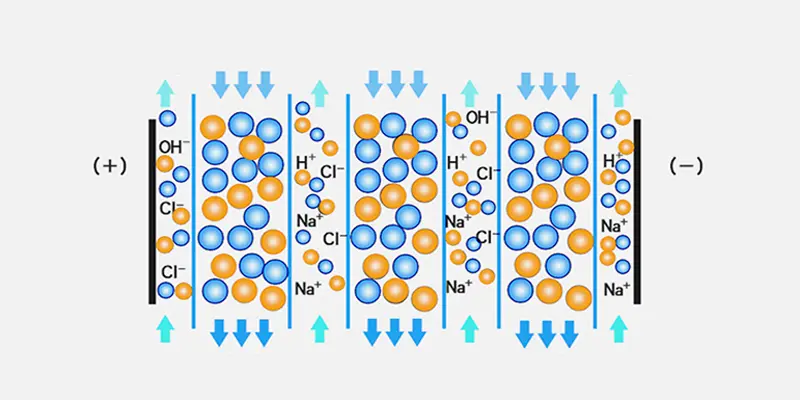
Electrodeionization working principle is achieving deep desalination of water by utilizing the selective permeability of ion-exchange membranes and the ion-exchange capability of resins, enabling ions in the water to migrate directionally under an electric field. Meanwhile, the H⁺ and OH⁻ generated through water electrolysis continuously regenerate the ion-exchange resins during operation, allowing the system to produce ultrapure water with a resistivity of 15–18.2 MΩ·cm on a continuous basis.
Electrodeionization vs ion exchange
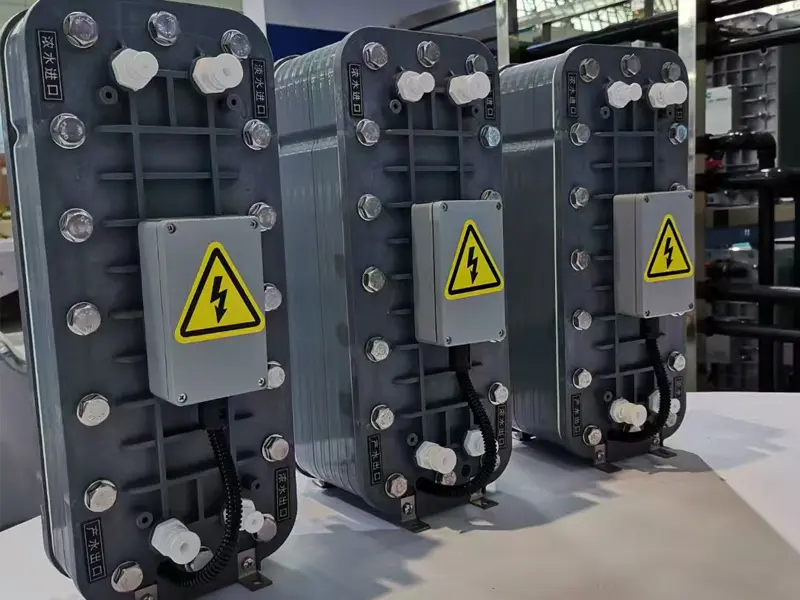
The electrodeionization process replaces the traditional DI mixed-bed resin system for producing deionized water. Unlike DI resin beds, EDI does not require system shutdown for resin replacement or chemical regeneration. Because of this, EDI offers notable advantages such as fewer factors that cause water quality instability and lower operating costs.
Electrodeionization primarily removes ions from water that has been pretreated by reverse osmosis (RO) or other purification processes. Our high-quality modules can continuously produce ultrapure water with a resistivity of over 17.5 MΩ·cm. EDI systems can operate either continuously or intermittently.
Advantages and disadvantages of electrodeionization
Advantages
- No acid or caustic chemicals are needed for regeneration (DI resin systems require acid and alkali for regeneration).
- Continuous production with stable product water quality (continuous electrodeionization).
- High level of automation, making operation and maintenance efficient and simple.
- Compact design: electrodeionization modules use smaller and lighter membrane stack units at the same flow rate, resulting in a more compact footprint.
- Low energy consumption.
- Low operating cost.
Disadvantages
- Must be used with high-quality RO permeate.
- Sensitive to fluctuations in feed water quality.
- Relatively higher cost.
- More complex system design.
Electrodeionization application
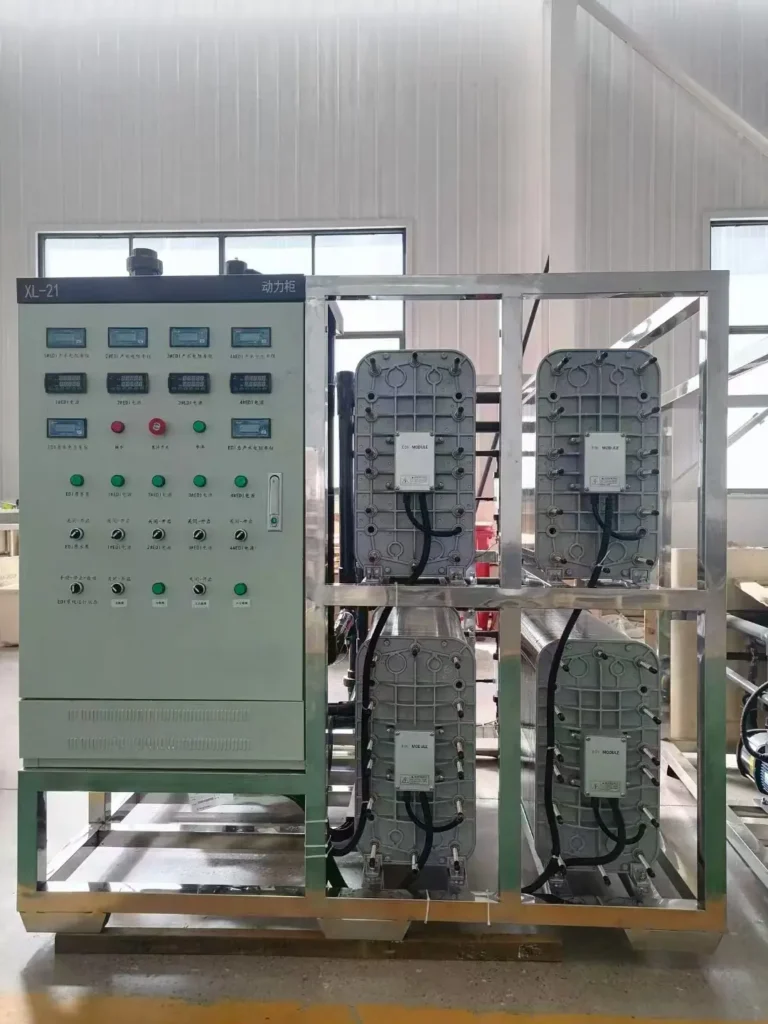
Ultrapure water is widely used in the microelectronics industry, semiconductor manufacturing, power generation, the pharmaceutical industry, and laboratories. EDI purified water can also be used as pharmaceutical-grade distilled water, water for food and beverage production, process water for chemical plants, and in other applications requiring ultrapure water.
Electrodeionization modules have a single-module flow rate ranging from 0.5 m³/h to 5 m³/h, and each module has a recommended operating flow range. By arranging modules in parallel, a system of virtually unlimited capacity can be constructed.
Depending on feed water conditions and operating parameters, EDI modules can produce purified water with a resistivity of 10–18.2 MΩ·cm.
Electrodeionization in pharmaceutical water treatment
According to the pharmacopeia, purified Water, as defined by the pharmacopeia, is water prepared from drinking water by distillation, ion-exchange, reverse osmosis, or other suitable purification methods, and contains no added substances.
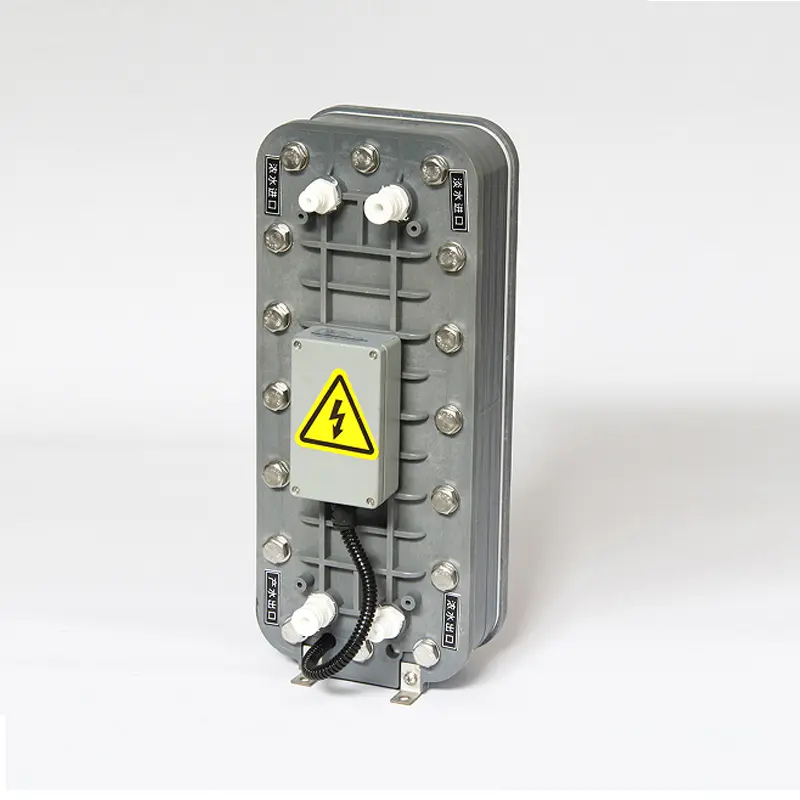
Mini EDI module
50L to 300L for Lab Ultra Pure Water

Industrial EDI module
500L to 5000L per module
Purified Water Standards
| Item | Purified Water |
|---|---|
| Appearance | Colorless, clear liquid; odorless |
| pH | Meets specified requirements |
| Ammonia | ≤ 0.3 µg/ml |
| Non-volatile residue | ≤ 1 mg/100 ml |
| Nitrates | ≤ 0.06 µg/ml |
| Nitrites | ≤ 0.02 µg/ml |
| Heavy metals | ≤ 0.1 µg/ml |
| Oxidizable substances | Meets requirements |
| Total Organic Carbon (TOC) | ≤ 0.5 mg/L |
| Conductivity | Meets specified requirements |
| Bacterial endotoxins | / |
| Microbial limit | Total aerobic microbial count ≤ 100 CFU/ml |
How is this achieved in engineering practice?
Electrodeionization (EDI) is the core purification technology used to produce pharmacopeia-grade Purified Water.
Although EDI serves as the final decontamination process, it is clear that it cannot remove all types of contaminants, such as pathogens, organic compounds, or dissolved gases. These impurities must be controlled and removed by upstream treatment processes.
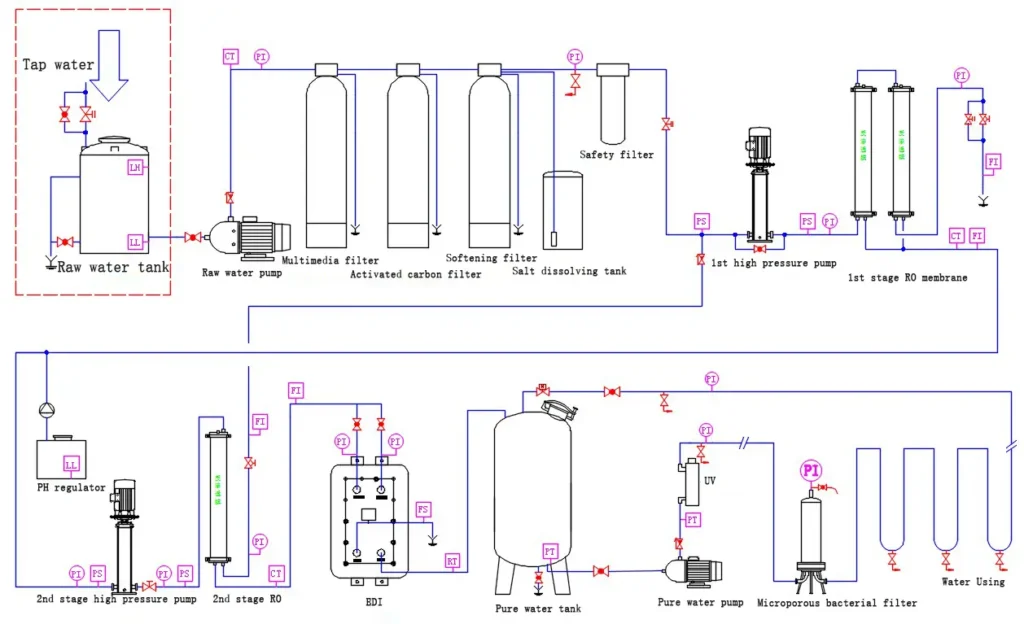
To achieve safer, more consistent Purified Water quality and to meet international regulatory requirements, RO + EDI systems — or RO + RO + EDI systems — are increasingly adopted by pharmaceutical manufacturers.
A high-quality feed water supply forms the foundation for stable, continuous, and compliant EDI performance.
Electrodeionization process flow diagram
Electrodeionization troubleshooting
| Phenomenon | Possible Causes | Correct Solution |
|---|---|---|
| Low product water resistivity | Power: no voltage; loose electrode connection; reversed polarity | Check and turn on power; ensure correct electrode connections and polarity |
| EDI parameters: low/high flow; incorrect pressure difference; high recovery; low/high voltage | Adjust flows/pressures; adjust recovery; adjust voltage | |
| Feedwater not meeting spec | Check RO permeate quality: conductivity, pH, CO2, hardness, SiO2, TOC, Cl2 | |
| Module blockage or scaling | Backwash or clean module | |
| Module torque too low | Readjust torque | |
| Resin failure | Regenerate module | |
| Low product flow | Pump: insufficient flow/head | Check pump selection and conditions; replace pump |
| Security filter: insufficient cartridges or fouled | Recalculate capacity; replace cartridges | |
| EDI: low inlet pressure; high outlet backpressure; inaccurate flowmeter; fouled module; burned/deformed module | Check piping/pressure; reduce backpressure; recalibrate flowmeter; flush piping; inspect/repair module | |
| Low feedwater temperature | Adjust feed temperature to 20-25°C | |
| High module flow variation | Resin failure; module contamination; flow too high/low | Regenerate; clean module; adjust flow |
| Feedwater conductivity/pH/CO2 abnormal | Check RO conditions; adjust pH; check degassing | |
| No module current | No power; reversed polarity; loose electrodes; low flows; power failure | Power on; reconnect properly; adjust flows; inspect power circuit |
| High module voltage | Scaling or contamination; module burned/deformed | Clean module; repair/replace |
| Feedwater hardness/temperature/TOC/iron/bacteria high | Check RO hardness; check softener; ensure heating works; control TOC and bacteria | |
| Module connector broken | Overforce during installation; accidental impact | Handle carefully; replace connector |
| Module leakage | Torque loose | Adjust torque |
| Pipe joints: missing O ring; improper hose | Install O ring; insert correct hose | |
| Module internal damage | Replace board/seal; repair/replace module | |
| Module burned | Low flows | Adjust flows above minimum |
| Feedwater conductivity >50 μS/cm | Check RO performance | |
| Control circuit failure; forced operation without water | Check protections; inspect controller; review operation logs |
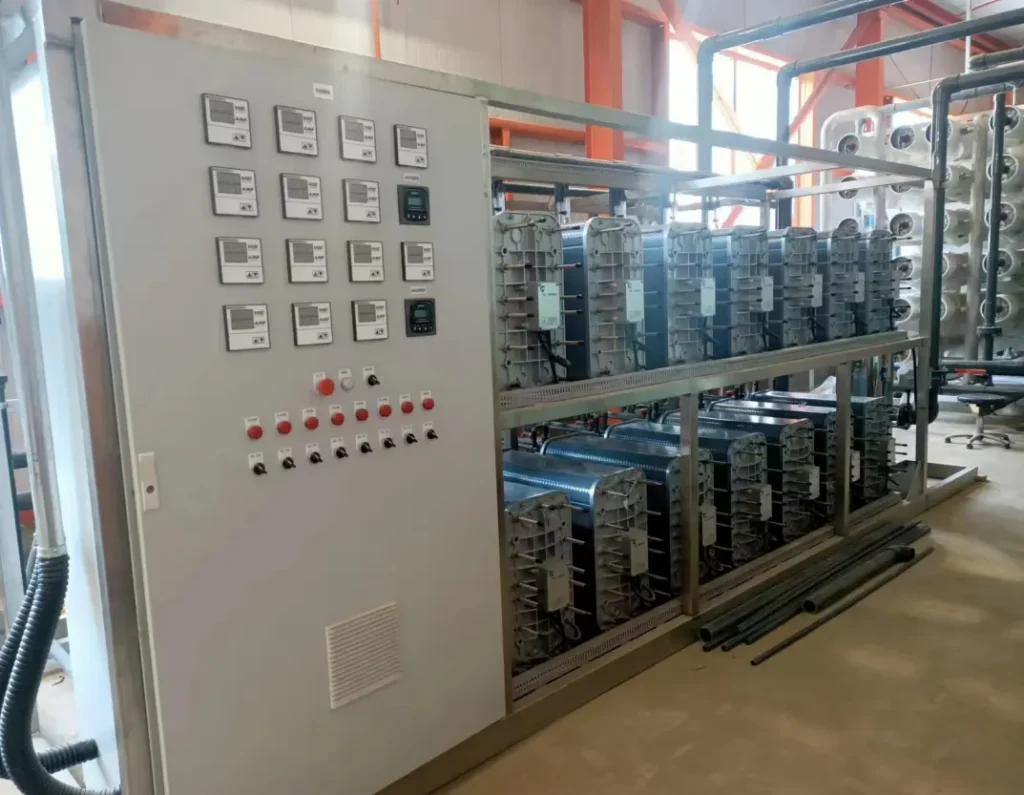
Electrodeionization cleaning
Feed Water
Electrodeionization feed water specifications are designed to minimize maintenance during normal and continuous operation. However, certain maintenance tasks may still be required if the feed water does not meet specifications and/or the applied voltage is insufficient.
The main foulants include TOC, hardness, particulates, and iron.
Salt/Hardness Scaling
If the EDI feed water contains a high concentration of dissolved solids, salt precipitation (scaling) may occur in the concentrate chambers, resulting in a decline in product water quality.
Feed water with high hardness ions (Ca²⁺, Mg²⁺), dissolved CO₂, and elevated pH significantly increases the risk of precipitation. To remove excessive carbonates, the concentrate chambers must be cleaned using an approved acid solution.
Ion-Exchange Resin (TOC / Organic Fouling)
Feed water containing organic contaminants can foul ion-exchange resins and ion-selective membranes. This forms a thin film that severely hinders ion migration rates and results in deteriorated product water quality.
If this occurs, the dilute chambers must be cleaned using an approved organic-removal cleaning agent. This may be a certified non-ionic surfactant or an approved alkaline cleaning solution.
Particulate Contamination
Coarse particulates in EDI feed water can block inlet flow paths and cause uneven water distribution among modules, reducing system performance. Fine particulates may foul the resin and concentrate chambers.
If the EDI feed water is supplied from an RO permeate tank (not directly from the RO system), a very fine pre-filtration step is required before water enters the EDI.
Before installing the EDI modules, the piping system should be thoroughly flushed with water to prevent particulates from entering the module.
Power Supply and Resin Regeneration
If an EDI module is operated without power or with insufficient voltage, the ion-exchange resin and membranes will become saturated, resulting in reduced product water purity.
To regenerate the resin, the system must be initialized by setting the water flow, then gradually increasing the power supply voltage. During ion transport out of the system, the module will draw higher current than under normal operation, and the resin will be regenerated.
Note:
If over-current protection is not available, ensure the current does not exceed the power supply limits.
Electrical Connections
Electrode connections should be inspected regularly for corrosion or looseness caused by environmental conditions. Such issues increase module resistance, impede current flow, and degrade product water quality. Under low-voltage conditions, the impact may be even more severe.
Bolts
The bolts that secure the stack and end plates are factory-set, but after a period of use, torque re-adjustment is required.
Inspect and retighten the bolts:
After installation onto the anti-slip support frame;
Before commissioning at the user site;
During the first month (weekly) until all internal plastic components are fully compressed;
Whenever a slight decline in product water quality is observed.
Excessive torque may deform the module, while insufficient torque may cause internal or external leakage.
External Cleaning
If external cleaning of the module is necessary, follow these steps:
a) For safety, turn off the power supply.
b) Do not use acetone or other solvent-based cleaning agents.
c) Use only a damp cloth, optionally with a mild detergent.
d) Do not scrub or attempt to remove any safety labels.