
The design and installation of chemical metering pumps—commonly referred to as dosing pumps, chemical dosing pumps, or metering and dosing pumps—is far more than simply connecting a pump to a pipeline. It is a complete engineering process that requires thorough consideration of chemical properties, process requirements, safety standards, and long-term operation and maintenance.
A metering dosing pump is typically composed of three main parts: the motor, the gearbox, and the hydraulic head.
The gearbox consists of a worm gear assembly, stroke adjustment mechanism, and crank–connecting rod system. By rotating the handwheel, the stroke is adjusted by changing the eccentricity of the moving shaft.
The hydraulic head includes the pump head, suction valve assembly, discharge valve assembly, plunger, and sealing components.
Working Principle of a Dosing Pump
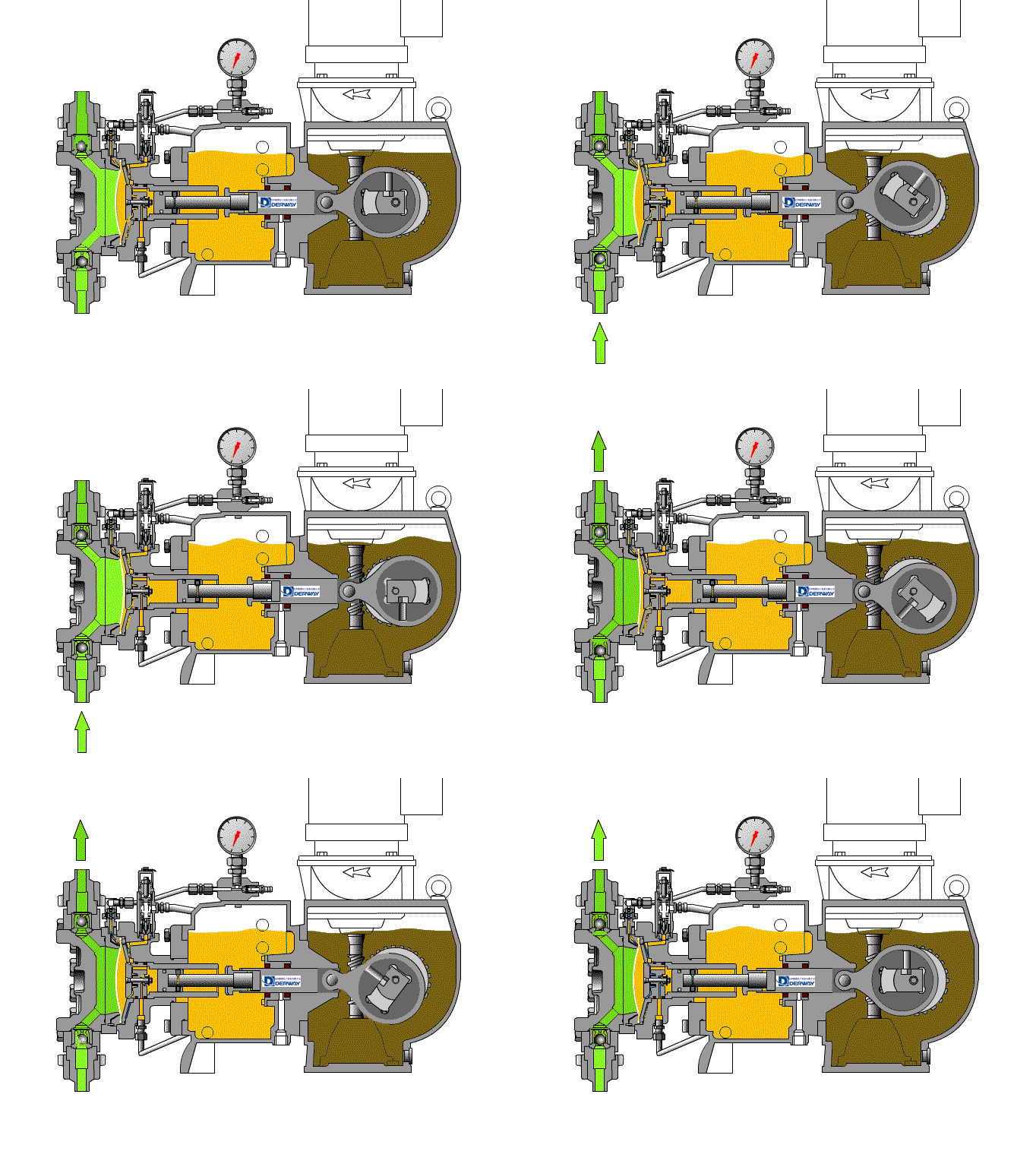
The motor drives the worm shaft through a coupling, reducing speed via the worm gear and causing the main shaft and eccentric wheel to rotate. The eccentric wheel moves the connecting rod assembly back and forth.
When the plunger moves backward, vacuum is created in the pump chamber, the suction valve opens, and chemical liquid enters. When the plunger moves forward, the suction valve closes, the discharge valve opens, and liquid is discharged under pressure.
Through continuous reciprocating motion, the pump delivers a stable and accurate flow.
Flow Regulation Methods
Adjusting the Plunger Stroke
A larger stroke results in a higher flow rate (with constant motor speed). Stroke can be adjusted manually via a dial or automatically using a stroke controller.
Adjusting Motor Speed
With a fixed stroke, the pump flow can be regulated by controlling motor speed through a VFD or external control signals such as 4–20 mA.
Different pump types—plunger pumps, mechanical diaphragm pumps, hydraulic diaphragm pumps, and solenoid dosing pumps—share similar flow adjustment principles.
Part 1: Design and Pump Selection
Selecting the wrong dosing pumps is the biggest potential hazard. Proper selection must be based on the following criteria:
Chemical Properties
Chemical compatibility: Pump head materials (pump chamber, diaphragm, valve ball & seat), piping, and seals must match the chemical.
For example, sodium hypochlorite should not use standard stainless steel but PVDF or PTFE.
Chemical state: Liquid, slurry, viscous, or crystallizable? This determines pump type and whether heating or agitation is required on the suction line.
Concentration & temperature: Directly impact corrosion level and material selection.
Flow and Pressure Requirements
Rated flow: Should be 1.1–1.2× the maximum process demand.
Rated pressure: Should exceed the system requirement by 1.2–1.5×.
Note: Diaphragm pump flow decreases slightly as discharge pressure increases.
Control Method
4–20 mA signal control: Most efficient, used for proportional or closed-loop control.
Pulse control: Proportional dosing based on water meter pulses.
Manual control: For simple, stable applications.
Automatic control: Combination of VFD + stroke adjustment for large modulation range.
Pump Type Selection
Mechanical diaphragm pumps: Cost-effective for medium/low-pressure.
Hydraulic diaphragm pumps: High accuracy, long life, ideal for industrial high-pressure applications.
Plunger pumps: High pressure capability but limited corrosion resistance; used mainly for oils or clean fluids.
Pump Head Material Selection
Common materials: PP, PVC, PTFE, SS316.
PP: Low cost, acid/alkali resistant, but not suitable for oxidizing agents or solvents.
PVC: Acid/alkali resistant but unsuitable above 40°C or food-grade uses.
PTFE: Excellent chemical resistance, high temperature tolerance.
SS316: Suitable for solvents and high-temperature fluids but not for strong acids.

Part 2: Installation Guidelines
Incorrect installation leads to inaccurate dosing, cavitation, leakage, and pump failure.
Installation Location
As close to chemical tank as possible.
Ideally above the chemical level; if below, ensure NPSHa >> NPSHr.
Install in ventilated, dry, clean environments—avoid direct sun and rain.
Suction Line
Install a vacuum gauge at the pump inlet.
Suction pipe should be 1–2 sizes larger than pump port.
Keep pipe short and straight.
Required accessories:
Foot valve
Y-strainer (60–80 mesh)
Discharge Line
Safety relief valve near pump outlet.
Back-pressure valve for stabilizing flow.
Pulse dampener for reducing water hammer and stabilizing dosing accuracy.
Injection valve to prevent backflow.
Electrical Control
Correct wiring and shielded cables for 4–20 mA signals.
Proper grounding.
Commissioning
Prime pump before startup—remove air from pump head.
Start at low speed/short stroke, gradually increase.
Inspect for leaks and abnormal noise.
Eight Reasons Why a Dosing Pump Fails to Deliver Liquid
1.Suction pipe or strainer clogged → Clean.
2.Suction/discharge valve blocked → Clean.
3.Valve sealing failure causing air leakage → Tighten valves.
4.O-rings loose or detached → Reinstall carefully.
5.Diaphragm damaged → Replace.
6.Connecting rod stuck → Repair or replace.
7.Motor burned → Replace.
8.Cam adjusted to zero stroke → Increase stroke setting.

Common Troubleshooting FAQ for Water Treatment Dosing Systems
1. What should be considered during pump operation?
Pressure at injection point, stroke frequency, suction lift, altitude, and chemical corrosiveness.
2. How to improve accuracy when outlet is at atmospheric pressure?
Install a spring on the discharge valve or use a back-pressure valve.
3. How to adjust a back-pressure valve?
Discharge pressure must be at least 1 bar higher than suction pressure.
4. How to size a pulsation dampener?
6–20× the pump’s stroke volume.
5. How to set a safety valve?
Below max working pressure of the system.
6. Factors to consider when dosing liquids:
Viscosity, density, vapor pressure, temperature.
7. Pump not suctioning properly?
Set stroke to 100% and check internal settings.
8. High-viscosity fluid triggering flow fault:
Follow diaphragm removal and lubrication steps to release the hydraulic head.
9. Prevent the stroke positioning motor from burning:
Ensure venting procedures and correct installation of pump head.
10. Hydraulic diaphragm pump flow too low or inaccurate:
Vent air and refill hydraulic oil through the oil compensation valve.
Ranking of Dosing pumps Manufacturers
The following ranking of metering pump manufacturers is compiled based on market influence, technology strength, and user reputation. Many of these companies are globally recognized for high-precision dosing pumps, fluid-handling technologies, and metering solutions. The list is provided for reference only (in no particular order).
MILTON ROY
A global leader in dosing pumps and metering technology under the Ingersoll Rand Group, with over 85 years of history. Its products cover petrochemicals, pharmaceuticals, food, and water treatment, known for exceptional accuracy and long-term reliability.
PULSAFEEDER
An American brand founded in 1942 and part of the IDEX Group since 1992. As a pioneer of hydraulically actuated diaphragm dosing pumps, its products comply with API 675 standards and are widely used in petrochemical, chemical, and power plant industries.
ProMinent
A German manufacturer established in 1960 that specializes in dosing pumps, fluid metering systems, and water treatment technologies. It provides advanced solutions for pharmaceuticals, food processing, and chemical industries.
LEWA
A German brand founded in 1952 and now a subsidiary of Nikkiso. LEWA is known worldwide for diaphragm metering pumps and high-performance dosing pumps, serving more than 80 countries and offering strong technological innovation.
GRUNDFOS
A Danish brand founded in 1945. As a global water technology supplier, Grundfos offers reliable dosing pumps widely used in industrial processes, building services, and wastewater treatment, with annual production exceeding 16 million units.
SEKO
An Italian brand established in 1976 focusing on electromagnetic and motor-driven dosing pumps. SEKO provides customized dosing systems and serves customers in more than 120 countries worldwide.
IWAKI
A Japanese brand established in 1956 and one of the world’s leading manufacturers of chemical pumps. IWAKI’s wide product range includes specialized dosing pumps designed for chemical processing, pharmaceuticals, and water treatment.
Neptune
An American brand under PSG, part of Dover Corporation. Neptune offers hydraulic, mechanical, and electronic diaphragm dosing pumps suitable for water treatment, chemical dosing, and industrial applications.
CNP
A Chinese manufacturer founded in 1991 and recognized as a “Single Champion Demonstration Enterprise” by the Ministry of Industry and Information Technology. CNP produces stainless steel centrifugal pumps and precision dosing pumps serving water supply, wastewater treatment, and industrial sectors.
AILIPU
A Chinese brand founded in 1997 specializing in metering systems and dosing pumps. Its products are widely applied in petrochemicals, pharmaceuticals, food production, and global dosing system projects.
These rankings consider brand history, technology, global market coverage, and user feedback. Depending on project requirements, different brands offer unique advantages in dosing pumps performance, reliability, and industry-specific applications.
Application Characteristics of Sodium Hypochlorite Dosing Pumps in Power Plant Raw Water Systems
A chemical dosing pump is used for accurate injection of NaClO to disinfect raw water, control microbial growth, and prevent biofouling.
Applications
Raw water pretreatment
Cooling tower and circulation system
Wastewater disinfection before discharge
Functions of NaClO
Disinfection, biofilm suppression, oxidation of organic matter.
Pump Selection
Using integrated modular hose-type dosing pump skid.
Control Strategy
Proportional dosing (1–3 ppm)
Feedback dosing using chlorine analyzer (0.1–0.5 mg/L)
Timer mode
Advantages & Challenges
Low cost, high efficiency, easy automation
Corrosive chemical → need for corrosion-resistant tubing